
Park-Ohio 2025 Revenue Decline and Profit Pressure Offset by Diversified Industrial Footprint
A diversified industrial manufacturer with solid cash flows, Park-Ohio faced top-line pressure and margin contraction in 2025 amid market softness and restructuring.
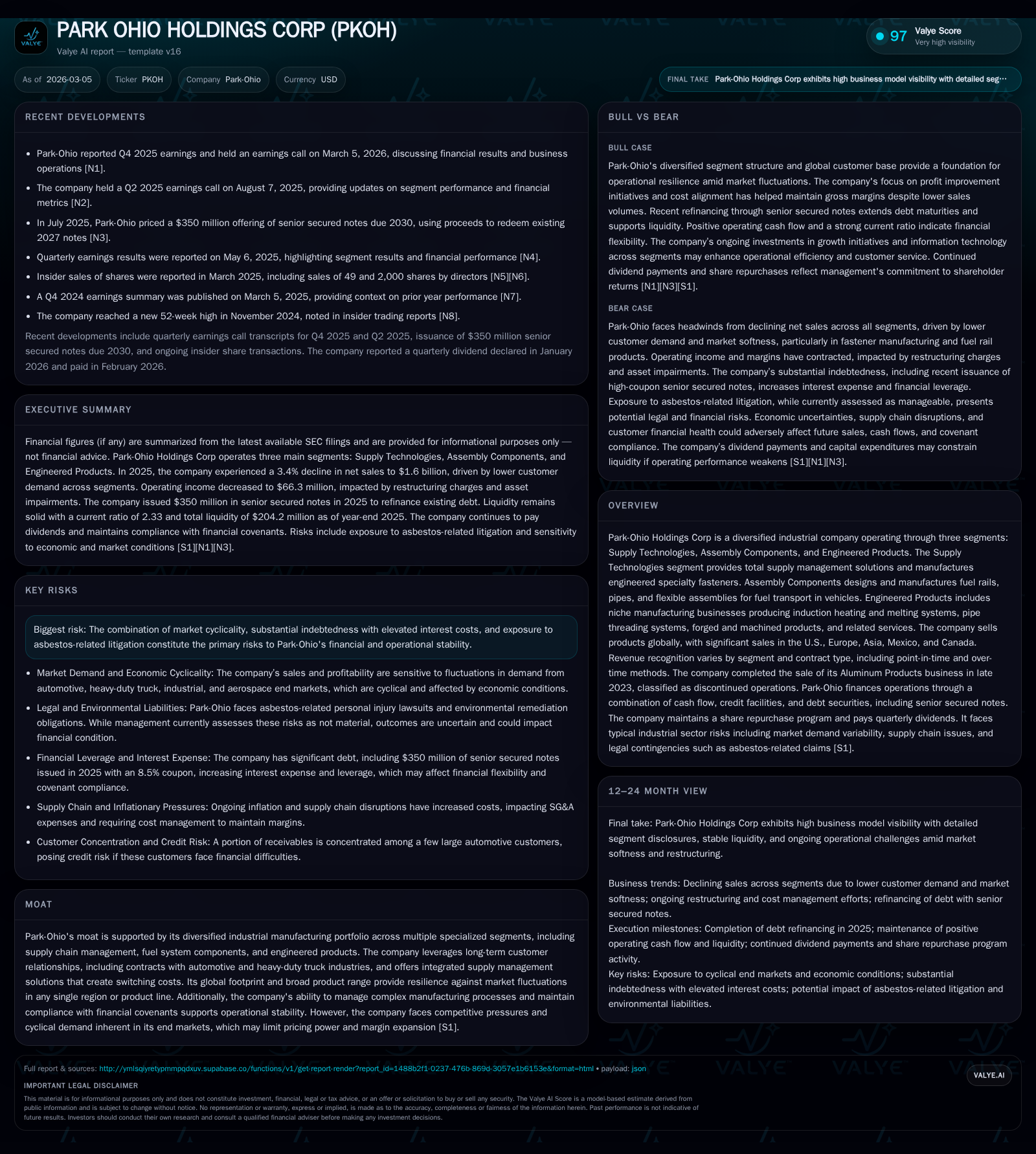
Park-Ohio Holdings Corp’s 2025 financial results reflect a 3% decrease in revenue to $1.6 billion, driven by softer demand across key segments including Supply Technologies and Assembly Components. Operating income declined 23% to $66 million due to lower volumes, restructuring charges, and an asset impairment. Despite the downturn, the company generated positive operating cash flow of $42 million. Its broad product portfolio and global footprint provide stability against cyclical headwinds, though leverage remains elevated with $636 million in debt. The recent payoff of senior notes through 2030 refinancing improved maturity profiles. Shareholder returns continue via modest dividends, but no share buybacks were reported.
Company Overview
Park-Ohio Holdings Corp is a diversified industrial manufacturing company serving global markets through three principal segments: Supply Technologies, Assembly Components, and Engineered Products [S1]. The business offers engineered specialty fasteners, fuel transport components for vehicles including high-pressure fuel rails and pipes, alongside niche industrial equipment such as induction heating systems and pipe threading products.
The firm maintains a geographically diverse footprint with substantial sales across the United States, Europe, Asia, Mexico, and Canada [S16][S17]. This global diversification underpins resilience amid regional economic cycles.
Historical Financial Performance
Park-Ohio's total revenue saw a mild contraction in recent years but has generally hovered around the mid-$1.6 billion mark before the divestiture of its Aluminum Products business completed late in 2023 [S1]. Revenue decreased by approximately 3% from $1.656 billion in 2024 to $1.599 billion in 2025 [F1]. This downturn principally reflects weaker demand and volume decreases across all three segments.
Operating income trends have shown volatility tied to market conditions affecting end customers such as automotive and heavy-duty trucks along with aerospace components. The company posted operating income of approximately $66 million for fiscal year 2025 compared to about $86 million in the prior year—a decline of over 23% reflecting margin pressures from lower volumes and restructuring costs [F1][S22]. Net income attributable to common shareholders decreased by roughly 25% year-over-year to about $24 million [F1].
Historical performance (annual)
| FY | Net ($mm) | OpInc ($mm) | Capex ($mm) | Net YoY |
|---|---|---|---|---|
| 2025 | 24 | 66 | 40 | -25.2% |
| 2024 | 32 | 87 | 31 | +307.7% |
| 2023 | 8 | 84 | 28 | +154.9% |
| 2022 | -14 | 33 | 27 |
Source: SEC companyfacts cache [F1].
Capital returns and efficiency (annual)
| FY | Div ($mm) | Buybacks | ROE% |
|---|---|---|---|
| 2025 | 8 | 6.2 | |
| 2024 | 7 | 9.6 | |
| 2023 | 7 | 0 | 2.8 |
| 2022 | 7 | 0 | -5.5 |
Source: SEC companyfacts cache [F1].
Note: Operating cash flow (CFO) and capex figures are sourced from SEC filings [S9] and company disclosures [F1].
Segment Analysis
Supply Technologies
The largest segment contributed approximately $748 million in revenues during FY25 versus about $776 million the prior year [S17]. This segment includes engineered fasteners with strategic supply management solutions for customers’ manufacturing floors. Segment earnings were pressured by overall market softness impacting automotive end-markets.
Assembly Components
Generating roughly $381 million in revenues for FY25 (down from ~$399 million in FY24), this segment manufactures advanced fuel delivery components like high-pressure fuel rails and flexible assemblies [S17]. Declines were attributed mainly to reduced unit volumes.
Engineered Products
This segment posted revenues near $471 million for FY25—a slight decrease from about $482 million the prior year [S17]—due to lower demand for forged parts counterbalanced partly by gains in industrial equipment sales within niche markets.[S22] Operating margins were squeezed across each segment due to fixed cost absorption challenges amid falling volumes.
Growth Prospects
Park-Ohio’s prospects hinge on leveraging its diversified product portfolio spanning supply chain solutions and critical vehicle components amid a recovering global industrial environment [N1]. Growth drivers include expansion into more integrated supply management contracts within Supply Technologies and innovation-led launches boosting fuel system components.
However, risks of market cyclicality remain pronounced given dependence on automotive production cycles plus exposure to aerospace sectors which undergo lumpier capital equipment spending [S16]. End-markets' sensitivity to inflationary pressures can limit pricing power or induce cautious customer ordering patterns.
Forecasts & Expectations
While explicit future guidance was not disclosed recently [N1], investors should monitor:
- Quarterly order trends in vehicle fuel systems as indicators of demand momentum.
- Capital expenditure allocation towards technology upgrades which may signal preparation for new contracts or expanded capacity.
- Ongoing restructuring results that could improve cost structures.
- The company’s ability to maintain compliance with credit covenants under varying economic conditions [S4][S6].
Capital Allocation & Returns
Park-Ohio has not engaged in share buybacks since fiscal year 2021 when it repurchased approximately $2.5 million worth of stock; no repurchases occurred in subsequent years [F1]. Instead, cash deployment focused on dividend payments and debt servicing obligations.
In FY25, the firm paid about $7.8 million in dividends ($0.125 per common share quarterly declared early in 2026) reflecting modest shareholder returns consistent with earnings performance [S7][F1].
Operating cash flow was positive at around $42 million despite net income decline owing largely to working capital improvements offsetting earnings softness [S9]. However, free cash flow was negative when incorporating significant capital expenditures that increased over prior years as Park-Ohio invested heavily ($40+ million) mainly into growth initiatives including IT systems modernization across segments [F1][S9][S22].
The balance sheet shows elevated leverage at about 58% net debt-to-capitalization given total outstanding debt near $636 million comprising senior secured notes due 2030 and revolving credit facility borrowings totaling over $257 million [S4][F1]. Refinancing efforts completed mid-2025 replaced higher-cost notes maturing sooner with longer dated instruments improving maturity profile but interest expense remains significant (~$47M annually)[S6][F1].
Risks & Challenges
Primary risk factors include:
- Continued cyclicality impacting gross margins through volume swings.[S13]
- Substantial indebtedness bearing elevated interest costs limiting financial flexibility.[S4][S13]
- Exposure to ongoing asbestos-related litigation despite historical success defending such claims; these legal proceedings pose unpredictability albeit management judges current reserves adequate without material impact anticipated on liquidity or operations.[S13][S20]
- Potential disruption risks from supply chain inflation or labor constraints influencing production schedules indirectly.[S16]
Conclusion
Park-Ohio’s industrial manufacturing platform benefits from diversified operations spread globally with integrated supply management offerings creating switching costs among large original equipment manufacturers (OEMs). The scale across various niche product lines underpins relative resilience amid softer markets. Nonetheless, recent top-line declines accompanied by margin compression highlight underlying cyclical vulnerabilities prevalent within automotive component suppliers today leading to cautious profitability outlooks ahead. Capital allocation favors operational continuity, liquidity maintenance and dividend distribution rather than aggressive return of capital through buybacks at this juncture. Monitoring evolving macroeconomic factors affecting customer sectors combined with any signs of easing litigation exposures should form key focus areas for assessment going forward.
This analysis is based on publicly available filings as of March 5, 2026 including the Company's Form 10-K dated March 5, 2026 ([S1]) along with supplemental documents ([N1]-[N2]). All figures cited are sourced directly without speculation or extrapolation beyond provided data.
Disclaimer: This is research-only, informational analysis and not investment advice. It may include AI-generated interpretation and general industry context. Always verify important details using primary sources.

Comments