
Quest Water Global’s Technology-Driven Approach to Sustainable Water Solutions and Financial Challenges
Quest Water Global pursues impact in water-scarce regions through proprietary solar purification tech and a Build-Own-Operate model, while grappling with ongoing operating losses and tight liquidity.
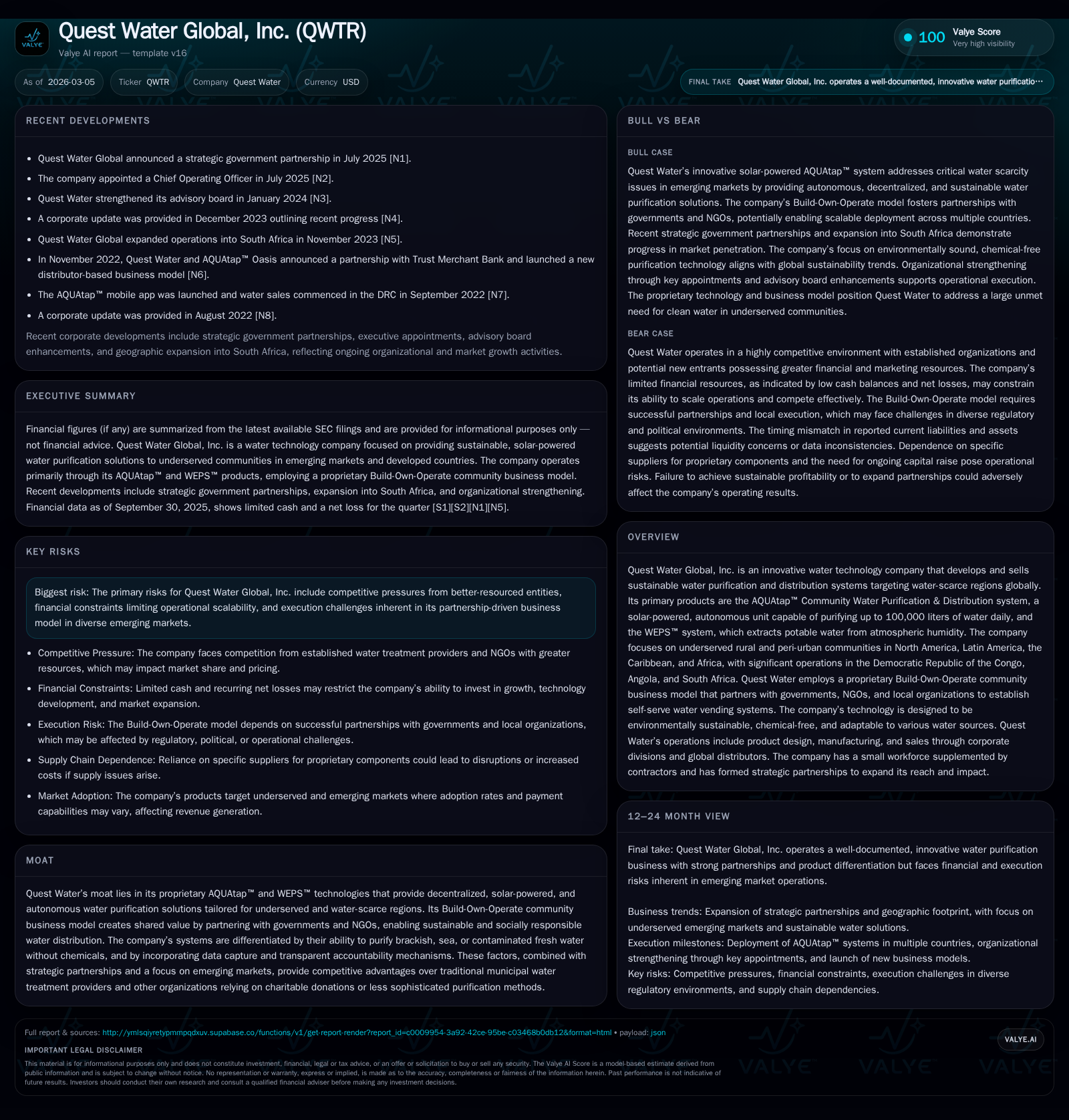
Quest Water Global, Inc. delivers decentralized, solar-powered water purification systems designed for underserved rural and peri-urban communities in emerging markets such as the DRC, Angola, and South Africa. Their flagship AQUAtap™ and atmospheric WEPS™ technologies distinguish them in water scarcity markets through chemical-free, autonomous operations paired with innovative community vending business models. However, the company’s financial history reveals sustained net losses exceeding $750k annually by FY2024 and persistent negative operating cash flow, constraining scalability amid limited cash reserves and growing negative equity. Future growth hinges on expanding system deployments across targeted countries, yet capital structure challenges and execution risks across diverse jurisdictions require close monitoring.
From Pilot Projects to Regional Expansion: Historical Growth Trajectory
Quest Water Global’s evolution from initial pilot projects in Angola in 2012 to more recent deployments in the Democratic Republic of Congo (DRC) illustrates a trajectory toward regional expansion in challenging emerging markets [S8]. The Bom Jesus pilot in Angola delivered clean water to approximately 500 residents via an AQUAtap™ unit capable of purifying 10,000 liters daily. A pivotal milestone came with the formation of the AQUAtap™ Oasis Partnership SARL joint venture in the DRC in 2019 aiming to install 500 AQUAtap™ systems over five years [S8]. The launch of the first DRC system coincided symbolically with World Water Day in March 2021 near Kinshasa [S3].
However, financial results reveal volatility alongside this growth phase. Revenues remain modest at $344k as per the fiscal year-end 2011 data point available [F1], reflecting nascent commercialization outside pilot zones. Net income shows persistent deficits: a loss of approximately $757k was recorded for FY2024, an increase of roughly 27% relative to the prior year loss of about $596k [F1]. This pattern underscores ongoing investment costs related to installations, marketing, and operational start-up rather than profitability. Operating cash flow has remained negative across four consecutive years (-$528k to -$567k between FY2021–FY2024) evidencing cash burn intrinsic to expansion efforts [F1].
Historical performance (annual)
| FY | Net ($) | CFO ($) | Capex ($) | Net YoY |
|---|---|---|---|---|
| 2024 | -757611 | -567509 | -27.1% | |
| 2023 | -596013 | -579827 | 1500 | +50.8% |
| 2022 | -1212320 | -561582 | 1500 | -362.6% |
| 2021 | -262044 | -528441 |
Source: SEC companyfacts cache [F1].
Capital returns and efficiency (annual)
| FY | FCF ($) | ROE% |
|---|---|---|
| 2024 | 31.5 | |
| 2023 | -581327 | 32.5 |
| 2022 | -563082 | 95.2 |
| 2021 | 7.1 |
Source: SEC companyfacts cache [F1].
Note: Some revenue data is only available for select fiscal periods.
This financial progression ties closely with scaling ambitions; the company’s move from pilots in Angola has extended into broader African presence with strategic focus on urban peripheries where infrastructure gaps are acute [S3]. Yet monetization remains constrained by operational rollouts still maturing.
Decoding AQUAtap™ and WEPS™: Distinctive Technologies Powering Market Differentiation
Quest Water’s technological advantage is anchored largely on two distinct platforms: the AQUAtap™ Community Water Purification & Distribution system and WEPS™ (Water Extraction and Purification System). The AQUAtap™ units operate fully autonomously powered exclusively by rooftop photovoltaic solar panels coupled with integrated battery storage enabling continuous service disconnected from grid reliability issues prevalent in target geographies [S10]. These containerized units employ either reverse osmosis membranes—suitable for desalination or brackish sources—or ultrafiltration membranes tailored for treating contaminated fresh water sources [S7]. This dual-membrane approach allows AQUAtap™ to address multiple water qualities without reliance on chemicals for pre- or post-treatment processes. Ultraviolet sterilization stages further ensure pathogen removal before dispensing.
The WEPS™ complements AQUAtap™ by extracting potable water directly from atmospheric humidity through air filtration, condensation capture, and multi-step purification—creating an alternative source that mitigates groundwater exploitation [S9]. It operates efficiently under low power consumption with no harmful byproducts or chemical additives, allowing applications ranging from bottled water production to agricultural irrigation.
Such technologies combine decentralized turnkey systems with photovoltaic autonomy desalinizing brackish/seawater using reverse osmosis membranes—a hallmark filtration technique removing salts—while ultrafiltration offers robust barriers against suspended solids and microbes. The chemical-free operation reduces operational complexity and maintenance overhead critical for remote deployments.
Business Model Insights: The Build-Own-Operate Framework in Emerging Markets
A core enabler for Quest Water is its proprietary Build-Own-Operate (BOO) community business model that leverages partnerships with governments, NGOs, and local entities to deploy decentralized self-service water vending infrastructures [S3][S4]. Instead of pure donations or subsidies common among charitable providers, this model generates shared economic value by selling clean water at socially responsible prices via integrated cashless point-of-sale systems built into each AQUAtap™ installation.
This setup benefits communities by hiring local personnel responsible for installation, operation, maintenance, and servicing activities—facilitating knowledge transfer along with socioeconomic upliftment while ensuring system sustainability through accountability metrics tracked via embedded data capture technology [S3]. Additionally, deploying fully transparent operational data supports monitoring financed infrastructure performance against success benchmarks.
By situating control within the community ecosystem but ensuring centralized technological oversight via their proprietary units coupled with remote monitoring capabilities [S4], Quest Water aligns profitability with societal impact. Unlike many organizations dependent on donor funding cycles—which can be volatile—the BOO model incentivizes economic sustainability balanced against affordability considerations vital for underserved populations.
Financial Performance Overview: Persistent Losses Amid Revenue Realities
Examining Quest Water’s financial metrics crystallizes the challenge of transforming innovative technology adoption within emerging markets into scalable profitability. According to reported figures up through FY2024 [F1], net losses deepened from approximately -$596k in FY2023 to about -$758k—reflecting increased investment alongside revenue stagnation (noted revenues just over $344k as last recorded). This equates to a roughly 27% enlarged bottom-line deficit year-over-year.
Operating cash flow trends mirror these earnings pressures; fluctuations have remained negative but relatively stable (-$528k to -$567k between FY2021-FY2024), indicative of continued cash outlays necessary principally for operational expansions including installation labor and logistics costs characteristic of multi-jurisdiction rollouts.
Capital expenditure outlays have been minimal recently (~$1.5k annually), suggesting heavy front-loading of infrastructure investment occurred earlier during initial pilot phases like Angola (with historical capex exceeding $340k back in FY2013) now tapering off [F1]. Reduced capex might also reflect constrained financing capacity curbing major asset additions.
Meanwhile, shareholders’ equity deteriorated markedly from about -$3.7 million net deficit in FY2021 improving slightly but still deeply negative at approximately -$2.4 million as of FY2024 [F1], pointing toward accumulated deficit exhaustion surpassing capital injections.
Calculating an approximate return-on-equity based solely on these figures suggests positive ratio magnitude owing predominantly to negative equity denominator—however such accounting distortions do not reflect underlying profitability but rather capital deficit effects.
These financial dynamics underscore limitations on Quest’s ability to internally fund rapid scale advancements without continued external capital support given persistent operating losses combined with negligible free cash flow after subtracting capex expenditures (-$569k approximate free cash flow as per CFO minus capex) [F1].
Forecast Outlook: Scaling Deployment Plans versus Operational Risks
Although explicit forward-looking guidance is absent within publicly filed documents examined here [Nnone direct news; S3 implied plans], Quest Water has articulated intentions to replicate its DRC Build-Own-Operate model across additional countries throughout Africa as well as Latin America and the Caribbean [S3]. The cornerstone involves rolling out up to 500 AQUAtap™ systems within five years in primarily underserved rural or peri-urban communities aiming for meaningful population coverage.
Key milestones worth watching include installation cadence achievements within the DRC partnership framework—the pace at which systems become operational will serve as proxy indicators for commercial viability and logistical proficiency. Success there will validate scalability potential applicable elsewhere.
Growth could face caps due either to operational complexities inherent in managing supply chains across multiple developing country contexts or financing bottlenecks constricting capital-intensive infrastructure projects given current financial strain observed.
Capital Structure and Allocation: Funding Innovation Amid Negative Equity
Quest Water's balance sheet reflects tension between innovation-driven expenditure requirements versus limited internal liquidity resources. As detailed above [F1][S6][S8], equity remains deeply negative at around -$2.4 million as end-FY2024 while reported cash & equivalents totaled only $12 as of latest quarter-end—signaling precarious near-term liquidity.
Current assets recorded approximated $6 million at September 30, 2025 seemingly robust yet juxtaposed against substantially higher current liabilities reported previously ($1.5 million+ at earlier dates) yield very low short-term solvency coverage ratios absent updated detail [F1][S8]. This suggests thin operating buffers heightening risk if receivables realization falters or unforeseen expenses arise.
Capex expenditures have been deliberately restrained post-pilot phase consistent with minimized infrastructure additions beyond maintenance level spending around $1.5k yearly recently indicating focus on operating existing assets rather than large-scale new investments [F1].
There are no reported dividends or share repurchase programs consistent with unprofitable operating status restricting capacity for cash returns.
Capital allocation appears tightly weighted toward sustaining incremental deployment initiatives necessary for future scale despite ongoing strategic vulnerability linked to raising external financing under conditions marked by net deficits and negative shareholders’ equity positions.
Competition Dynamics: Positioning Against Traditional and Charitable Providers
The clean-water access arena hosting Quest Water is fragmented comprising entrenched municipal utilities, global charitable NGOs focused on free provision models, smaller local providers employing basic well pumping or boreholes without advanced purification methods, plus emerging tech startups offering variable sophistication levels [S4][S7].
Quest differentiates principally through its solar-powered decentralized platforms delivering chemical-free purification leveraging state-of-the-art reverse osmosis or ultrafiltration membranes—a contrast to municipal systems reliant on centralized infrastructure costly enough to deter rapid rural expansion. Its autonomous energy use circumvents unreliable grid dependencies prevalent across developing economies thus enhancing resilience compared with generator-based competitors [S7].
Moreover, unlike many charitable organizations distributing free potable water funded solely by donations—which faces long-term sustainability challenges—Quest employs a commercial sales approach promoting sustainable business models incentivizing maintenance alongside social impact aligning customer willingness-to-pay at socially responsible price points interfaced via integrated POS technologies facilitating efficient vendor operations [S4].
This carve-out targets specific niches where turnkey decentralized solutions paired with local partnerships can feasibly supplant patchy traditional supply frameworks enabling scalable growth potential despite market competition intensifying as incumbents potentially adopt advanced technologies themselves.
Risks Spotlight: Execution Complexities in Multi-Jurisdiction Operations
Several risk vectors pose substantive execution hurdles as Quest expands amidst inherently complex emerging market environments:
- Partnership Dependency: Success heavily contingent on maintaining fluid cooperation among multiple stakeholders—including governments at various administrative levels plus NGOs—which can experience changes owing political shifts or funding realignments affecting project continuity [S5][S13].
- Competitive Pressures: Well-capitalized incumbents possess superior resources enabling accelerated technology adoption or aggressive pricing potentially eroding Quest’s foothold particularly without large-scale balance sheet support or diversified geographic presence quickly established [S14][S15].
- Financial Constraints: Persistent operating losses combined with narrow liquidity margins raise uncertainty regarding ability to finance large-scale rollout beyond pilot projects without dilutive capital raising jeopardizing control or imposing high cost burdens.
- Regulatory Variances: Diverse legal regimes across African countries require navigating distinct permitting regimes plus tariffs impacting unit economics fraught with unpredictability necessitating tailored compliance frameworks adding overhead.
Overall operational risks should be monitored closely given they could materially impair progress toward attaining self-sustaining business operations envisaged under the Build-Own-Operate paradigm especially when coupled with fragile capital structures limiting buffering capacity.
Disclaimer: This document is an informational analysis prepared by Valye News using data derived from publicly available SEC filings and company disclosures without any investment advisory intent. Metrics reported are strictly those disclosed or cited explicitly; no forecasting or valuation recommendations are provided herein.
Disclaimer: This is research-only, informational analysis and not investment advice. It may include AI-generated interpretation and general industry context. Always verify important details using primary sources.

Comments