
NetApp’s Strategic Evolution and Financial Stewardship Through Cloud Transformation
NetApp is advancing its Public Cloud segment growth while managing operational shifts and capital allocation amid industry pressures.
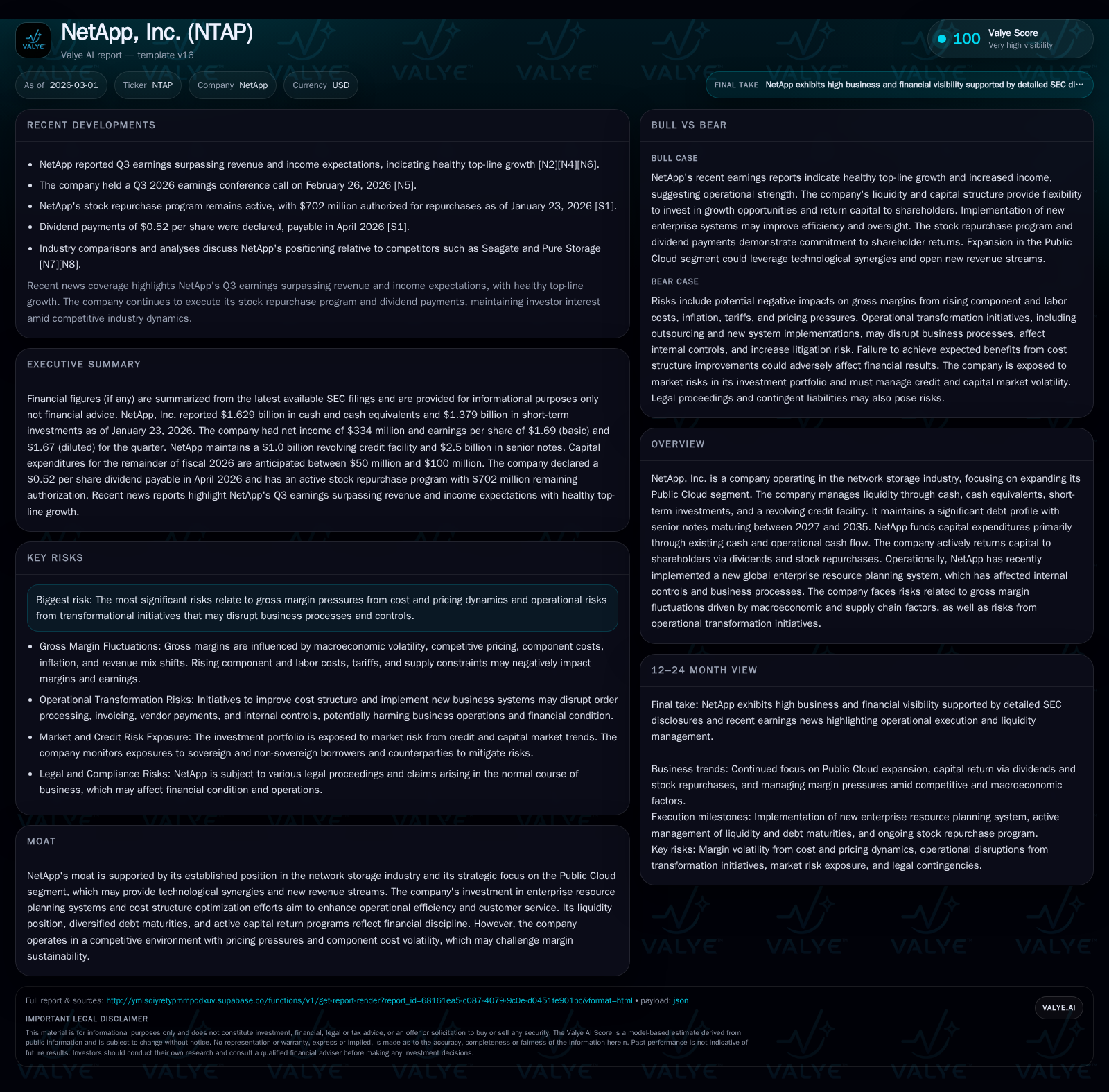
NetApp has demonstrated solid historical growth with a significant revenue increase in FY2025, driven by strategic positioning in the network storage industry. The company is pivoting to expand its Public Cloud offerings alongside implementing a new ERP system, which introduces operational risks but aims to enhance scalability and efficiency. Despite margin pressures from competitive pricing and component cost volatility, NetApp maintains a disciplined liquidity and capital structure, supported by manageable debt maturities and robust shareholder return programs. Ongoing monitoring of cloud segment penetration, margin trends, and ERP rollout progress will be critical for assessing future growth sustainability.
From Steady Growth to Transformation: Historical Financial Performance
NetApp's fiscal trajectory through FY2025 exhibits robust top-line momentum with total revenues reaching approximately $1.7 billion, representing a healthy 19.2% year-over-year increase from FY2024 [F1]. This acceleration reflects strong demand for its network storage hardware and software solutions amid shifting IT infrastructure preferences. Correspondingly, operating income advanced by 10.1% to near $1.34 billion, while net income surged 20.3% to about $1.19 billion—highlighting improvements in operational leverage despite macroeconomic headwinds.
However, operating cash flow (CFO) retreated by 10.6% over the same period to $1.51 billion [F1], which may be attributed to heightened investment activity or working capital adjustments common within transformative phases. Capital expenditure modestly rose by 8.4%, totaling $168 million in FY2025 [F1], underscoring ongoing commitment to infrastructure and technology capabilities.
Historical performance (annual)
| FY | Net ($mm) | CFO ($mm) | OpInc ($mm) | Capex ($mm) | Net YoY |
|---|---|---|---|---|---|
| 2025 | 1186 | 1506 | 1337 | 168 | +20.3% |
| 2024 | 986 | 1685 | 1214 | 155 | -22.6% |
| 2023 | 1274 | 1107 | 1018 | 239 | +36.0% |
| 2022 | 937 | 1211 | 1157 | 226 |
Source: SEC companyfacts cache [F1].
Capital returns and efficiency (annual)
| FY | Div ($mm) | Buybacks ($mm) | FCF ($mm) |
|---|---|---|---|
| 2025 | 424 | 1150 | 1338 |
| 2024 | 416 | 900 | 1530 |
| 2023 | 432 | 850 | 868 |
| 2022 | 446 | 600 | 985 |
Source: SEC companyfacts cache [F1].
This performance backdrop establishes a firm baseline ahead of deeper strategic evolutions.
Pivoting Toward Public Cloud: Growth Drivers and Operational Shifts
Central to NetApp’s current agenda is scaling its Public Cloud segment — an initiative that harnesses synergies between its legacy on-premises network storage platforms and emerging cloud-native storage solutions integral for hybrid IT environments [N2][N3][N4][S2]. The company’s recent earnings beats suggest initial traction here, supported by enhanced product mix favoring software-defined storage offerings optimized for multicloud interoperability.
The upgrade to a comprehensive global enterprise resource planning (ERP) system during Q3 FY2026 reflects efforts to institutionalize operational scalability amid expanding cloud deployments [S20]. Such systems can streamline order processing, invoicing cycles, and vendor payment flows—benefits vital for the complexity inherent in converged cloud infrastructure service delivery.
However, these internal transformations have disrupted some standard business processes temporarily [S24], an expected but consequential friction point that demands close management focus during rollout completion.
Key Risks on the Horizon: Margin Pressures and ERP System Implementation
NetApp openly acknowledges gross margin vulnerability stemming from several vectors: rising component costs including NAND flash memory prices, logistical inflationary pressures related to supply chains, competitive pricing environments leading to discounting initiatives, and currency exchange fluctuations impacting input costs [S17][S24]. These factors compose 'component cost volatility,' a nuanced challenge within the hardware-dependent storage sector where supplier constraints intermittently tighten market dynamics.
Additionally, the large-scale ERP implementation introduces execution risks beyond mere operational hiccups; it may temporarily undermine financial reporting integrity or customer fulfillment efficacy if controls lapse during transition periods [S24]. The cumulative effect poses short-term risks that could pressure quarterly margins or cash conversion cycles.
Liquidity Profile and Capital Structure: Navigating Debt Maturities and Investment Flexibility
As of January 23, 2026, NetApp maintains approximately $3 billion in combined cash balances and short-term investments—$1.63 billion in cash & equivalents plus $1.38 billion in short-term securities—providing substantial liquid reserves for operations or opportunistic growth initiatives [S2][S4][S11]. Although roughly $2.6 billion of this liquidity resides offshore within foreign subsidiaries primarily holding U.S.-dollar denominated assets, only about $394 million is immediately available domestically.
Debt service commitments include senior unsecured notes aggregating $2.5 billion across four tranches with staggered maturities between June 2027 and March 2035 carrying coupon rates from circa 2.375% to around 5.7% [S4][S5][S6]. The company also benefits from a $1 billion revolving credit facility expiring in March 2030 with extension options plus an unused commercial paper program that facilitates short-term funding flexibility without encumbering long-term solvency [S9][S10].
Regular review of the maturity ladder confirms manageable refinancing risk given abundant liquidity buffers coupled with operating cash inflows unless abrupt macroeconomic deterioration occurs.
Capital Returns to Shareholders: Dividends, Buybacks, and Return on Equity
NetApp has consistently engaged in capital return programs balancing stable dividend distributions against aggressive share repurchases reflecting confidence in intrinsic valuation [F1][S7][S15]. Dividends paid rose moderately from approximately $416 million in FY2024 to $424 million in FY2025 [F1], yielding a reliable income stream for shareholders.
Concurrently buybacks rose sharply—from about $900 million net repurchases in FY2024 to $1.15 billion in FY2025—underscoring management’s prioritization of offsetting share count dilution while signaling conviction about long-run earnings power at prevailing price points [F1].
With year-end equity approximated at $1.04 billion against net income of nearly $1.19 billion for FY2025 [F1], the resultant return on equity (ROE) exceeds an impressive ~114%, signaling highly efficient deployment of shareholder capital during this phase of structural business transformation.
Forecasting Growth Pathways: What To Watch Next
Market consensus anticipates continued expansion within NetApp's Public Cloud segment as a critical driver for future revenue growth blending legacy device sales with increasingly software-led cloud subscriptions [N7][N8][N10]. Monitoring the pace at which cloud revenue constitutes an evolving portion of total sales will provide insight into strategic execution effectiveness.
The forthcoming quarters will also test stabilization of gross margins as supply chain challenges abate and ERP rollout matures beyond transitional frictions [N2][N3][S24]. Successful mitigation here could catalyze improved profitability metrics.
Large customer adoption patterns especially among hyperscalers or enterprises embarking on hybrid cloud architectures represent another pivotal indicator for validating NetApp’s competitive differentiation against peers increasingly focused exclusively on public cloud native offerings.
Overall, vigilant assessment of ERP integration outcomes alongside shifts in product mix toward cloud-native solutions remain key milestones shaping longer-term financial trajectories.
Disclaimer: This analysis synthesizes publicly available SEC filings and market reports without providing investment advice or recommendations.
Disclaimer: This is research-only, informational analysis and not investment advice. It may include AI-generated interpretation and general industry context. Always verify important details using primary sources.

Comments