
Navitas Semiconductor’s Strategic Shift Fuels High-Power Market Ambitions
Navitas Semiconductor pivots to AI data centers and industrial electrification to leverage its dual GaN and SiC technology expertise.
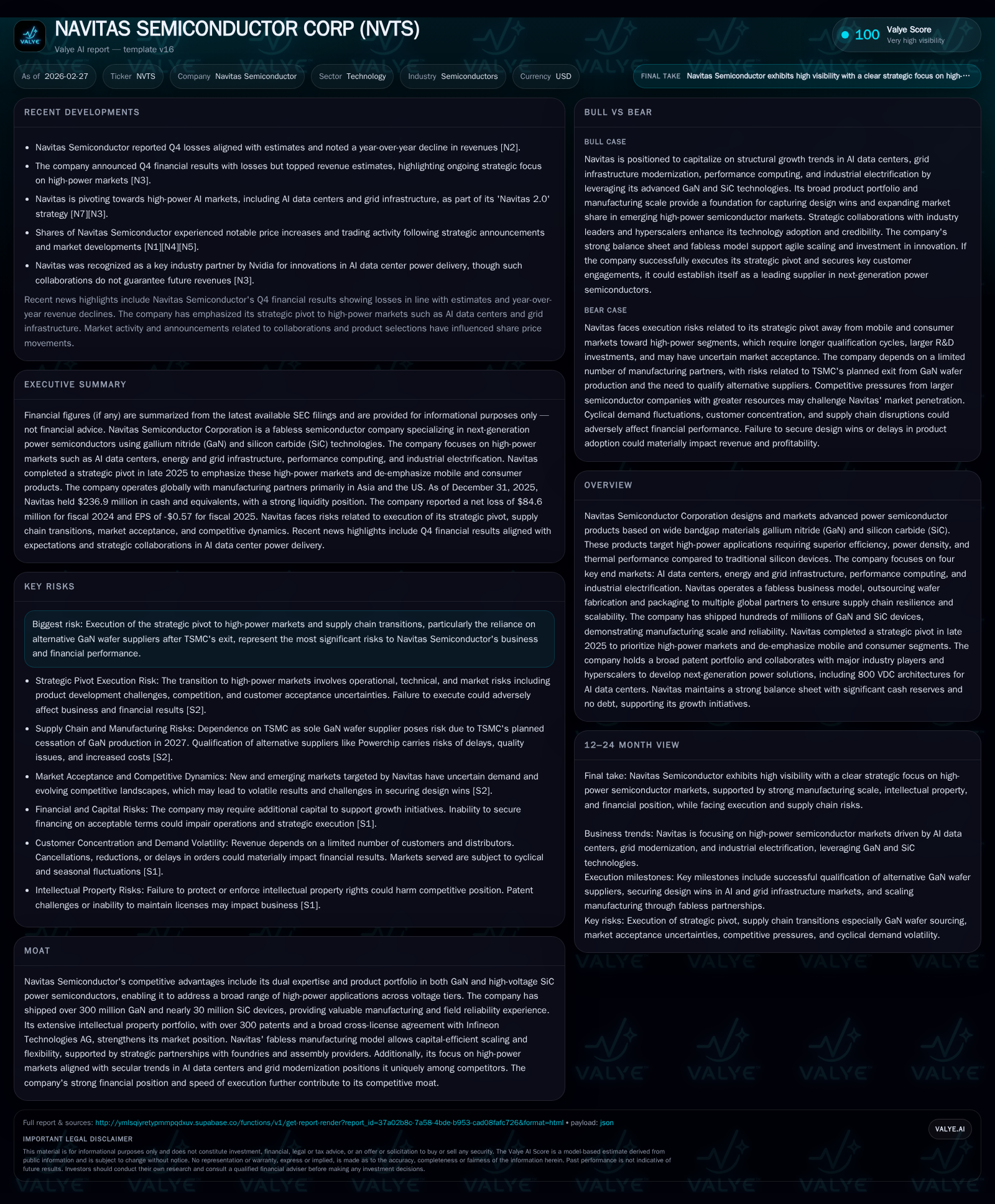
Navitas Semiconductor has transitioned from mobile and consumer markets to focus on high-power applications driven by AI data centers, energy infrastructure, and industrial electrification. Its unique dual-technology portfolio of GaN and SiC power devices, combined with a fabless manufacturing model and strategic foundry partnerships, positions it for growth amid challenging supply chain adjustments. Despite improving operating losses and strong liquidity, the company faces execution risks as it navigates new design cycles, supplier transitions after TSMC’s exit, and competitive industry dynamics. Key milestones including design wins and supply stabilization will be critical indicators of Navitas's progress.
Revenue Evolution and Key Historical Drivers
From fiscal years 2022 through 2025, Navitas Semiconductor experienced a steady narrowing of operating losses, signaling progress despite ongoing investments that outpaced near-term revenue gains. Operating income improved from a loss of approximately $124 million in 2022 to about $108 million in deficit by the end of 2025 ([F1]). Over the same period, net income remained negative with a notable improvement in 2024 compared to prior years.
This financial trajectory coincides with an intentional shift away from prior revenue sources concentrated in mobile and consumer electronics segments toward higher-power applications. The company has shipped over 300 million GaN devices alongside nearly 30 million SiC devices, establishing demonstrable manufacturing scale and field reliability that underpin this transition ([S14]).
Historical performance (annual)
| FY | Net ($mm) | CFO ($mm) | OpInc ($mm) | Capex ($mm) | Net YoY |
|---|---|---|---|---|---|
| 2025 | -43 | -108 | 1 | ||
| 2024 | -85 | -59 | -131 | 7 | +41.8% |
| 2023 | -145 | -40 | -118 | 5 | -296.8% |
| 2022 | 74 | -44 | -124 | 5 | +148.4% |
Source: SEC companyfacts cache [F1].
Capital returns and efficiency (annual)
| FY | Buybacks ($) | FCF ($mm) | ROE% |
|---|---|---|---|
| 2025 | -44 | ||
| 2024 | -66 | ||
| 2023 | 0 | -45 | -38.2 |
| 2022 | 550000 | -49 | 19.4 |
Source: SEC companyfacts cache [F1].
Capital expenditures have contracted significantly since their peak in prior years as the company leverages its fabless manufacturing strategy ([F1]).
Strategic Pivot: From Mobile Markets to High-Power Applications
In late 2025, Navitas announced its "Navitas 2.0" initiative—an enhanced focus on burgeoning high-power markets including AI data centers, energy grid modernization, performance computing clusters, and industrial electrification ([S10], [N3], [N11]). This pivot entailed de-prioritizing mobile charging solutions and low-end consumer electronics where the firm historically derived much of its revenue.
This shift is far from trivial operationally. High-power segments demand products handling higher voltages (up to or exceeding 800 VDC) with greater thermal performance and reliability standards than mobile power ICs typically require ([S10], [S5]). Navitas confronts longer R&D development cycles due to complex device design requirements and protracted customer qualification phases inherent in large-scale enterprise applications ([S1], [S2]).
Moreover, the design-win-centric sales model introduces timing uncertainty: revenue recognition might lag initial wins by well more than a year depending on adoption speed by hyperscale platforms or industrial customers ([S1]). The upfront capital commitment also rises given larger die sizes and sophisticated packaging technologies necessary for high-voltage GaN/SiC integration ([N3]).
Technology Competitive Edge: Dual GaN and SiC Capabilities
Navitas carved a distinctive niche by combining gallium nitride (GaNFast™ ICs) capable of delivering ultra-efficient mid-voltage power conversion with GeneSiC™ silicon carbide devices designed for ultra-high voltage operation demanded by grid infrastructure and industrial automation ([S5], [S10]).
The company’s proprietary GaNFast technology integrates drive, control, protection circuitry into monolithic power ICs enabling compact designs optimized for AI servers' demanding power delivery needs—especially relevant for emerging architectures supporting up to circa-800 V DC bus voltages common in hyperscale GPUs ([S5]). Concurrently, its GeneSiC portfolio addresses harsh industrial environments requiring robust device reliability at >1200 V thresholds such as three-phase motor drives or grid-tied inverters.
Underpinning these offerings is a suite of customized process design kits (PDKs) jointly developed with foundries that enable precise wafer-level optimization tailored toward specific application topologies—a crucial advantage for fabless scaling without sacrificing device performance or yield consistency ([S5]).
Supply Chain Transformation and Associated Risks
The transition comes with supply chain complexities intensified by TSMC's exit from GaN wafer production ([S18]). Navitas has secured alternative fabrication arrangements with US-based GlobalFoundries for GaN wafers alongside X-Fabs as its principal SiC foundry partner domestically—a strategic alignment augmenting supply chain resilience amid escalating geopolitical tensions impacting Asia-based suppliers ([S5], [S6], [S18]).
While diversifying reduces dependence on a single foundry node thus enhancing security-of-supply, it also poses risks related to yield volatility during qualification ramp phases and potential cost escalations linked to new vendor onboarding ([S1], [S6]). Notably absent are long-term wafer supply contracts obligating minimum volume commitments creating exposure to sudden capacity constraints or price renegotiations ([S1], [S18]).
Raw material price fluctuations further compound operational risk given limited influence over select epitaxial wafer suppliers critical for wide bandgap semiconductor production ([S16]). Quality assurance remains paramount since any yield shortfalls or defects can cascade into reputational damage among hyperscalers whose tolerance for failures is negligible ([S26]).
Market Positioning Within AI Data Centers and Industrial Electrification
Navitas targets strategic design wins with hyperscalers, major GPU vendors, Tier-1 OEMs, ODMs, and platform integrators focusing on emerging AI workloads requiring groundbreaking power efficiency at scale ([S5], [N3], [N10]). Leveraging enabled architectures including ultra-high efficiency GaN-based power conversion integrated into latest generation server power supplies aligns the firm closely with structural demand growth shaping the semiconductor power market.
Beyond data centers, Navitas penetrates the energy and grid infrastructure sector where GeneSiC's robustness facilitates grid modernization projects emphasizing sustainability ([S5], [N11]). Performance computing clusters mirror similar AI-driven compute intensity trends while industrial electrification addresses automation trends propelling efficient motor control solutions with wide adoption potential ([S10]).
The company’s differentiated value proposition includes accelerated application engineering support via dedicated labs co-located with key customers plus proprietary design tools fostering rapid co-development cycles fostering seamless platform integration an important factor underpinning sustained design wins ([S5]).
Financial Health: Profitability, Cash Flows, and Capital Allocation
Financially Navitas remains in investment mode as reflected by ongoing operating losses despite steady improvements—from around $130 million loss in operating income in FY24 narrowing towards $108 million deficit in FY25 ([F1]). This progression signals containment of spending growth relative to strategic repositioning benefits.
Operational cash flow exhibited recovery trends; FY25 marked a roughly $43 million outflow improving from an almost $59 million outflow year-over-year indicating better working capital management though free cash flow remains negative adjusting for minimal capital expenditures (~$1.5 million) characteristic of its fabless business model ([F1]).
The balance sheet boasts a strong liquidity position with approximately $237 million cash & equivalents against manageable current liabilities providing near five times current ratio coverage ensuring runway for continued R&D expenditure supporting product maturation efforts without imminent financing dependency concerns ([F1], [S11]).
There are currently no dividends or share repurchases consistent with early-stage growth capitalization prioritizing reinvestment in product development rather than shareholder returns at this juncture ([F1], [S11]). Return on equity metrics remain negative but show signs of recovery as losses moderate reflecting reinvestment policies normally prevalent during technology transition phases.
What Investors Should Monitor Moving Forward
Looking ahead analysts should watch for tangible evidence that the strategic pivot is gaining traction:
- Progression of design wins converting into revenue streams within expected timelines particularly among hyperscale cloud providers.
- Successful qualification cycles demonstrating yield stability at GlobalFoundries and X-Fabs wafer facilities mitigating risk derived from TSMC’s withdrawal.
- Margin expansion stemming from economies of scale counterbalancing initial higher costs of new process nodes adapting to GaN/SiC technology requirements.
- Signs of operating leverage manifesting through controlled opex expenses relative to growing revenue contribution due to enhanced channel engagement and platform penetration ([N8], [N11]).
- Continued management execution regarding supplier diversification measures alongside navigating geopolitical export controls impacting supply chains ([S23], [S29]).
- Monitoring backlog health vis-à-vis customer cancellation rates will aid visibility into demand durability amidst volatile macroeconomic conditions.
In sum, overcoming supply chain rigors whilst demonstrating growing adoption beyond early-stage deployments will validate Navitas’ hypothesis around sustainable premium growth fueled by electrification megatrends across data center evolution and global energy transitions.
Disclaimer: This analysis is based on information publicly available as of February 27, 2026 including SEC filings and market reports summarized herein; unforeseen developments may materially alter the outlook discussed above. This document does not constitute investment advice or recommendations.
Disclaimer: This is research-only, informational analysis and not investment advice. It may include AI-generated interpretation and general industry context. Always verify important details using primary sources.

Comments