
NexPoint Residential Trust's Strategic Shifts Impact Multifamily Growth and Returns
Examining how operational execution, capital structure changes, and external management influence NexPoint's growth and cash flow in key U.S. regions.
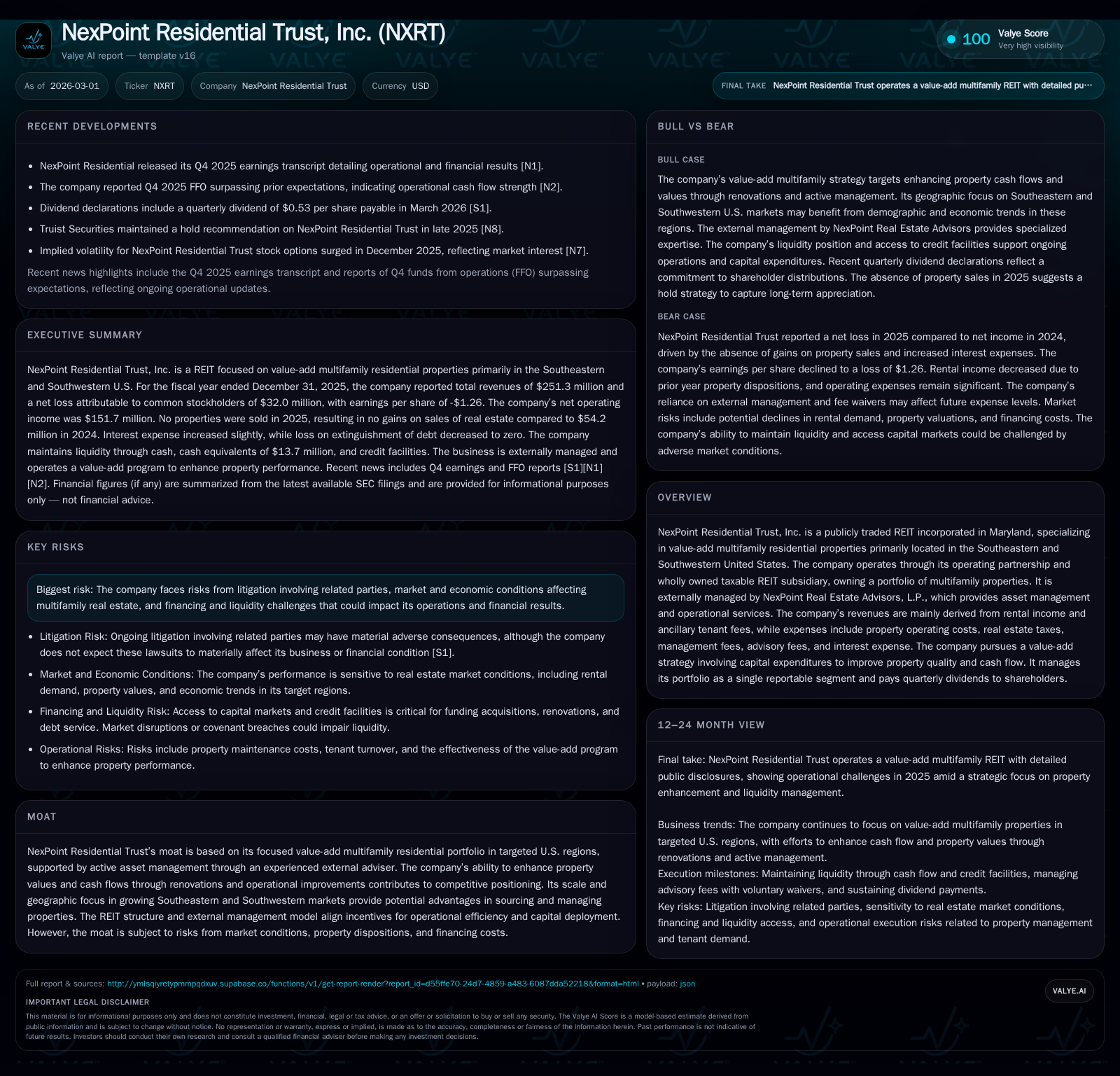
NexPoint Residential Trust, a REIT focused on value-add multifamily assets in the Southeastern and Southwestern U.S., reported a modest revenue decline alongside a marked drop in operating income and net profitability in fiscal 2025. Despite this, operating cash flow rose, underscoring operational resilience amid elevated expenses and refinancing activities. The company’s strategic use of a revolving credit facility and interest rate swaps manages rising interest costs while supporting ongoing value-add initiatives. Quarterly dividends remain steady with continued share repurchases, reflecting a balanced approach to shareholder returns despite earnings volatility. Legal risks tied to related-party litigation exist but are currently viewed as non-material; external management by NexPoint Real Estate Advisors remains central to asset enhancement and geographic focus execution.
Reviewing Historical Growth: Revenue, Earnings, and Cash Flow Trends
NexPoint Residential Trust's financial trajectory over the past four years exhibits mixed performance reflecting operational challenges and strategic financial maneuvers. Revenue peaked at $277.5 million in FY2023 before declining steadily to $251.3 million in FY2025, representing a cumulative contraction influenced by market dynamics within target regions [F1]. Operating income displayed significant volatility: after reaching $113.2 million in FY2023, it fell sharply by two-thirds to $27.9 million in FY2025.
Net income swung from positive territory ($44.3 million in FY2023; $1.1 million in FY2024) to a net loss of $32.0 million last fiscal year, impacted materially by refinancing-related charges and increased interest costs [F1]. Contrastingly, operating cash flow improved by nearly 14% in FY2025 versus the prior year to approximately $83.6 million – highlighting effective cash generation despite lowered profitability metrics.
Historical performance (annual)
| FY | Rev ($mm) | Net ($mm) | CFO ($mm) | OpInc ($mm) | Rev YoY | Net YoY |
|---|---|---|---|---|---|---|
| 2025 | 251 | -32 | 84 | 28 | -3.2% | -2985.3% |
| 2024 | 260 | 1 | 74 | 84 | -6.4% | -97.5% |
| 2023 | 278 | 44 | 97 | 113 | +5.1% | +578.0% |
| 2022 | 264 | -9 | 79 | 46 |
Source: SEC companyfacts cache [F1].
Capital returns and efficiency (annual)
| FY | Div ($mm) | Buybacks ($mm) | ROE% |
|---|---|---|---|
| 2025 | 54 | 8 | -10.8 |
| 2024 | 49 | 15 | 0.3 |
| 2023 | 45 | 11 | 8.9 |
| 2022 | 41 | 11 | -1.8 |
Source: SEC companyfacts cache [F1].
Figures sourced from latest SEC filings; percentage changes reflect year-over-year movements based on available data [F1].
Operational Drivers Behind Recent Performance Changes
The declines in operating income and net earnings primarily stem from elevated property operating expenses, refinancing-related losses, and increased interest burdens tied to floating rate debt exposure during a rising rate cycle [S1][S6]. Capital expenditures associated with NexPoint’s ongoing value-add strategy elevate near-term costs while aiming to boost property quality and rental cash flows over time.
Rental revenues constitute the majority of earnings alongside ancillary tenant fees such as utility reimbursements, late fees, pet fees, laundry services, application fees, and cable TV charges that diversify revenue streams beyond base rents [S1]. Typical lease terms average under one year, allowing for nimble re-pricing aligned with local market conditions.
Refinancing activities completed in late-2024 resulted in deferred financing costs of approximately $41 million plus prepayment penalties near $15 million expensed immediately, substantially dampening net results through FY2025 [S6][S21]. Higher interest expense (over $12 million on the revolving credit facility portion alone post-refinance) further pressured margins despite mitigation efforts such as interest rate swaps.
Future Growth Outlook: Pipeline, Geographic Focus, and Market Dynamics
NexPoint plans incremental investments contingent upon equity and debt capital availability within its core Southeastern and Southwestern U.S markets—regions benefiting from population growth fueled by employment expansion and housing demand favorable for multifamily properties [N1][S5].
The value-add approach combines selective acquisitions with renovations targeting unit quality enhancements aimed at capturing rental premiums over holding periods aligned with long-term appreciation goals [S26]. However, sustaining expansion depends on continued access to capital markets amid macroeconomic uncertainties that could affect transaction volumes.
Constraints such as rising financing costs or limited equity issuance capacity might limit expansion or delay renovation pipelines if market disruptions arise [S5]. The company also retains flexibility for real estate-related debt or securities investments within portfolio limits (~30%) offering some diversification opportunity.
Managing Capital Structure: Debt Facilities and Interest Rate Considerations
Following maturity of a prior $350 million corporate credit facility mid-2025, NexPoint replaced it with a new $200 million revolving credit line secured through JPMorgan Chase [S4][S7]. As of end-2025:
- $90 million drawn against the Credit Facility with $108 million undrawn.
- Interest accrues at daily or term SOFR plus margins ranging from approximately 150 to 225 basis points depending on leverage ratios.
- Facility matures June 30, 2028 with extension options.
- Covenants include maximum leverage ratios, payout caps, minimum fixed charge coverage ratios consistent with REIT lender standards [S8][S9].
Additionally, seven interest rate swap agreements cover $900 million of floating-rate mortgage debt at an effective fixed weighted average rate near 1.36%, significantly reducing SOFR sensitivity amidst short-term rates around ~3.7% as of end-2025 [S8][S9][S21].
Mortgage debt totals roughly $1.5 billion with adjusted weighted average rates near ~3.28% after hedging effects [S11][S22]. Several loans mature between late-2028 through the mid-2030s presenting refinancing opportunities into longer-duration fixed-rate structures post-value-add program completion.
Shareholder Returns: Dividend Policy and Share Repurchase Activity
Despite earnings pressure, shareholder returns remain prioritized:
- Quarterly dividend declared at $0.53 per share payable March 31, 2026 reflects confidence supported by stable operational cash flows [S12][N1].
- Annual dividend payments increased from about $40 million in FY2022 to over $53 million in FY2025 reflecting commitment even amid net losses last year [F1].
- Share repurchases totaled approximately $7.7 million in FY2025 at an average price near $34 per share continuing an active buyback program authorized through October 2026 albeit reduced relative to prior year activity [F1][S10][S16][S28].
This balanced approach supports liquidity for capital improvements while providing returns via yield and buybacks when valuation discounts arise.
Risks from Litigation and Market Factors on Operational Stability
The company discloses litigation involving related parties but affirms no direct claims against its business or assets; management views these lawsuits as lacking merit with defendants intending vigorous defense without expected material impact on operations or financial condition [S1][S25]. Nevertheless, litigation risks inherent to affiliated sponsor structures warrant monitoring.
Market risks include economic downturns potentially suppressing occupancy or rent growth along with sensitivity to financing cost fluctuations affecting leverage economics [S25]. Geographic concentration offers growth benefits but may increase vulnerability if regional markets soften unexpectedly.
The Role of External Management in Enhancing Asset Value
NexPoint’s external management by NexPoint Real Estate Advisors drives asset selection, underwriting, operational oversight including value-add renovation programs focusing on unit upgrades and cost control.
Advisory fees are capped annually at approximately 1.5% of average real estate assets fostering alignment while fee waivers provide flexibility optimizing expense management during uneven cycles [S1]. This governance model combined with regional expertise enables targeted execution tailored to high-growth Southeast/Southwest submarkets sustaining competitive positioning amid sector pressures.
Disclaimer: This analysis is based solely on publicly available information up to March 1, 2026 including SEC filings (10-K/Q/8-K), earnings call transcripts and does not constitute investment advice.
Disclaimer: This is research-only, informational analysis and not investment advice. It may include AI-generated interpretation and general industry context. Always verify important details using primary sources.

Comments