
New York Times Co.: Digital Subscriptions Propel Record Growth and Strategic Innovation
NYT leverages a multi-product digital bundle and technology investments to fuel strong financial performance while balancing legacy print operations.
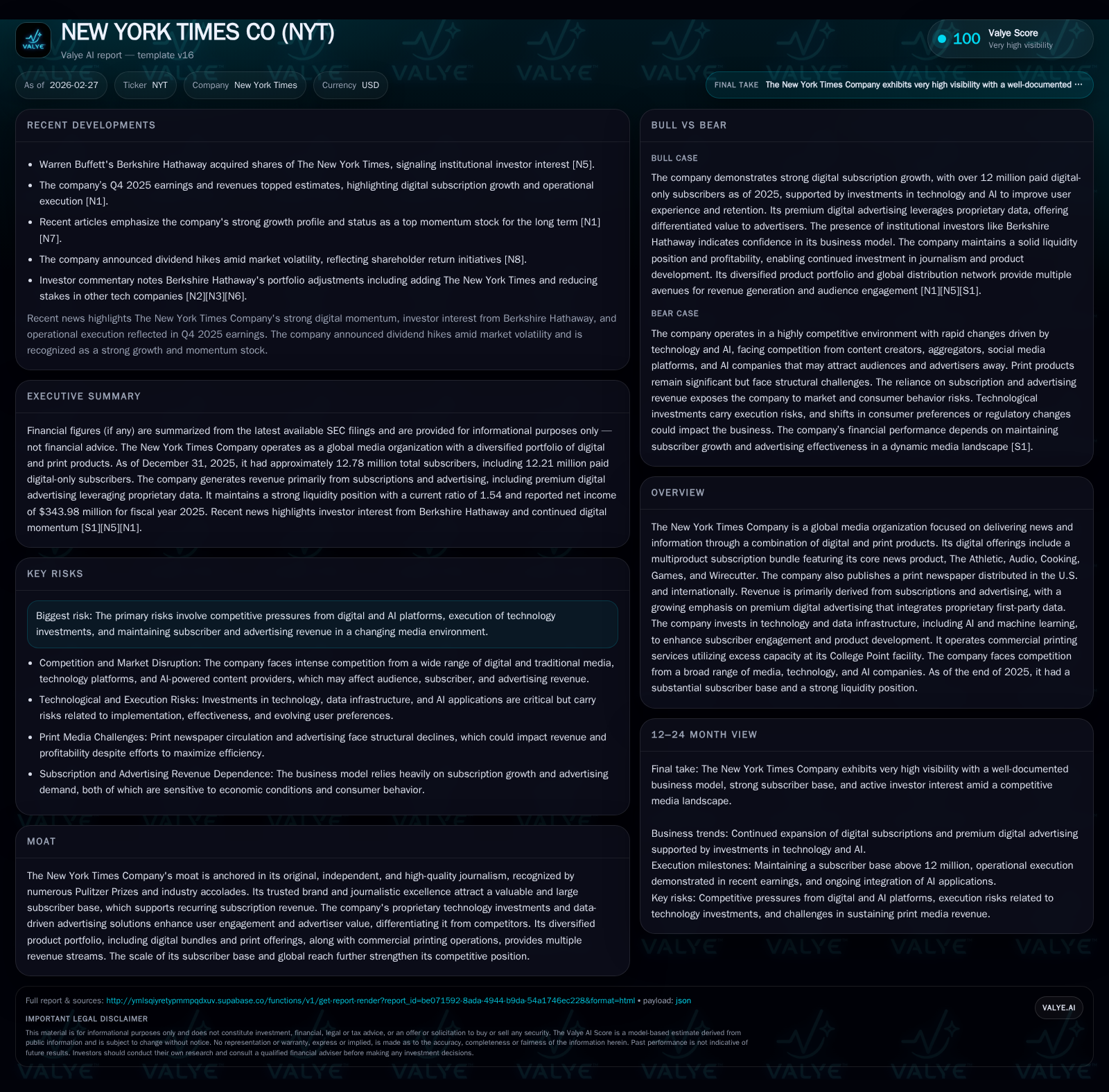
The New York Times Company reached a historic subscriber milestone of approximately 12.78 million at the end of 2025, underpinning record revenue and operating income driven primarily by its digital subscription ecosystem and growing premium advertising. Strategic investments in AI and machine learning enhance subscriber engagement and enable data-driven advertising solutions that boost monetization. Despite the enduring presence of print operations, NYT's disciplined capital allocation, including accelerating share repurchases and moderate capex, supports robust cash flow generation and balance sheet strength. The company targets 15 million subscribers by 2027 but remains vigilant against intensifying competition from digital and AI platforms.
Historical Financial Performance Highlights: From Print Legacy to Digital Revival
The New York Times Company demonstrated consistent top-line growth through FY2025, achieving annual revenue estimated at approximately USD 509 million [F1]. This marked an approximate compound annual growth rate of just over 5% compared with prior years—a testament to the company's successful transition from traditional print reliance toward a digitally-focused subscription model.
More striking is NYT's operating income trajectory: rising from about USD 202 million in FY2022 to USD 432 million in FY2025, an impressive gain of nearly +22.9% year-over-year most recently [F1]. This outpaced revenue expansion, reflecting effective cost management coupled with scalable digital margins.
Net income also followed an upward trend, closing at USD 344 million in FY2025 (up +17.1% YoY), underscoring profitable growth alongside expanding operating efficiencies.
Operating cash flow expanded robustly by +42.4% year-on-year to roughly USD 584 million in FY2025 [F1], bolstered by recurring subscription revenues alongside disciplined working capital controls. Capital expenditures increased modestly (+16.5% YoY) to about USD 34 million [F1], consistent with measured investments especially in technology infrastructure without jeopardizing cash flow generation.
Historical performance (annual)
| FY | Net ($mm) | CFO ($mm) | OpInc ($mm) | Capex ($mm) | Net YoY |
|---|---|---|---|---|---|
| 2025 | 344 | 584 | 432 | 34 | +17.1% |
| 2024 | 294 | 411 | 351 | 29 | +26.4% |
| 2023 | 232 | 361 | 276 | 23 | +33.6% |
| 2022 | 174 | 151 | 202 | 37 |
Source: SEC companyfacts cache [F1].
Capital returns and efficiency (annual)
| FY | Buybacks ($mm) | FCF ($mm) | ROE% |
|---|---|---|---|
| 2025 | 165 | 551 | 16.9 |
| 2024 | 85 | 381 | 15.2 |
| 2023 | 45 | 338 | 13.2 |
| 2022 | 105 | 114 | 10.9 |
Source: SEC companyfacts cache [F1].
Note: Revenue figures for recent years are not fully detailed across FYs; only operating income, net income, CFO, and capex trends are highlighted quantitatively from [F1].
Key Drivers Behind NYT’s Accelerated Revenue and Profit Expansion
A pivotal driver behind NYT’s financial gains is the surge in digital subscription volume, which climbed to approximately 12.78 million total subscribers globally at year-end FY2025 [S7][S14]. Within this total, paid digital-only subscribers numbered roughly 12.21 million, including standalones or bundled subscriptions spanning The Athletic, Cooking, Audio, Games and Wirecutter products [S6][S14].
The company pursues a dual strategy: aggressively encouraging uptake of multiproduct bundles for deeper engagement while maintaining standalone product subscriptions to capture different customer segments [S4]. By tailoring pricing models aligned with customer willingness-to-pay and the increasing value of its interconnected content offerings — what can be described as subscription bundle economics — NYT optimizes lifetime value per subscriber rather than relying solely on volume growth [S4][S6].
Complementing subscriptions is the advancement of premium digital advertising revenue now constituting approximately three-quarters of overall ad sales as of FY2025 [S16]. NYT leverages proprietary first-party data for targeted advertising solutions within display, audio, email, and video formats—enhancing CPMs (cost per thousand impressions) beyond generic programmatic channels [S4][S16]. The integration of such bespoke ad offerings into trusted editorial contexts uniquely positions NYT vis-à-vis both pure media companies and tech platforms.
Print operations support remains relevant albeit declining relative to the digital transformation; leveraging excess production capacity at the College Point site yields commercial printing revenues that partially offset print circulation softness [S5][S10]. Overall print advertising contributes about one-quarter of advertising revenue with seasonal Q4 boosts typical due to holiday campaigns [S16].
Digital Ecosystem: Products, Bundles, and Subscriber Strategy
NYT’s core news brand operates digitally via nytimes.com alongside mobile applications offering real-time updates including live briefings—vital for habitual daily user engagement [S6][S13]. Surrounding this flagship are vertical lifestyle products such as The Athletic for sports aficionados (broadening audience beyond traditional news), Cooking delivering recipe content enhanced by dedicated apps, Games serving daily puzzles like Wordle (which partially operates as a free conversion funnel), Audio providing podcasts under separate subscription tiers, and Wirecutter furnishing expert product recommendations monetized through affiliate fees [S4][S6][S10].
Subscribers experience bundled offers where cross-product access boosts their interaction frequency across categories—such multi-access packages tap into willingness-to-pay dynamics where incremental content nudges users towards premium bundles instead of single-product purchases [S4][S11][S13]. Further efforts include rebalancing free vs paywall limits strategically; allowing broader free reach during major news events or via games maximizes audience size for advertiser yields while nurturing subsequent subscriber conversions [S6][S14].
Incorporating educational and corporate group packages enhances scale by licensing access rather than purely individual consumers—expanding enterprise customer footprint contributes meaningfully though exact counts reflect discounted estimations due to trial memberships or multi-user accounts counted partly as single paid subs [S14].
Technology as a Growth Catalyst: AI, Machine Learning, and Data Infrastructure
Investment into backend technology is central to NYT’s strategic growth agenda signaled by substantive R&D directed towards platform enhancements supporting their multiproduct bundle ecosystem [S4][N1]. Priorities include strengthening data management systems enabling richer first-party dataset utilization—critical for delivering targeted advertising solutions commanding CPM uplifts.
Machine-learning-enabled content recommendation engines bolster subscriber conversion efficiency by tailoring paywall prompts calibrated to consumption patterns—effectively refining marketing spend return on investment through conversion rate optimization techniques well understood at scale in media subscription economies [S4][N1].
Simultaneously these innovations empower journalists via analytics tools improving newsroom operational leverage by identifying trending topics or promotions facilitating impactful break stories fundamental to sustaining journalistic excellence and subscriber loyalty.
On the advertising front, proprietary platforms synthesizing user behavioral signals aid marketers in campaign design leveraging predictive insights—thus marketing partners benefit from demonstrably enhanced targeting metrics unattainable solely via third-party data reliant programmatic systems common elsewhere [S4].
Competitive Moat in Journalism and Advertising Innovations
NYT draws substantial moat strength from its reputation anchored in original independent journalism widely recognized through numerous Pulitzer Prizes unrivaled among peers globally—a core intangible asset translating directly into consumer willingness-to-pay for premium news content underpinned by trustworthiness [S7][F1]. This editorial integrity differentiates NYT amid proliferating free or AI-generated news aggregators that may lack comparable depth or investigative rigor.
The brand’s trustworthiness likewise attracts luxury goods, technology providers, financial institutions among others searching for safe harbors for their brands in an increasingly complex digital advertising environment—boosting advertiser retention alongside growing ad revenue share realized from direct engagement leveraging proprietary data assets [F1][S16]. Such advantages support recurring high-value subscription revenues complemented by innovative ad product mix decisions that exploit scale effects afforded by a broad international audience reach exceeding two hundred countries as reported [S7][S14].
Capital Allocation Overview: Share Repurchases, Dividends, and Cash Flow Management
NYT exhibits capital discipline fueling strong shareholder value metrics exemplified by an approximate return on equity near sixteen point nine percent as measured by net income over equity reported at USD ~2 billion as of FY2025 closing balance sheets [F1]. Significant cash flow generation creates runway for simultaneous investment funding along with accelerated capital returns.
Operating cash flow's escalation above USD five hundred eighty-four million annually comfortably covers moderate capital expenditures which stood near USD thirty-four million reflecting emphasis on tech infrastructure upgrades while preserving cash flow flexibility [F1][S26].
Share repurchase activity notably intensified—from around USD forty-four point six million in FY2023 escalating more than threefold to USD one hundred sixty-five point three million by end-FY2025—signaling confidence in business fundamentals ([F1]). Although explicit dividend policies were not detailed in provided sources for FY2025 period examined beyond general quarterly remittance allowance under debt covenants [S8], existing agreements permit regular dividends alongside repurchases contingent on maintaining leverage ratios below stipulated maxima.
Financial Health Snapshot: Liquidity and Balance Sheet Resilience
At fiscal year-end FY2025 NYT held approximately USD two hundred fifty-five million cash and equivalents supported current assets totaling over one billion dollars against current liabilities near USD six hundred sixty-seven million yielding a current ratio close to one point five four—a comfortable liquidity buffer supporting operational needs without strain [F1][S9].
Long-term debt is governed through a revolving credit facility established mid-2025 ceilings capped at four hundred million dollars subject to customary covenants including consolidated leverage ratio limits not exceeding roughly three point five times EBITDA barring material acquisitions which temporarily allow up to four times coverage ratios per credit terms reviewed circa mid-2025 amendment filings [S8][S20][S21].
This prudent debt posture alongside ample equity capitalization enables funding continued investments beneath technological innovation umbrellas while retaining covenant compliance mitigating refinancing risk ahead.
Outlook Considerations: Strategic Priorities and Market Risks
NYT aims ambitiously at achieving fifteen million total subscribers by the close of calendar year twenty twenty-seven—building on strong momentum fueled largely by bundling strategies supplemented with ongoing product innovation particularly emphasizing immersive multimedia programming incorporating video/audio enhancements enhancing user stickiness expectations laid out explicitly within management commentary on strategic goals surrounding essential subscription positioning globally [S11][N6].
There remain non-trivial risks stemming chiefly from intensifying competition emanating from tech giants deploying generative AI-powered news aggregators or social media entities driving fragmented attention economies impacting subscriber retention dynamics along with pressures inherent in executing complex technology integration projects effectively while balancing cost structures amid evolving consumer preferences highlighted across recent SEC risk disclosures [N1][N2][S23][S24].
Further expansion into international markets leveraging content licensing partnerships combined with utilization of commercial printing capacities allows operational diversification providing partial natural hedge against singular geographic market volatility risks shared openly within company disclosures evidencing thoughtful portfolio resilience building approaches consistent with long-term sustainable growth thesis delineated internally [S6][S10].
This analysis reflects information grounded exclusively on disclosed financials and regulatory filings as of February twenty-seventh two thousand twenty-six without expressing any investment recommendations or market opinions.
Disclaimer: This is research-only, informational analysis and not investment advice. It may include AI-generated interpretation and general industry context. Always verify important details using primary sources.

Comments