
Octave Intelligence Unbundles from Hexagon with Solid Q1 Operating Results
Following its May 2026 spin-off from Hexagon AB, Octave Intelligence reports profitable first-quarter results amid tight liquidity and ongoing transition arrangements.
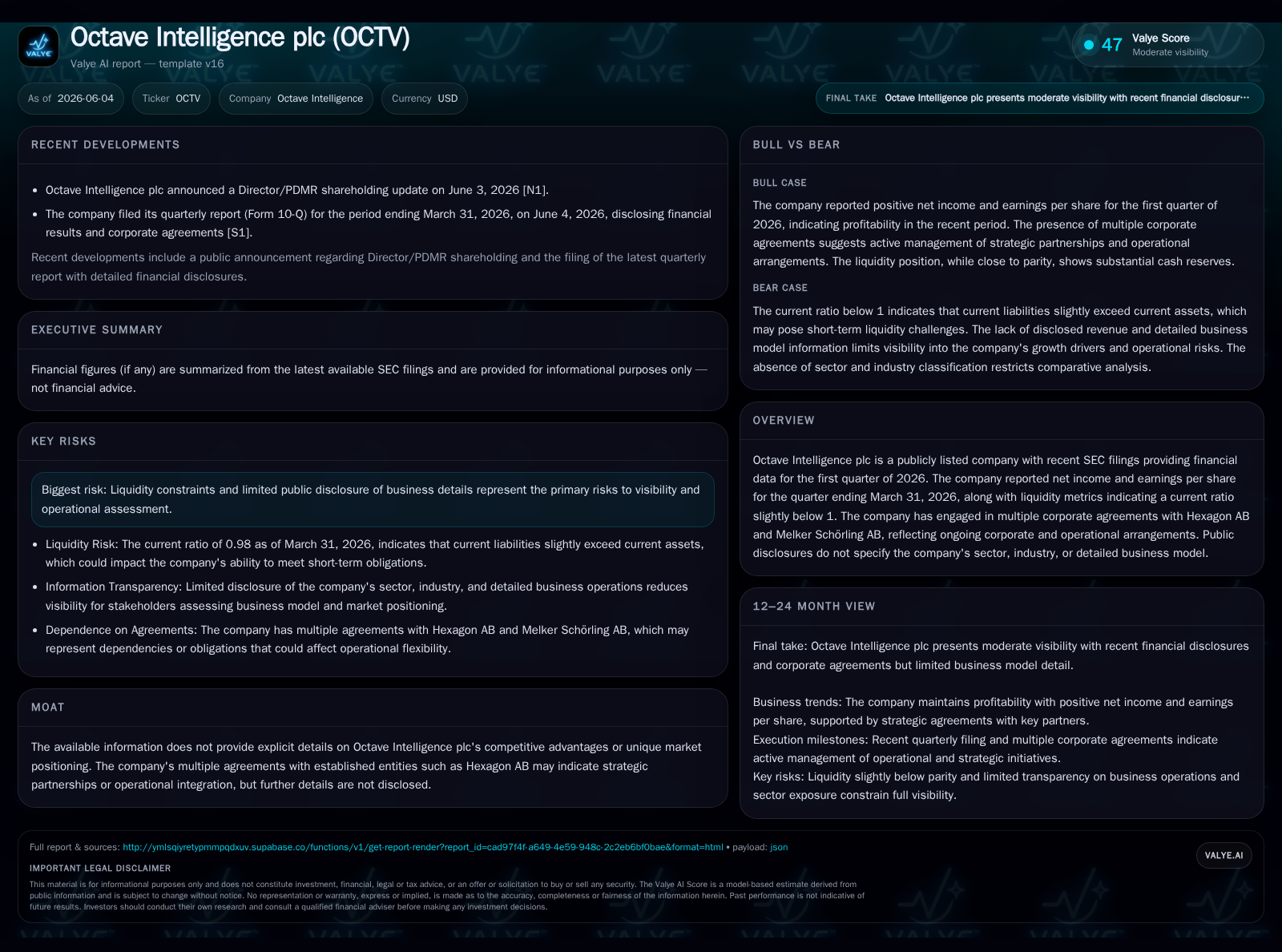
Octave Intelligence plc completed its distribution from Hexagon AB in late May 2026, marking the start of its independent public-company journey. The company's first standalone quarterly filing for Q1 2026 reveals solid operating income and net earnings, supported by strategic agreements with Hexagon AB and Melker Schörling AB that underscore integration with key ecosystem partners. Despite robust profitability, the current ratio of 0.98 highlights near-term liquidity pressures typical of early spin-offs reliant on transitional services and credit facility draws to fund separation costs. Growth opportunities hinge on accelerating AI adoption in manufacturing quality analytics, though financial and disclosure opacity remain watchpoints.
New Independent Phase: Spin-Off Completion and Corporate Restructuring
Octave Intelligence plc formally launched as an independent public company upon its distribution from Hexagon AB on May 22, 2026. This transaction allotted one Octave share to every ten shares of Hexagon stock held by shareholders, immediately establishing Octave as a separately traded entity listed on Nasdaq [S2][S3]. Structurally pivotal were several binding agreements executed concurrently that frame the new corporate boundary between Octave and Hexagon: the Distribution Agreement defining the terms of separation; a Tax Disaffiliation Agreement; Employee Matters Agreement to govern workforce transfers; a Master Transition Services Agreement assuring continuity of shared services post-spin-off; and a Registration Rights Agreement involving Melker Schörling AB, a significant shareholder [S2][S3][S5].
To fund costs associated with this distribution event — including a substantial $625 million cash payment to Hexagon — Octave drew meaningfully under its senior unsecured credit facilities established shortly prior (a revolving facility up to $500 million and term loans totaling $350 million) [S2][S5]. This credit structure represents a deliberate capital strategy to bolster the cash position amidst separation-related liquidity demands.
An additional governance marker was Octave’s change in its external auditor appointment: PwC Sweden was replaced by PwC US effective immediately following the Distribution date [S3][S16]. This swap aims to align audit processes more tightly with Octave’s newly independent U.S.-based operational footprint.
Quarter One Performance: Profitability Amidst Tight Liquidity
In its first quarterly financial disclosure as an autonomous enterprise ending March 31, 2026, Octave reported operating income of $63.6 million alongside net income of $47.4 million [F1]. These figures convey a positive baseline profitability profile early in standalone operations despite anticipated challenges related to spin-off costs and corporate restructuring [S2].
However, balance sheet metrics highlight ongoing working capital pressure: current assets totaled $622.7 million versus current liabilities of $633.8 million at quarter-end, yielding a current ratio of approximately 0.98 [F1]. This sub-one ratio underscores near-term liquidity constraints frequently observed as newly spun companies adapt to cash flow cycles without parent-company support. Proper management of this liquidity profile will be crucial in sustaining operational flexibility until internal cash generation strengthens further.
Business Model Snapshot: Software-Driven Analytics Backed by Strategic Partners
Octave Intelligence’s commercial offering centers on enterprise-grade software solutions leveraging advanced AI-powered analytics aimed at enhancing manufacturing quality control and operational intelligence [N1][S2][S3]. Though explicit product portfolio details remain sparse publicly, multiple corporate agreements point toward deep integration within established industrial ecosystems — notably through continued ties with Hexagon AB and affiliation with Melker Schörling AB [S2]. These partnerships may underpin recurring revenue streams via contractual relationships supporting predictive analytics, defect detection, or process optimization domains.
From a value proposition perspective, customers likely pay for proprietary AI-driven platforms that convert manufacturing process data into actionable insights driving yield improvements and cost reduction. Pricing models in this segment typically combine subscription fees (volume/mix dependent) plus potential usage-based components tied to analytics scale or enterprise deployment breadth. Integration within client IT environments creates switching costs that can reinforce customer retention but necessitate sustained platform innovation and service reliability.
Competitive Environment: Positioning Post-Hexagon and Market Context
Post-distribution, Octave occupies the competitive landscape as an independent software-as-a-service (SaaS) analytics provider detached from its industrial conglomerate founder but still entwined via transition arrangements. This positioning introduces a dual challenge: retaining market stature against larger integrated peers benefiting from broader capital resources while simultaneously building scale as a narrower specialist focused intensely on manufacturing analytics.
Standalone spin-offs within tech-inflected industrial sectors often wrestle with pricing pressure due to concentrated consumer bases well versed in vendor alternatives — particularly when competing SaaS platforms differentiate primarily via marginal AI model superiority or data access pipelines rather than wholly unique capabilities. Consequently, durable pricing power may require rapid feature platform enhancement or pursuit of ecosystem lock-in strategies.
Growth Catalysts: Demand Drivers and AI Adoption Potential
A meaningful structural tailwind for Octave’s core offerings is the accelerating adoption of artificial intelligence technologies across manufacturing quality assurance workflows [N1]. The June 2026 Pulse of Quality in Manufacturing Survey reports robust increases in AI deployment for predictive maintenance, defect classification, and real-time process monitoring—markets directly aligned with Octave’s AI analytic tools.
This surge in AI uptake reflects broader shifts in Operational Technology (OT) budgets internationally towards digitalization initiatives seeking gains through precision analytics — suggesting that incremental customer acquisitions or upselling existing clients could drive top-line growth. Moreover, SaaS scale effects can progressively improve margin profiles as fixed platform costs amortize over growing subscription bases.
Risks and Constraints: Liquidity Pressure and Visibility Challenges
Key near-term risks stem from the company’s liquidity position where current liabilities slightly exceed short-term assets [F1], implying potential cash flow tightness if receivables collection or operating cash conversion falter post-spin-off [S2]. This scenario amplifies dependence on credit facility availability while the organization transitions away from legacy Hexagon back-office support under its Master Transition Services Agreement.
Further complicating risk assessment is sparse public disclosure on detailed business operations or unique competitive advantages beyond association with credible partners like Hexagon AB [S2]. Limited transparency constrains confidence regarding sustainability of demand drivers or resilience under adverse macroeconomic shifts affecting industrial spending into AI infrastructure.
Finally, ongoing reliance on third-party contracts for employee matters and transitional services entails execution risk should negotiations falter or service quality degrade over time requiring internal capability buildout.
Forward Look: Milestones and Market Signals to Monitor
Investors tracking Octave should prioritize forthcoming quarterly earnings releases seeking confirmation of sustained profitability alongside improved liquidity ratios signaling normalized working capital dynamics beyond initial spin-off stress [S2]. Observable indicators include cash flow from operations growth outpacing investing activities related to platform development.
Progress toward autonomy from Hexagon-supported transition arrangements will be critical; successful migration to fully independent systems reduces vendor dependency risk while potentially lowering cost bases.
Contract renewals or expansions involving the strategic partner base—Hexagon AB and Melker Schörling AB—will serve as tactical demand signals validating product-market fit within targeted manufacturing segments.
Additional SEC filings clarifying operational metrics or evolving governance frameworks could enhance visibility into Octave’s evolving standalone profile.
Financial Summary
The latest quarter ended March 31, 2026 shows Octave Intelligence generating operating income of $63.6 million and net income of $47.4 million alongside cash & equivalents totaling approximately $175.5 million [F1]. Current assets stand at $622.7 million against current liabilities near $633.8 million, yielding a slightly sub-par current ratio of 0.98 reflecting short-term liquidity tension common in recent spin-offs relying on transitional support facilities [F1][S2]. These results illustrate solid early-stage profitability paired with cautious financial stewardship needed to stabilize cash flows amid evolving standalone execution.
The analysis synthesizes publicly available SEC filings through mid-2026 combined with industry context surrounding enterprise software spin-offs specialized in manufacturing AI analytics. It underscores Octave Intelligence plc's delicate balancing act between leveraging inherited corporate relationships for stable revenue foundations while expanding independently amidst liquidity constraints inherent to recent separations from large conglomerate parents.
This report does not constitute investment advice but aims to provide a rigorous operational perspective grounded in verified disclosures as mandated by SEC filings and corroborated news sources.
Disclaimer: This is research-only, informational analysis and not investment advice. It may include AI-generated interpretation and general industry context. Always verify important details using primary sources.

Comments