
Odysight.ai Q2 2026: Visual AI Monitoring Expands with Strong Liquidity and New Equity Offering
Odysight.ai reported solid Q2 2026 liquidity and announced a significant equity raise to support growth in AI-powered visual monitoring solutions.
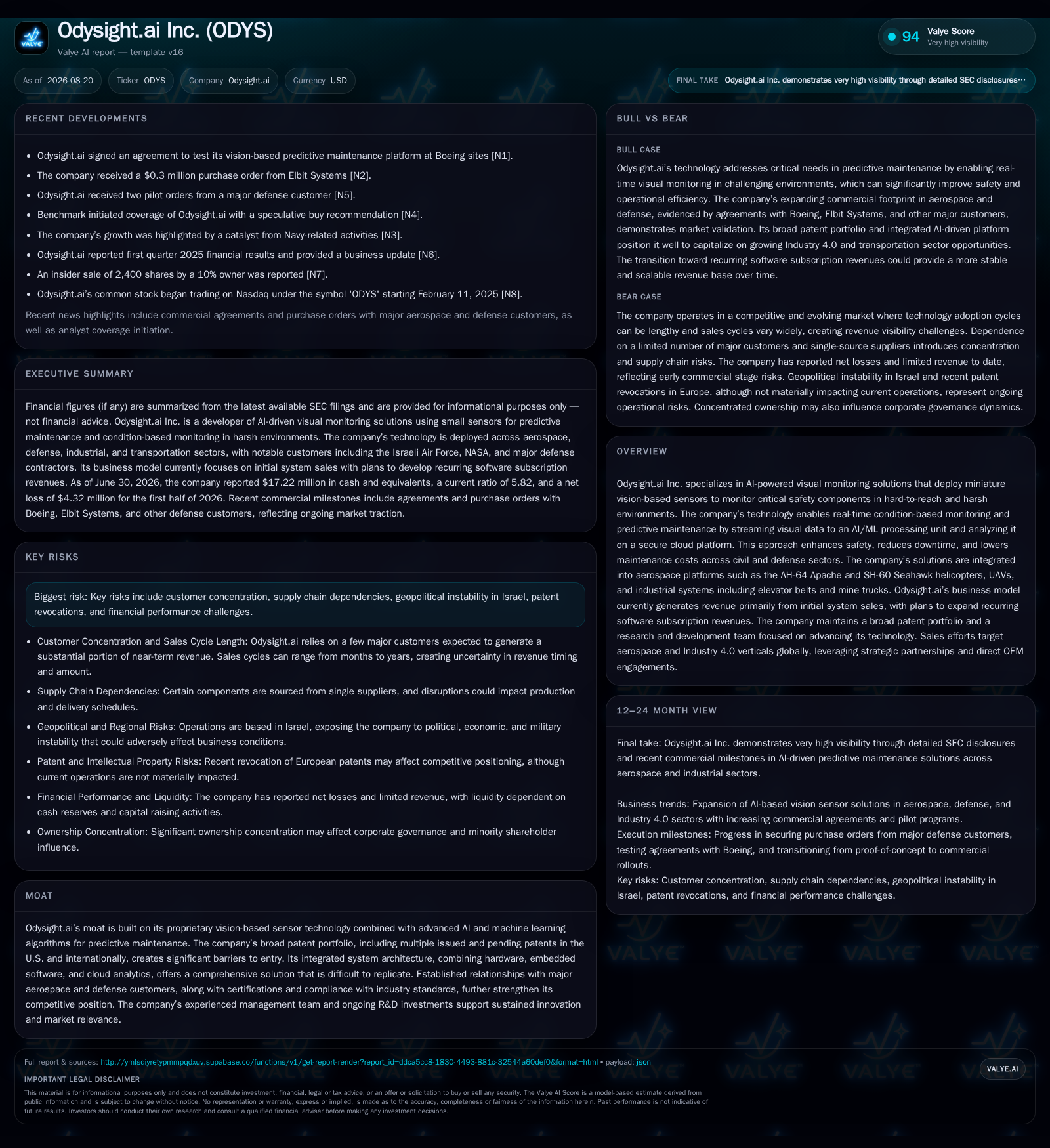
Odysight.ai Inc. ended Q2 2026 with $17.22 million in cash and equivalents and a current ratio of 5.82, reflecting a strong liquidity position that underpins its capital-intensive AI hardware and software business. The company announced a firm commitment public offering of 3.44 million shares in August 2026 to raise additional growth capital. Odysight.ai’s business model centers on AI-driven visual monitoring solutions primarily sold as initial system sales, with a strategic shift toward recurring subscription revenues as the installed base expands. These developments provide financial flexibility to sustain R&D and commercial expansion amid geopolitical and supply chain risks.
Odysight.ai Inc. The company held $17.22 million in cash and equivalents as of the quarter-end [F1]. Additionally, Odysight.ai announced a firm commitment public equity offering of 3,437,500 common shares, which will increase its capital base and may provide additional financial resources to fund ongoing research and development as well as commercial expansion in AI-based predictive maintenance solutions [S3]. The combination of reported balance sheet metrics and fresh equity capital could support the company in navigating near-term uncertainties while investing in growth initiatives.
On August 20, 2026, Odysight.ai priced the firm commitment underwritten public offering of 3,437,500 common shares, signaling an active capital raise to support growth initiatives [S3]. This equity issuance provides fresh capital beyond operating cash flow, potentially accelerating product development and market expansion efforts. However, it also introduces dilution risk for existing shareholders, a factor investors should weigh against the benefits of enhanced financial flexibility. The offering underscores management’s proactive approach to securing growth capital amid competitive and geopolitical challenges.
Business Model and Market Position
Odysight.ai specializes in AI-powered visual monitoring solutions that combine miniature vision sensors, an embedded AI/ML processing unit, and secured cloud-based analytics. These integrated solutions enable real-time failure detection, anomaly alerts, streaming video/images, and predictive maintenance insights, primarily targeting aerospace, defense, industrial, automotive, and medical sectors [S1]. The company’s technology is designed to operate in hard-to-reach locations and harsh environments, providing continuous condition-based monitoring (CBM) and predictive maintenance (PdM) capabilities that enhance safety and reduce costly downtime.
Currently, Odysight.ai’s revenue is primarily derived from initial system sales, including hardware and installation. However, the company plans to expand recurring software subscription revenues as the installed base grows, transitioning toward a more predictable and scalable revenue model [S1]. This shift is expected to improve cash conversion and margin profiles over time, as subscription revenues typically carry higher gross margins and lower incremental costs compared to hardware sales.
Customers include government agencies such as the Israeli Air Force, the Israeli Ministry of Defense, NASA, and commercial entities like Israel Railways and a European elevator monitoring provider, reflecting a diversified sector footprint [S1]. This customer mix provides exposure to both civil and defense sectors, which can offer some revenue stability but also exposes the company to geopolitical and budgetary risks. The company’s proprietary video-based sensor technology combined with AI/ML analytics creates a competitive moat, supported by a broad patent portfolio, although recent revocation of European patents may affect intellectual property protection in some jurisdictions [S1].
Risks and Industry Context
Operating from Israel with manufacturing outside the U.S., Odysight.ai faces geopolitical and supply chain risks. U.S. trade tariffs imposed since 2025, including a 15% global tariff effective February 2026, may increase costs of importing finished products and components, potentially pressuring profit margins [S1]. While the company currently believes these tariffs will not materially impact operations, rising costs could lead customers to seek local alternatives, affecting demand and market share. The tariffs also introduce volatility and complexity in supply chain planning, which could increase operational risks.
Additionally, the company has experienced revocation of key European patents, which may affect its intellectual property protection and competitive positioning, although these revocations are not expected to materially impact current operations [S1]. The loss of patent protection in Europe could increase competitive pressures in that market, necessitating continued innovation and differentiation.
The industrial AI-powered visual monitoring sector is structurally driven by growing demand for condition-based monitoring and predictive maintenance, which reduce operational downtime and maintenance costs. This structural growth is supported by increasing adoption of AI and machine learning analytics in industrial and aerospace maintenance workflows.
The recent equity offering represents a capital raise through the issuance of over 3.4 million shares in a firm commitment offering, providing fresh capital beyond operating cash flow [S3]. This capital raise may enhance the company’s financial resources to invest in its transition toward recurring subscription revenues and to strengthen its AI/ML capabilities.
One plausible base scenario is that Odysight.ai successfully transitions from primarily upfront system sales to a recurring subscription revenue model, leveraging its installed base growth and AI/ML analytics capabilities to drive more predictable and scalable revenues [S1]. Confirmation of this scenario would come from quarterly filings showing increasing subscription revenue contribution and customer contracts with recurring revenue terms. Sustained R&D investment and a stable geopolitical environment supporting defense contracts are key conditions for this outcome.
Conversely, a bear scenario involves geopolitical instability and U.S. trade tariffs materially increasing supply chain costs and reducing demand, which would pressure margins and growth [S1]. Evidence supporting this scenario would include rising cost of goods sold reported in future filings and customer attrition or contract cancellations citing tariff-related cost increases. Supply chain disruptions or shifts in customer preferences toward local alternatives could exacerbate these challenges.
Watchpoints
Investors and observers should monitor quarterly disclosures for subscription revenue growth and contribution to assess the company’s transition toward recurring revenues. Updates on supply chain costs and gross margin trends will be critical to evaluate tariff impacts. Additionally, progress in product development and customer adoption following the equity raise will provide insight into capital deployment effectiveness. Geopolitical developments affecting Israel and U.S. trade policies remain key external risk factors to watch.
The reported liquidity and equity offering may provide resources to invest in R&D and commercial expansion, while the evolving revenue model and geopolitical environment could influence its near-term trajectory. The company’s ability to manage supply chain challenges and grow recurring subscription revenues may be important factors in realizing its growth potential and maintaining competitive positioning in the evolving industrial AI market.
Disclaimer: This is research-only, informational analysis and not investment advice. It may include AI-generated interpretation and general industry context. Always verify important details using primary sources.

Comments