
Pitney Bowes Q2 2026: Revenue Decline Continues Amid Margin Improvement and Debt Reduction Efforts
Pitney Bowes reports ongoing revenue declines in Q2 2026 but shows operational resilience through margin expansion and initiates debt tender offers to enhance financial flexibility.
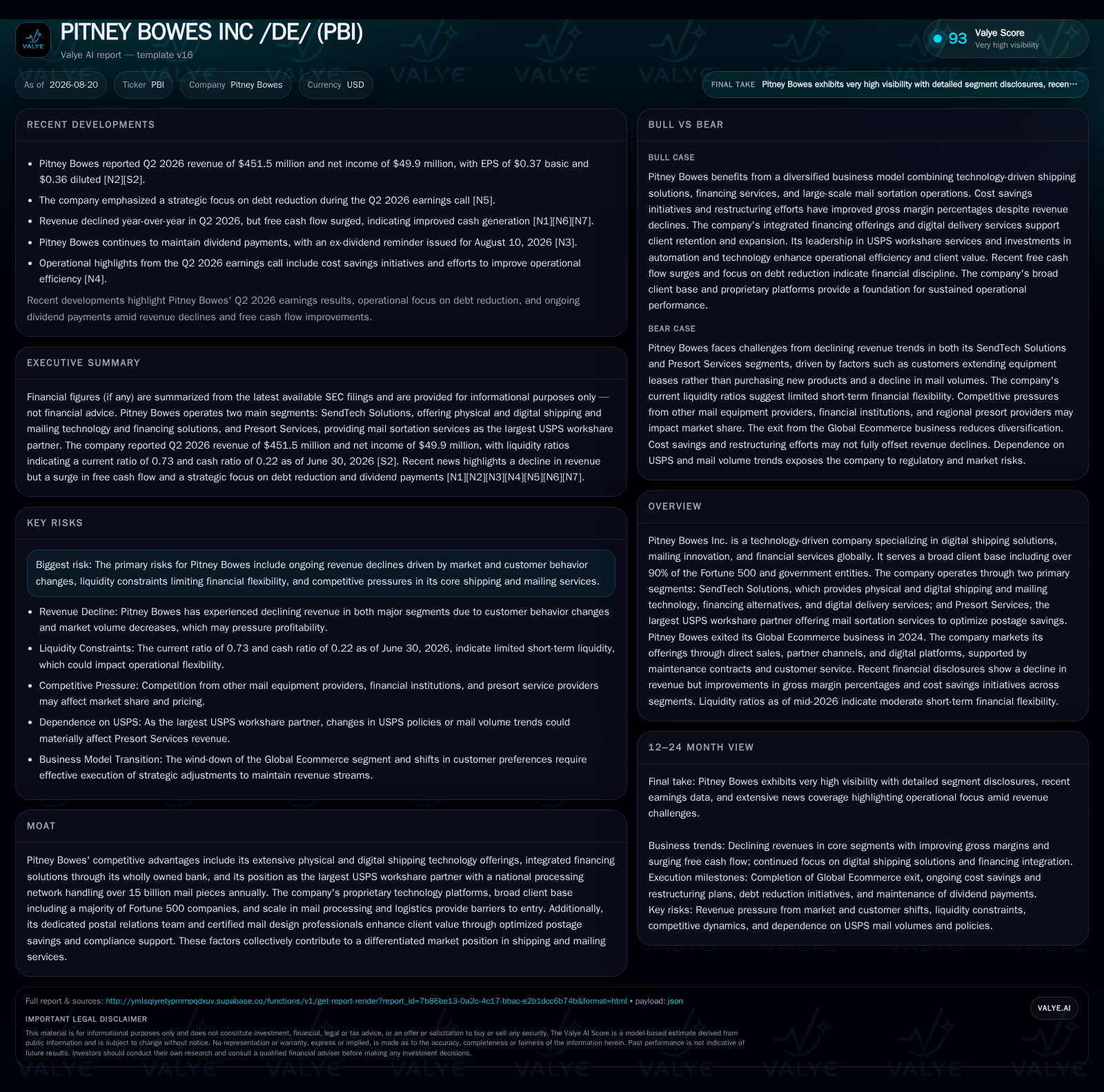
In Q2 2026, Pitney Bowes experienced a continued decline in total revenue compared to the prior year, reflecting persistent structural challenges in its core mailing and shipping businesses. Despite this top-line pressure, the company improved its gross margin percentage through cost savings and reallocation of expenses. Concurrently, Pitney Bowes announced a tender offer to repurchase up to $50 million of its long-term notes, signaling active management of its capital structure amid elevated debt levels and liquidity constraints. The company’s ability to sustain margin gains and generate free cash flow will be critical to offset ongoing revenue pressures and support financial flexibility.
Q2 2026 Operating Performance and Segment Analysis
Pitney Bowes Inc. reported a continued decline in total revenue for the second quarter of 2026 compared to the same period in 2025, underscoring ongoing structural challenges in its core markets [S2]. The company's revenue contraction reflects secular shifts away from traditional mailing and shipping volumes, which remain a significant headwind for its business segments. Despite this decline, Pitney Bowes achieved an improvement in its gross margin percentage during the quarter. This margin expansion was driven by cost savings initiatives and the strategic reallocation of marketing and innovation expenses to its SendTech Solutions segment, which includes physical and digital shipping technology, financing alternatives, and related services.
The SendTech Solutions segment, a key revenue contributor, experienced revenue declines but demonstrated margin gains due to tighter cost controls and the expense reallocation [S2]. This operational discipline helped offset some of the top-line pressures, supporting improved profitability and cash flow generation. The company's Presort Services segment, which provides mail sortation services to qualify clients for postal workshare discounts, also faced revenue challenges consistent with the broader decline in mailing volumes.
Capital Structure and Liquidity Update
In August 2026, Pitney Bowes initiated a cash tender offer to repurchase up to $50 million aggregate principal amount of its 6.70% Notes due 2043 and 5.25% Notes due 2037 [S3]. The company's current ratio stood at 0.73, indicating liquidity below the level typically considered sufficient to cover short-term liabilities without additional financing [F1]. These balance sheet metrics highlight the company's leverage and working capital challenges, which the tender offer program seeks to address by lowering debt and interest obligations to improve financial flexibility [S2][S3][F1].
Business Model and Competitive Positioning
Pitney Bowes operates as a technology-driven provider of physical and digital shipping and mailing solutions, serving a diverse client base that includes over 90% of the Fortune 500, small businesses, large enterprises, and government entities. Its offerings span hardware sales, maintenance contracts, financing solutions, revolving credit products for postage and meter rental, and mail sortation services that enable clients to capture postal workshare discounts [S1]. Revenue is generated through a combination of product sales, service contracts, financing interest and fees, and mail processing services [S1]. Margins and cash conversion are influenced by product mix, operational efficiencies, and financing costs. The company’s scale as the largest USPS workshare partner and its proprietary technology platforms provide competitive advantages, although these are challenged by secular declines in traditional mailing volumes and liquidity constraints.
The company’s exit from its Global Ecommerce business in 2024 simplified its portfolio, allowing greater focus on its core segments—SendTech Solutions and Presort Services—which better align with its strategic offerings and operational structure [S1]
Risks and Scenario Analysis
The sustained revenue decline in Q2 2026 is consistent with structural market headwinds affecting traditional mailing and shipping volumes [S2]. This trend is unlikely to reverse in the near term, posing ongoing challenges to revenue durability across Pitney Bowes’ core segments.
However, margin improvement and cost-saving initiatives have partially offset these pressures, supporting better profitability and free cash flow generation [S2]. The gross margin percentage increase reflects operational discipline, including expense reallocation and cost control.
Looking forward, one plausible scenario is that Pitney Bowes accelerates margin expansion and cost control efforts, stabilizing earnings and generating sufficient free cash flow to reduce leverage and invest in growth initiatives. This scenario depends on sustained or improved gross margins, stable customer retention, and successful execution of debt reduction programs, including the tender offers [S2][S3][F1]. Confirmation would come from future quarterly filings showing margin expansion, reduced net debt, improved liquidity ratios, and positive free cash flow trends.
Conversely, a bear case envisions accelerating revenue declines due to secular shifts and competitive pressures overwhelming margin gains, leading to liquidity stress and increased leverage risk [S2][F1]. This risk is underscored by the current ratio of 0.73 and net debt around $1.8 billion as of June 30, 2026 [F1]. The company’s active capital structure management, exemplified by the recent debt tender offer, aims to enhance financial flexibility amid these challenges.
These indicators will be critical to assess whether Pitney Bowes can sustainably offset top-line pressures and improve its financial health over time.
Disclaimer: This is research-only, informational analysis and not investment advice. It may include AI-generated interpretation and general industry context. Always verify important details using primary sources.

Comments