
Oil States International’s Strategic Reset Amid Offshore Challenges
The company’s 2025 losses reflect operational retrenchment, asset impairments, and evolving offshore demand under regulatory and pricing pressures.
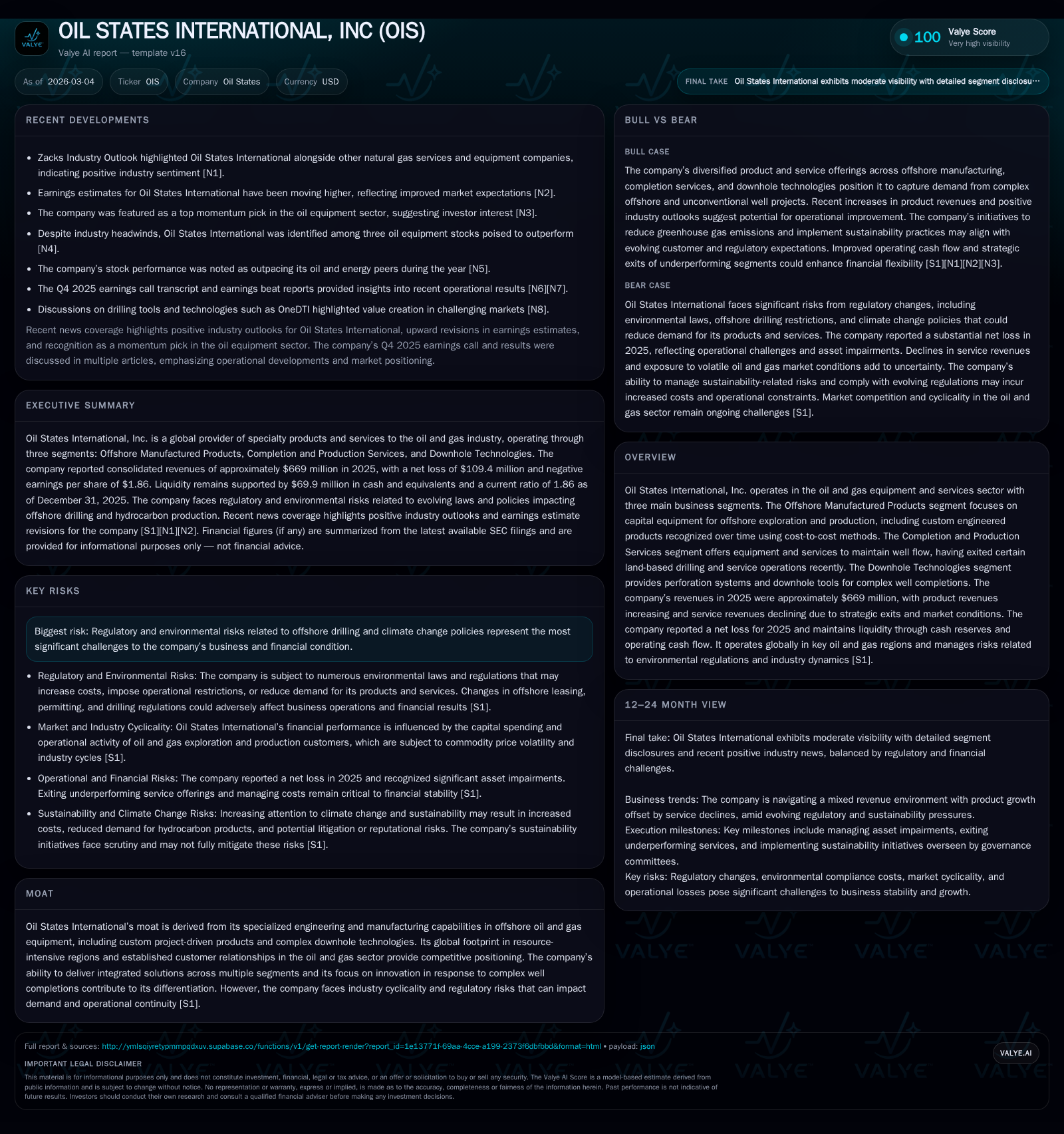
Oil States International transitioned sharply from marginal profitability in 2024 to a significant net loss in 2025, driven by weaker commodity pricing, tariff-induced cost increases, and strategic exits from underperforming segments. The company concentrated on its core offshore manufactured products segment while exiting lower-margin U.S. land-based services, incurring $121 million of non-cash asset impairments and restructuring costs. Despite the earnings challenges, robust operating cash flow and disciplined capital allocation, including debt repayment and share repurchases, have supported liquidity and reduced leverage. Regulatory uncertainties in offshore drilling and environmental compliance remain critical headwinds that could influence future demand trajectories.
From Growth to Contraction: Drivers Behind 2025 Financial Results
Oil States International (OIS) experienced a pronounced reversal in financial performance during 2025, shifting from a near-breakeven operating income of -$1.7 million in 2024 to a sizeable loss of -$97.9 million [F1]. Net income followed suit with a steep drop to -$109.4 million compared to -$11.3 million last year [F1]. This deterioration was largely driven by macroeconomic pressures impacting the oilfield services sector.
WTI crude prices averaged $65.4 per barrel for 2025, down approximately 15% from the $76.6 benchmark in 2024 due to increased production by OPEC+ and global oversupply concerns [S1]. Concurrently, broad U.S. trade tariffs on raw materials elevated manufacturing costs domestically, further compressing margins [S1][S25]. These external factors disproportionately affected the U.S.-land focused operations within OIS’s portfolio.
Management responded with an extensive operational reset including consolidation and exit of certain product lines and service offerings mainly within completion services tied to land drilling—services considered less commercially viable given current market dynamics [S1]. Additionally, OIS recorded substantial non-cash impairment charges totaling $121.1 million reflecting reduced carrying values aligned with industry outlooks on demand and pricing stability [S1]. Facility exit expenses and other restructuring charges added another $11.6 million hit to earnings [S1]. These impairment actions underline the company’s focus on rationalizing its asset base to better align with future demand expectations.
While total company-wide revenues dipped modestly by approximately 3%, this masks an underlying shift: product revenues increased by about $33.8 million (+8%), led by stronger sales within offshore manufactured equipment like connectors, cranes, and drilling products [S18]. In contrast, service revenues contracted sharply by over $57 million (-20%), primarily due to exited land-based completion and production services [S18]. This revenue mix evolution is a direct consequence of strategic pruning aimed at higher-margin businesses.
Strategic Exits and Operational Consolidation in U.S. Land-Based Markets
The company’s detailed restructuring strategies centered markedly on optimizing resources away from unprofitable service lines associated with U.S. land operations. This involved closure or consolidation of several facilities as well as workforce reductions aimed at cutting fixed costs [S1].
Such operational consolidation intended not only to reduce cash burn but also improve long-term return profiles by focusing capital deployment on high-growth opportunity sets predominantly linked to offshore markets where bespoke engineering expertise adds significant value.
This tactical pivot bolsters Oil States’ competitive positioning in project-driven product manufacturing for offshore developments which require intricate engineering solutions with longer lead times and advanced cost-to-cost revenue recognition methods [S10], differentiating it from commoditized land-drilling services facing severe margin squeezes.
Segment Performance: Offshore Manufactured Products and Beyond
Segmentally, Offshore Manufactured Products emerged as the primary growth pillar during this transition, reporting revenue gains fueled by rising demand for deepwater equipment such as flexible bearings, mooring systems, cranes, high-pressure risers, and managed pressure drilling modules [S8][S18]. This segment generated approximately $431 million of revenue for the year versus approximately $398 million in prior year—an appreciable gain reflecting resilience amid broader industry headwinds [S18]. Despite cost pressures associated with tariffs affecting domestic inputs, this division's focus on integrated offshore solutions allowed it to hold relative profitability compared with other segments.
In contrast, Completion and Production Services faced a notable downturn linked directly to strategic withdrawals from land-based service offerings (including wireline support, frac stacks, isolation tools which were mostly exited by Q4 ’25), truncating revenues from approximately $164 million in 2024 down to around $115 million in 2025 [S18][S12]. This contraction was partly deliberate given low profitability metrics within these legacy services coupled with persistent declines in domestic shale activity.
Downhole Technologies posted relatively steady revenue around $123 million but saw compressed operating income as customers delayed capital expenditures or downgraded well complexity preferences amid economic uncertainty [S18][S14].
Capital Allocation Discipline Amid Cyclicality: Buybacks, Debt Reduction, and Liquidity
Despite operational setbacks reflected in GAAP net losses influenced heavily by impairment charges, Oil States maintained robust cash flow generation with operating cash flows swelling to approximately $105 million compared to roughly $46 million in prior year—a roughly +129% increase attributable mainly to improved working capital management alongside adjusted operations [F1][S16].
Leveraging this liquidity strength, OIS strategically repurchased $16.6 million worth of common shares during the twelve months ending December ’25 under an existing buyback authorization targeting enhanced shareholder value amidst market undervaluation sentiment [F1][S16]. Concurrently, the company executed material deleveraging efforts repurchasing about $70.8 million aggregate principal amount of its maturing convertible notes ahead of official maturities scheduled April ’26—a prudent move alleviating interest burdens while bolstering balance sheet flexibility going forward [F1][S15][S16].
The balance sheet corroborates this prudent financial stewardship: ending cash & equivalents stood strong at nearly $69.9 million despite negative earnings impact; current ratio calculated at ~1.86 reflecting solid short-term liquidity; long-term debt significantly pared down relative to prior years improving leverage metrics; and newly negotiated cash flow-based credit facilities replacing previous asset-based revolvers extend availability up through early 2030 maintaining ample borrowing capacity [F1][S6][S22][S16]. Financial covenants under these arrangements are comfortably met including interest coverage ratios above minimum thresholds ensuring no immediate refinancing risks [F1][S6].
Regulatory and Environmental Risks Impacting Future Demand
A key layer complicating Oil States' growth outlook rests with stringent regulatory regimes governing offshore drilling across different jurisdictions notably the U.S., UK, Singapore among others where it holds operations or clients [S25][S26]. These include evolving legislation potentially limiting leasing permits or enforcing stricter safety/environmental operational standards resulting in increased compliance costs or delays that disrupt customers’ exploration timelines thereby suppressing capital investment requirements for specialized offshore equipment platforms critical to OIS's core business [S25].
Moreover, new environmental laws addressing wastewater disposal via underground injection wells pose latent risks if operators curtail or shut such disposal practices—potentially rippling into decreased demand for related production maintenance services offered by OIS segments [S25]. Spill event contingencies can trigger temporary drilling halts alongside progressive tightening of emission controls contributing unpredictability toward budgeting decisions made by oilfield operators.
Further complicating matters are broader policy shifts incentivizing renewable energy transitions redirecting investor focus away from fossil fuel upstream capital spending toward green energy investments—a secular threat implicit within long-term demand drivers for traditional oilfield equipment providers like Oil States International [S26].
Outlook and Milestones: What Investors Should Monitor
Explicit guidance remains limited though equity analysts have recently revised earnings estimates upward reflecting cautious optimism surrounding stabilization or modest recovery trends post-restructuring initiatives [N1][N3][N7][N8]. Forward-looking considerations should center on monitoring quarterly updates for signs that:
- Facility network rationalizations yield sustained cost efficiency gains without compromising delivery capabilities,
- Offshore deepwater contract awards rebound signaling renewed capital allocation by operators,
- Service revenue declines begin plateauing or reversing as core offerings align more tightly with market demands,
- Crude oil price behavior stabilizes near or above mid-$60 benchmark supporting renewed activity levels,
- Regulatory environments either clarify favorably or at least avoid sudden constraints that could tighten capital project cadence.
These milestones represent critical junctions influencing whether OIS can regain profitable momentum while managing risk exposures inherent to cyclical resource industries [N3][N7][N8].
Historical Financial Performance (USD thousands)
Historical performance (annual)
| FY | Net ($mm) | CFO ($mm) | OpInc ($mm) | Net YoY |
|---|---|---|---|---|
| 2025 | -109 | 105 | -98 | -871.5% |
| 2024 | -11 | 46 | -2 | -187.3% |
| 2023 | 13 | 57 | 23 | +235.1% |
| 2022 | -10 | 33 | 3 |
Source: SEC companyfacts cache [F1].
Capital returns and efficiency (annual)
| FY | Buybacks ($mm) | ROE% |
|---|---|---|
| 2025 | 17 | -19.1 |
| 2024 | 14 | -1.7 |
| 2023 | 7 | 1.8 |
| 2022 | -1.4 |
Source: SEC companyfacts cache [F1]. *Detailed consolidated revenue figures for recent years are not available from structured data but segment revenues are provided within filings.[S18] **Capex detailed below.
Capital expenditures totaled approximately $31.2 million during 2025 compared to prior year levels around $27 million reported within SEC filings indicating ongoing investment discipline consistent with operational priorities [S11][F1].
This historical perspective underscores significant earnings volatility driven largely by asset impairments but balanced by robust free cash flow generation supporting deleveraging efforts.
Disclaimer: This is research-only, informational analysis and not investment advice. It may include AI-generated interpretation and general industry context. Always verify important details using primary sources.

Comments