
OMNIQ Corp. Confronts Liquidity and Profitability Pressures While Leveraging AI Machine Vision in Growing Public Safety and Supply Chain Markets
Recent quarter reveals operational headwinds amid ongoing balance sheet challenges, highlighting integration-driven growth in AI-enabled surveillance and logistics solutions.
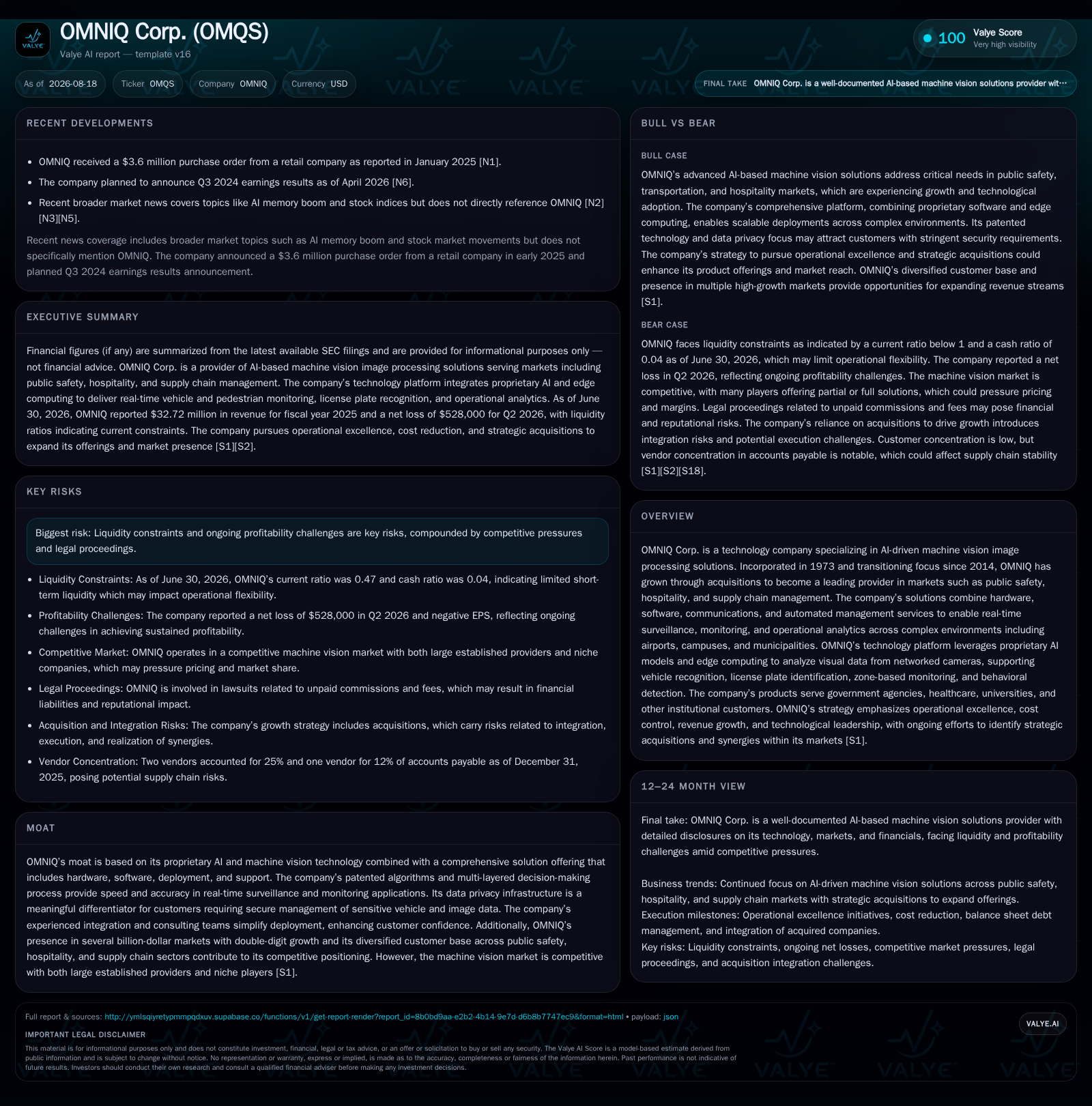
OMNIQ Corp. reported ongoing operational losses and a strained liquidity position in its latest quarterly filing, reflecting the capital-intensive nature of its AI-driven machine vision technology business focused on public safety, hospitality, and supply chain clients. The company leverages proprietary AI, hardware-software integration, and system integration services to deliver real-time surveillance and operational analytics solutions. While OMNIQ’s comprehensive product suite and data privacy capabilities differentiate it within competitive billion-dollar markets, profit pressure and low current ratio underscore funding and execution risks. Monitoring contract backlog, recurring revenue growth, and deployment efficiency will be key indicators of future progress.
Recent Operating Update Highlights
OMNIQ Corp.’s latest quarterly disclosure dated August 18, 2026 reiterates the company's focus on executing operational excellence amid challenging liquidity conditions [S2]. An accompanying 8-K filing affirms management's commitment to debt reduction efforts combined with targeted cost controls in pursuit of sustained revenue growth through technological leadership [S3][S1]. The company also continues to express intent to pursue strategic acquisitions focused on complementary technologies such as data collection and mobile systems aimed at solidifying OMNIQ's position as a leading specialty integrator within its served markets [S1]. These ongoing acquisition ambitions reflect broader consolidation trends within the competitive machine vision sector.
Business Model: AI-Driven Machine Vision Systems Integration
OMNIQ operates as an integrator of proprietary artificial intelligence-powered machine vision solutions that combine hardware components (cameras/sensors), custom software platforms implementing patented algorithms for image processing, communications layers for real-time data transfer, and automated management services including technical support [S1][S26]. Revenue flows arise from several distinct streams: up-front sales of physical camera nodes or imaging hardware; licensing or subscription fees associated with the AI software stack; recurring service contracts such as maintenance and remote monitoring; plus specialized consulting related to customized installation and integration projects.
This multifaceted monetization architecture is critical in large institutional environments like airports, municipalities, campuses, healthcare facilities, and supply chain operations where both strict security/compliance standards—especially around data privacy—and robust operational analytics are mandatory [S26]. Beyond mere image capture, OMNIQ's solutions provide actionable insights through vehicle recognition (including license plate ID), zone-based behavior detection for crowd/safety monitoring, and logistics tracking that directly improve asset flow efficiency. The interplay between edge computing capabilities reducing latency for AI inference onsite versus centralized cloud processing remains a distinctive technology focus impacting deployment speed and system scalability.
Industry Structure & Competitive Position
The global AI-driven machine vision industry remains dynamic with a spectrum of competitors ranging from specialized component manufacturers like Cognex Corporation to integrated public safety analytics vendors such as Verint Systems, along with automation majors like Honeywell International who offer overlapping security solutions. Against this backdrop, OMNIQ's moat derives from its comprehensive solution suite extending beyond single-point hardware or software products.
Key differentiators include its proprietary multi-layered decision-making algorithms enabling rapid real-time surveillance applications plus stringent data privacy infrastructure designed for sensitive government deployments—a requirement less emphasized by many peers [S26]. Furthermore, OMNIQ couples technology offerings with seasoned professional services teams that ease complex system integrations which remain one of the longest-lead items when deploying cutting-edge machine vision technologies in large-scale environments.
Customer retention benefits from this tight integration ecosystem alongside sales teams organized by industry verticals facilitating upselling/cross-selling opportunities. Nevertheless, competitive pressures persist given the fragmented vendor landscape where niche players may undercut on standalone components. Execution against pipeline conversion timelines—measured via deployment cycle time—and recurring revenue growth will be proxies for sustainable differentiation.
Growth Drivers
Several structural tailwinds exist supporting OMNIQ’s market opportunity. First is the accelerating adoption of artificial intelligence and edge computing architectures that enable higher-fidelity machine vision analytics without prohibitive cloud backhaul costs. This supports use cases across smart city/safe city frameworks where enhanced surveillance meets urban infrastructure modernization mandates.
Second is regulatory momentum demanding advanced public safety monitoring solutions capable of rapid threat detection in transportation hubs or border crossings—markets where OMNIQ already has footholds [S26]. In parallel, rising commercial interest in automated supply chain visibility and ticketless parking systems offers new vertical expansion avenues leveraging existing AI competence.
Finally, market consolidation favors integrators like OMNIQ pursuing synergistic acquisitions in complementary data capture or mobile technologies to broaden addressable markets while extracting cross-platform cost efficiencies [S1].
Risks & Watchpoints
Despite these opportunities, OMNIQ faces meaningful risks. Foremost among these is its precarious liquidity profile: current assets trailing current liabilities by a wide margin (current ratio approximately 0.47) imply dependence on external financing or asset sales to maintain operations without disruption [F1]. This is compounded by a history of ongoing operating losses which together elevate refinancing risk especially if credit markets tighten.
Legal proceedings related to real estate lease disputes and unpaid consultant claims introduce contingent liabilities that could further strain limited resources although management asserts intentions to vigorously defend such actions [S1]. Additionally, rapid technological obsolescence intrinsic to AI-driven machine vision demands sustained R&D investment placing pressure on margins particularly if hardware sales dominate versus higher-margin service revenue.
Integration complexity inherent in large-scale installations can extend sales cycles delaying revenue recognition while potentially impacting customer satisfaction levels if deployment timelines slip. Customer concentration risk appears mitigated given no single client accounts for over 10% revenues historically; however exposure to government procurement cycles could induce volatility.
What to Watch Next
Key upcoming milestones include updates on OMNIQ’s system integration project backlog which will indicate visibility into near-term revenue conversion and potential margin improvement as synergies materialize from past acquisitions. Tracking improvements in recurring revenue percentage—through licensing or service contracts—is essential given recurring streams generally provide steadier free cash flow conversion unlike lumpy hardware orders.
Operational metrics such as deployment cycle times will reflect whether engineering teams maintain pace supporting accelerated rollouts critical for smart city contracts where timing often affects win rates. Advances claimed in AI processing latency reductions or model accuracy enhancements would strengthen competitive positioning if substantiated.
Any announced financing activity addressing liquidity shortfalls or debt restructuring would also be critical given the current balance sheet stressors observed at mid-year 2026 [F1][S2][S3]. Finally, prospective acquisition announcements aligned with stated strategy could deliver incremental scale but require careful capital allocation scrutiny amidst prevailing financial constraints.
Financial Profile Discussion
As of June 30, 2026, OMNIQ held roughly $1.08 million in cash against total current liabilities approaching $28.8 million resulting in a notably weak liquidity position captured by a current ratio under 0.5—a significant operating constraint warranting vigilant monitoring going forward [F1]. Limited free cash flow generation remains a challenge due primarily to the capital intensity embedded across hardware manufacturing coupled with extended system integration projects which delay billing cycles. This dynamic is common across technology firms reliant on bundled solution delivery but accentuates reliance on external financing sources until consistent positive EBITDA can be achieved. As such, maintaining access to capital markets or optimizing working capital terms represent pivotal financial priorities alongside continuous operational execution improvements.
This analysis leverages the company’s latest SEC filings alongside a contextual understanding of the AI-driven machine vision industry emphasizing integrated hardware/software service models deployed into institutional public safety and supply chain environments. All statements herein refrain from investment advice or price forecasts but aim to distill material facts combined with sector-relevant interpretation for internal analytical use.
Disclaimer: This is research-only, informational analysis and not investment advice. It may include AI-generated interpretation and general industry context. Always verify important details using primary sources.

Comments