
Oshkosh Corporation Battles Cyclicality and USPS Contract Challenges in Industrial Vehicles
Q2 2026 results highlight Oshkosh’s resilience amid cyclical pressures and ongoing risks tied to its postal vehicle contract and government dependencies.
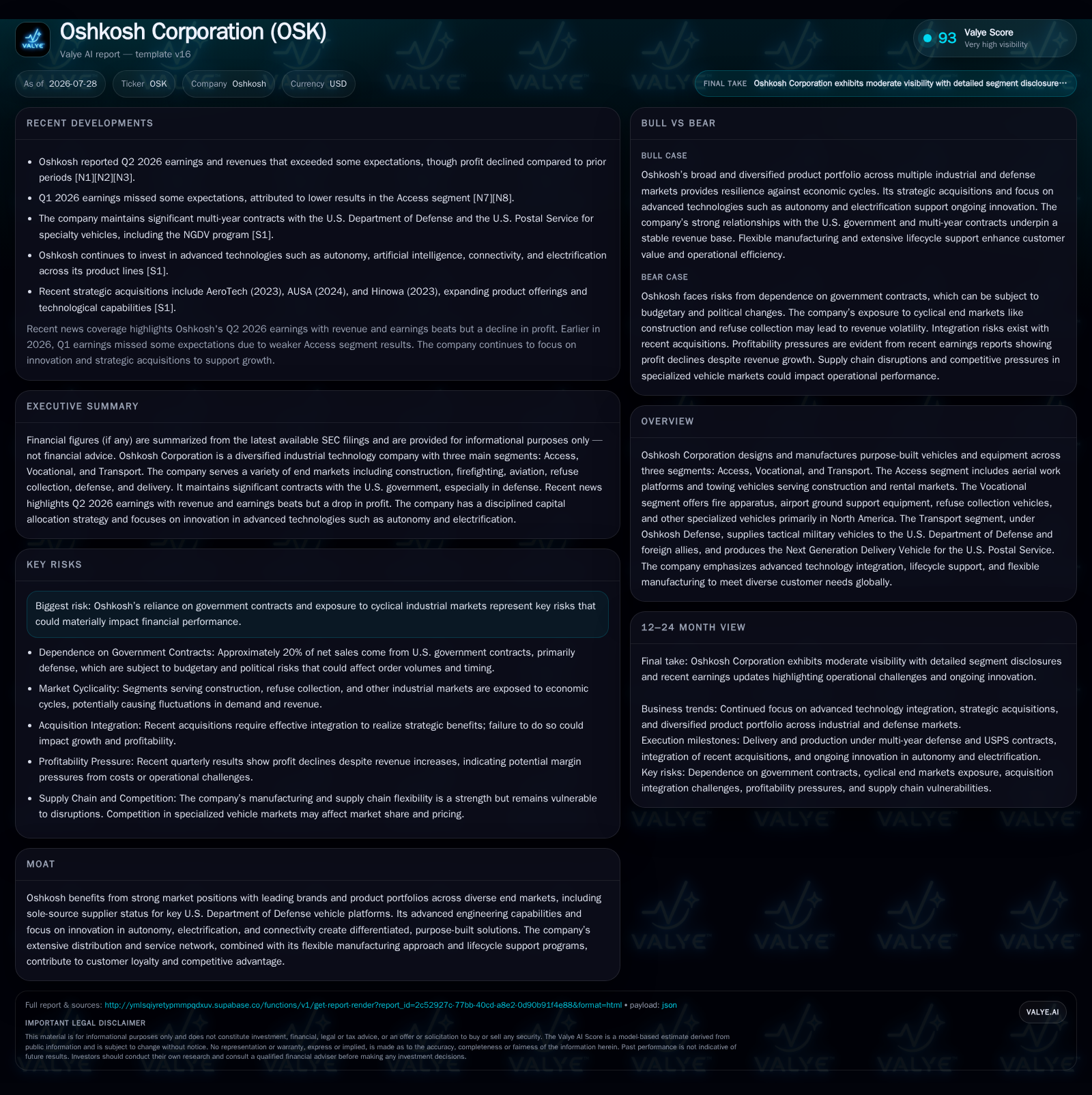
Oshkosh Corporation’s Q2 2026 operating update reveals steady execution despite headwinds from cyclical end markets and challenges scaling the Next Generation Delivery Vehicle program for the U.S. Postal Service. The company’s broad portfolio across Access, Vocational, and Defense segments benefits from strong brand positioning, advanced technology integration, and lifecycle support services. However, exposure to government contracts—including the USPS NGDV order timing and potential production delays—plus macroeconomic cycles in construction and municipal spending introduce volatility. Aftermarket parts and service remain stable revenue pillars while manufacturing efficiencies from simplification projects underpin capacity expansion. Oshkosh’s financial position remains solid with a current ratio above 1.6, but elevated leverage underscores sensitivity to market downturns and contract risks.
Recent Operating Update
Oshkosh Corporation reported second-quarter results for the period ending June 30, 2026, that beat market expectations on revenues despite facing operational challenges tied primarily to its Next Generation Delivery Vehicle (NGDV) contract with the United States Postal Service (USPS) [S2][S3][N2]. While total sales advanced modestly versus prior quarters, profit margins were pressured by ongoing ramp-up delays and higher production costs in the Transport segment.
The NGDV contract remains a focal point of Oshkosh's near-term operating profile. As of December 31, 2025, Oshkosh had received orders for approximately 51,500 units out of a potential maximum of 165,000 vehicles over ten years [S1]. However, deferred contract costs currently exceed estimated future profits on existing orders by around $135 million—highlighting that unit pacing or mix changes could materially impact earnings going forward. Production has taken longer than anticipated due to equipment design modifications, quality control issues with suppliers, and scaling complexities inherent to such a large-volume defense logistics program [S1].
Meanwhile, Oshkosh's other segments provide diversified exposure with more stable margin profiles. The Access segment serves global construction markets through aerial work platforms and telehandlers targeting equipment rental firms whose capital spending is partly reliant on third-party financing availability—a known cyclicality driver [S1][S24]. The Vocational segment’s focus on fire apparatus, refuse collection vehicles, airport ground support equipment, and concrete mixers mostly addresses North American municipal customers who are similarly sensitive to local tax receipts and budget cycles [S1].
Business Model and Segment Dynamics
Oshkosh Corp operates through three reportable segments: Access (43% of net sales in 2025), Vocational (36%), and Transport (20%) [S1]. The Access division’s customer base includes rental companies that generate significant equipment turnover through renting rather than owning their fleets; thus market conditions influencing rental demand heavily affect Access sales volume and pricing.
Vocational products—like Pierce fire apparatus or McNeilus refuse trucks—are purpose-built vocational vehicles often purchased by municipalities or commercial operators under longer replacement cycles but requiring high reliability and uptime. Such customers place substantial value on aftermarket parts availability and lifecycle support plans where Oshkosh leverages its broad distribution networks.
Transport encompasses tactical military vehicles sold primarily via long-term DoD contracts alongside foreign military sales channels. This segment benefits from considerable technological complexity barriers to entry and few direct substitutes but carries political risk associated with government budget fluctuations [S22]. Additionally, Oshkosh is executing on the USPS NGDV program—a major public sector logistics vehicle initiative—which also faces risks of order cancellations or changes in electric vs internal combustion engine vehicle mix affecting profitability.
Advanced technology integration across all segments is central to maintaining competitive advantage. Oshkosh emphasizes electrification solutions to meet shifting emissions regulations alongside autonomy features targeted at improving safety in high-demand operational environments. Connectivity offerings aim to optimize fleet management through real-time telematics—features attractive to both governmental end users focused on asset utilization and private-sector contractors emphasizing cost control [S1]
The company continually invests in research & development ($169 million spent in 2024) supporting new product introductions tailored for diverse customer-specific needs across geographic regions while maintaining scalability across manufacturing lines to realize cost efficiencies [S5]
Industry Structure and Competitive Position
Operating within the industrial specialty vehicle manufacturing industry places Oshkosh at the intersection of complex supply chains requiring precision engineering, extensive customization capabilities, stringent regulatory compliance across emissions and safety standards, plus reliance on both commercial cyclical markets (construction-related equipment) and relatively steady government procurement flows (defense vehicles).
Peers like Caterpillar compete primarily on heavy-duty construction machinery but share customer overlap in some vocational vehicles; PACCAR’s focus on commercial truck manufacturing offers complementary competitive insight regarding scale manufacturing efficiency; Federal Signal directly parallels Oshkosh’s municipal vehicle efforts especially in refuse/recycling specialties while Terex contributes notable context for specialized industrial equipment manufacturing.
Oshkosh’s competitive moat derives from its sole-source supplier status on several key DoD platforms delivering rugged tactical vehicles with advanced innovation integration; its leading brand recognition in vocational fire apparatus products; deep aftermarket service penetration; flexible manufacturing systems enabling customization without excessive cost penalties; plus extensive lifecycle support guaranteeing parts availability over long vehicle life horizons—a critical factor reinforcing customer loyalty given high switching costs for such specialized fleets [S22].
Growth Drivers
Several structural factors underpin potential growth opportunities:
- Infrastructure spending trends stimulating demand for access equipment rentals tied to residential/commercial building cycles.
- Municipal budget allocations driving replacement cycles for vocational firefighting apparatuses/refuse trucks.
- Expansion of defense budgets ensuring sustained flow of tactical military vehicle contracts alongside growth in allied foreign markets.
- Increasing adoption of electrified vehicle platforms responding to regulatory environment changes.
- Growing emphasis on autonomy capabilities anticipated to improve operational safety and efficiency.
- Rising aftermarket services featuring higher-margin revenue streams less exposed to new vehicle purchase cyclicality.
- Select strategic acquisitions like AeroTech complementing product portfolio expansion into airport ground support equipment further diversifying revenue sources.
- Manufacturing simplification projects delivering improved throughput capacity allowing responses to accelerated order inflows without proportionate cost escalation [S1][S17]
Risks / Watchpoints / Constraints
Despite positives, Oshkosh faces notable challenges:
- Marked cyclicality: Construction-related rental equipment demand can fluctuate sharply with macroeconomic conditions constraining Access segment throughput.
- Government contract dependency: Revenue reliance (~20% net sales in US government contracts predominantly transport defense) exposes the company to changing political funding priorities or abrupt order cancellations such as USPS NGDV termination rights which remain risks throughout the contract lifecycle.
- Production ramp risk: NGDV program delays have already caused margin compression; further supplier quality or design setbacks could extend this pressure.
- Tariff exposure: Escalating U.S. trade tariffs predicted to hit approximately $200 million additional costs in 2026 up from $35 million in prior year increase procurement expenses impacting gross margin unless mitigated by pricing adjustments.
- Supply chain disruptions caused by geopolitical tensions may raise component lead times and costs further reducing flexibility.
- Warranty provisions potentially rising should delayed NGDV quality issues persist beyond initial estimations impacting cash flows.
- Integration risks related to recent smaller acquisitions could detract managerial focus or dilute synergy realization prospects if cultural mismatches arise.
- Regulatory uncertainties including environmental compliance tightening may require unplanned capital expenditure increments affecting EBIT margins negatively [S1][S24][S6]
What to Watch Next
Market watchers should monitor:
- Quarterly order backlog developments particularly updates on USPS NGDV ordering cadence reflecting federal postal service budget priorities.
- Reported production volume milestones from Transport segment indicating progress resolving bottlenecks impacting delivery timelines.
- Pricing trends within Access rental channel clients signaling shifts in capital availability or rental equipment replacement rates.
- Aftermarket parts sales growth trajectory as durable revenue source reflecting installed base size/stability.
- New product launches integrating electrification/autonomy features potentially translating into premium pricing or opening adjacent market opportunities.
- Raw material cost trends combined with tariff policy adjustments influencing input cost pass-through capabilities.
- Manufacturing cycle time metrics evolving post simplification initiatives acting as bellwethers for operational leverage gains or capacity constraints ahead.
- Any changes in contractual terms/renewals relating to sole-source military platforms offering insights into competitive positioning durability.
Financial Profile Discussion
The company operates with meaningful leverage constrained by covenants requiring maintenance of specific leverage ratios (maximum typically around 3.75x EBITDA) posing refinancing discipline pressures especially should cyclicality depress earnings unexpectedly [S15]. Free cash flow generation hinges largely on production efficiency improvements offsetting rising material costs plus prudent working capital management underpinning favorable capital structure dynamics going forward.
Overall return metrics benefit from proprietary product niches fortified by aftermarket service streams contributing higher-margin revenue less prone to downturns offering some earnings stability through volatile equipment replacement cycles inherent across primary end markets served by Oshkosh.
This analysis synthesizes publicly available SEC filings up to July 28, 2026 ([S1], [S2], [S3]), supplemented by recent news disclosures ([N2]) applying industrial vehicle sector expertise without offering investment advice.
Disclaimer: This is research-only, informational analysis and not investment advice. It may include AI-generated interpretation and general industry context. Always verify important details using primary sources.

Comments