
Plains All American Pipeline’s Strategic Shift Compresses Revenues With Focus on Core Midstream Assets
A pivot to divest non-core Canadian NGL assets has driven steep revenue decline but preserved strong cash flows and liquidity.
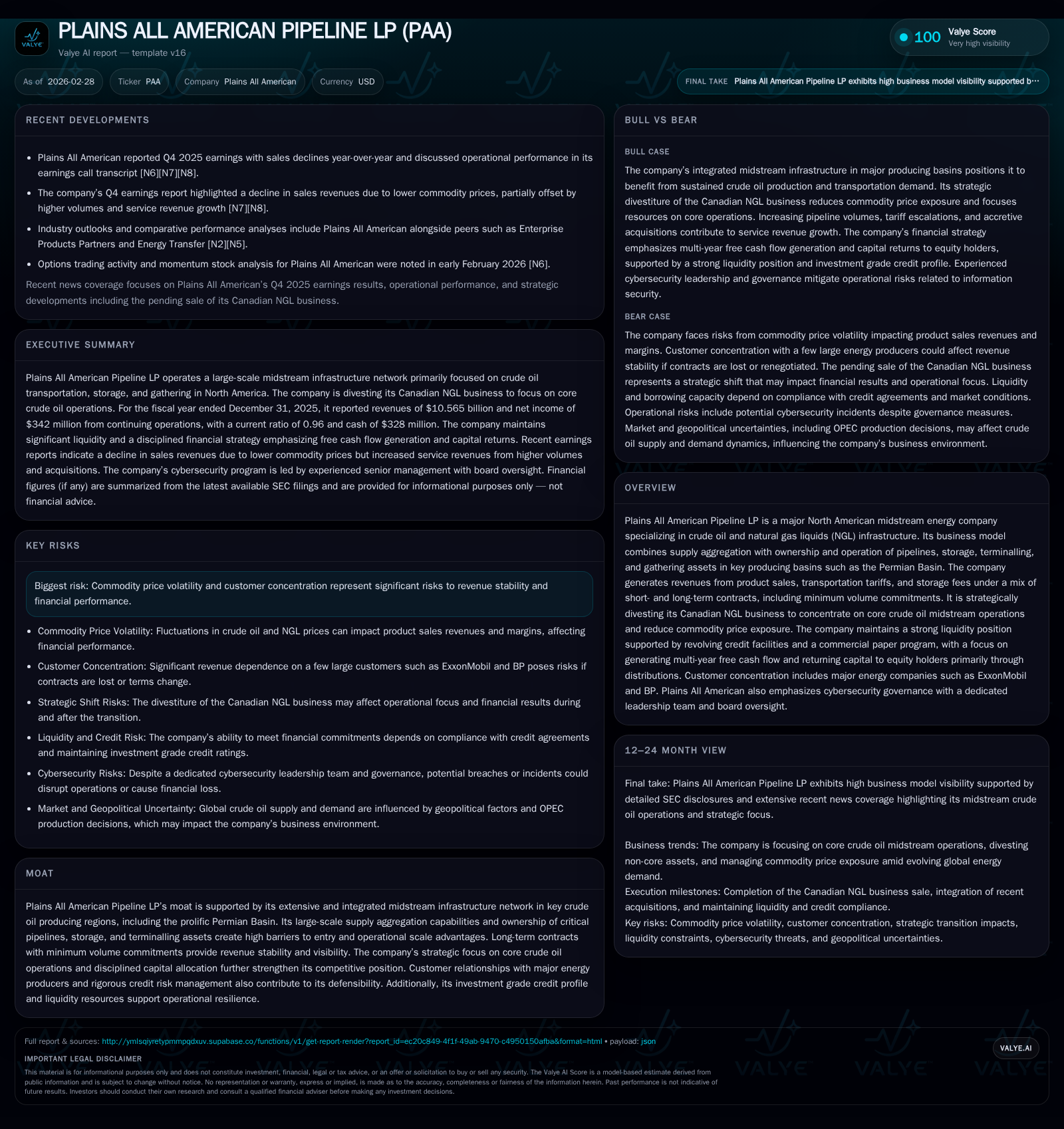
Plains All American Pipeline LP (PAA) experienced a significant revenue contraction of nearly 79% in fiscal 2025 following its strategic divestiture of the Canadian NGL business, shifting focus to its core crude oil midstream operations. Despite this top-line decline, operating cash flow increased substantially, supported by disciplined capital expenditure and strong liquidity facilities. The company maintains operational scale through its extensive pipeline network concentrated in key U.S. basins such as the Permian, with contractual safeguards that provide earnings stability. Going forward, growth prospects hinge on capture of incremental crude volumes across integrated assets and successful deleveraging using proceeds from asset sales. Investors should monitor quarterly volume trends, contract renewals, and capital allocation decisions as key indicators.
Company Overview and Business Model
Plains All American Pipeline LP (PAA) is a leading midstream energy infrastructure company in North America predominantly engaged in crude oil pipeline transportation, storage, and terminalling services. It has built significant scale by integrating supply aggregation capabilities with ownership and operation of critical assets located primarily in major producing basins such as the Permian Basin and key demand hubs across the U.S. and Canada. Its business model blends merchant activities—buying and selling crude oil inventories—with fee-based revenues from transportation tariffs and storage fees contracted under short- and long-term agreements with minimum volume commitments [S1][S13]. This integration enables PAA to capture margin both from physical product movements and service contracts.
Historical Performance: Revenue Collapse Amid Strategic Divestiture
The company's fiscal year 2025 results show a sharp recalibration reflecting a transformational repositioning. Most notably:
Historical performance (annual)
| FY | Rev ($bn) | Net ($mm) | CFO ($bn) | OpInc ($mm) | Rev YoY | Net YoY |
|---|---|---|---|---|---|---|
| 2025 | 10.6 | 342 | 2.9 | 355 | -78.9% | -55.7% |
| 2024 | 50.1 | 772 | 2.5 | 1178 | +2.8% | -37.2% |
| 2023 | 48.7 | 1230 | 2.7 | 1510 | -15.1% | +18.6% |
| 2022 | 57.3 | 1037 | 2.4 | 1292 |
Source: SEC companyfacts cache [F1].
Capital returns and efficiency (annual)
| FY | Buybacks ($mm) | FCF ($bn) |
|---|---|---|
| 2025 | 8 | 2.3 |
| 2024 | 74 | 1.9 |
| 2023 | 74 | 2.2 |
| 2022 | 74 | 2.0 |
Source: SEC companyfacts cache [F1].
Revenue declined nearly fourfold (-78.9%) from approximately $50 billion in FY2024 to $10.6 billion due largely to the planned divestiture of the Canadian NGL business that accounted for significant volumes previously consolidated.
Operating income declined by around two-thirds (-69.9%), while net income decreased by over half (-55.7%). These declines are tied not only to lower commodity price environments but also reduced merchant trading activity following asset sales [F1][S1][S13].
Notably, operating cash flow grew by approximately +17.9% during this period—a strong indicator that cash-generative capacity remains robust despite top-line shrinkage—reflecting tight working capital controls and continued fee-based revenues [F1][S15].
Capital expenditures showed moderate increase (+3.9%), signaling continued investment in maintenance and selective expansions focusing on enhancing core crude oil midstream capabilities rather than growth via NGL assets [F1].
Under its equity repurchase program authorized for up to $500 million outstanding since November 2020, PAA bought back only $8 million worth of common units during FY2025 compared with $74 million in prior years—consistent with a cautious capital return stance amid ongoing transition [S11][F1].
Segment Composition and Geographic Concentration
Following its June 2025 definitive agreement to sell all shares in PMC ULC (Canadian NGL business) to Keyera Corporation with expected closing near Q1-2026, PAA has sharpened focus on U.S.-based crude oil midstream operations [S24]. The Canadian NGL business was relatively small compared to core crude segments but materially impacted revenue recognition due to high-volume commodity trading components.
PAA’s remaining portfolio includes large-scale pipelines such as BridgeTex, Capline, Diamond Pipeline LLC, Eagle Ford Pipeline LLC, among others—many operated jointly or via equity stakes ranging between approximately 17%-54%. These interconnected pipelines transport crude oil from prolific production regions including the Permian Basin toward Gulf Coast refining centers or export terminals [S22][S27].
ExxonMobil represents about one-third of total revenues (~31%), emphasizing customer concentration risk; nevertheless, long-term contracts with minimum volume commitments provide protections against abrupt revenue shocks [S16][S27]. BP was previously another sizable customer but less material after divestitures.
Contract Structures and Margin Drivers
Revenues derive from product sales—mainly merchant crude inventory trades indexed largely to NYMEX Light Sweet futures—and fees from transportation tariffs based on volumetric throughput under contracted terms lasting multiple quarters or years [S25][S13].
Storage fees are generally recognized ratably over contract periods regardless of exact usage level; terminal handling fees accrue when liquid movements occur [S22]. Given significant merchant activity exposure historically tied to spot commodity prices fluctuations, PAA’s recent strategic pivot aims at lowering volatility by concentrating on stable fee-based components.
Benchmark NYMEX prices averaged around $65/bbl in calendar year 2025 down from $76/bbl in prior year, weighing on merchant margins but relatively muted impact on fee revenues due to contractual protections [S25].
Financial Condition: Liquidity & Capital Structure
As of December 31, 2025:
- Cash & equivalents stood at $328 million.
- Current assets of approximately $4.73 billion contrasted with current liabilities near $4.93 billion reflect a tight current ratio just below unity at ~0.96 [F1].
- Total liquidity mirrors more than $2 billion available through senior unsecured revolving credit facilities ($1.35 billion capacity), senior secured hedged inventory facility (~$1.35 billion), offset partially by commercial paper borrowings near $970 million [S4][S6][S12].
- Debt maturity profile is well spread with senior notes issued at fixed rates between ~4.7%-5.95%, maturing between late '20s through mid-'30s providing interest cost predictability [S18][S24].
- Covenants tied primarily to leverage ratios have been maintained without breach throughout [S14][S19].
PAA's access to capital markets remains intact given its investment grade standing; however exposure exists if there were meaningful prolonged commodity downturns impairing cash flows and borrowing costs could rise accordingly [S4][S12].
Capital Allocation & Returns Strategy
The repurchase program remained lightly utilized in FY2025 suggesting cautious prioritization amid leverage reduction efforts post-acquisition financing and pending asset sale proceeds deployment [S11]. Proceeds expected from the Canadian NGL divestiture are earmarked chiefly for debt repayment which should enhance financial flexibility going forward [S24][N9].
Dividends are maintained subject to partnership agreement definitions related to available cash after satisfying preferred unit distributions which have embedded rate resets linked partially to U.S. Treasury yields plus spread since early '23 increasing payout obligations notably on Series A preferred units [S19][S20].
Future Growth Outlook & Risks
Future top-line growth will likely rekindle once asset sales complete allowing PAA to refocus capital toward expanding throughput volumes across established pipelines serving growing production basins especially Permian sands where takeaway constraints remain salient industry themes [N5][N6]. Incremental margin expansion hinges on optimizing integrated logistics solutions leveraging existing terminals alongside new or expanded gathering connections.
On the flip side:
- Continued customer concentration and commodity price volatility pose downside risks warranting careful counterparty credit diligence.
- Regulatory shifts or delays obstructing transaction closings could defer deleveraging plans.
- Macroeconomic factors including OPEC actions impacting global oil pricing introduce external uncertainties beyond direct operational control.
From an analytical perspective monitoring quarterly volume growth against contract renewals as well as tracking free cash flow conversion post-capital investment cycles will be critical milestones alongside balance sheet metrics reflecting debt paydown progress.
Summation
PAA’s strategic repositioning through shedding non-core Canadian NGL assets underscores a deliberate rebalancing aimed at consolidating its position as one of North America’s largest pure-play crude oil midstream operators leveraging durable infrastructure footprint amid volatile industry pricing cycles. Though revenue figures plunged drastically due to these structural changes coupled with challenging macro conditions during FY2025, robust operating cash flows supported liquidity buffers enabling continued investment in essential upkeep capex alongside disciplined capital returns albeit at a restrained pace. The decisive deployment of divestiture proceeds towards deleveraging offers potential credit profile uplift underpinning financial resilience. Yet navigating customer concentration risks alongside commodity price oscillations remain essential considerations for ongoing operational stability going forward. Stakeholders should weigh incremental throughput developments within established U.S basin networks against prevailing energy markets dynamics while appraising periodic financial disclosures revealing trajectory towards long-term sustainable earnings generation.
This analysis is for informational purposes only and does not constitute investment advice or recommendations concerning Plains All American Pipeline LP securities or any related financial instruments.
Disclaimer: This is research-only, informational analysis and not investment advice. It may include AI-generated interpretation and general industry context. Always verify important details using primary sources.

Comments