
PagSeguro Advances Digital Payments Leadership with New Q1 Momentum
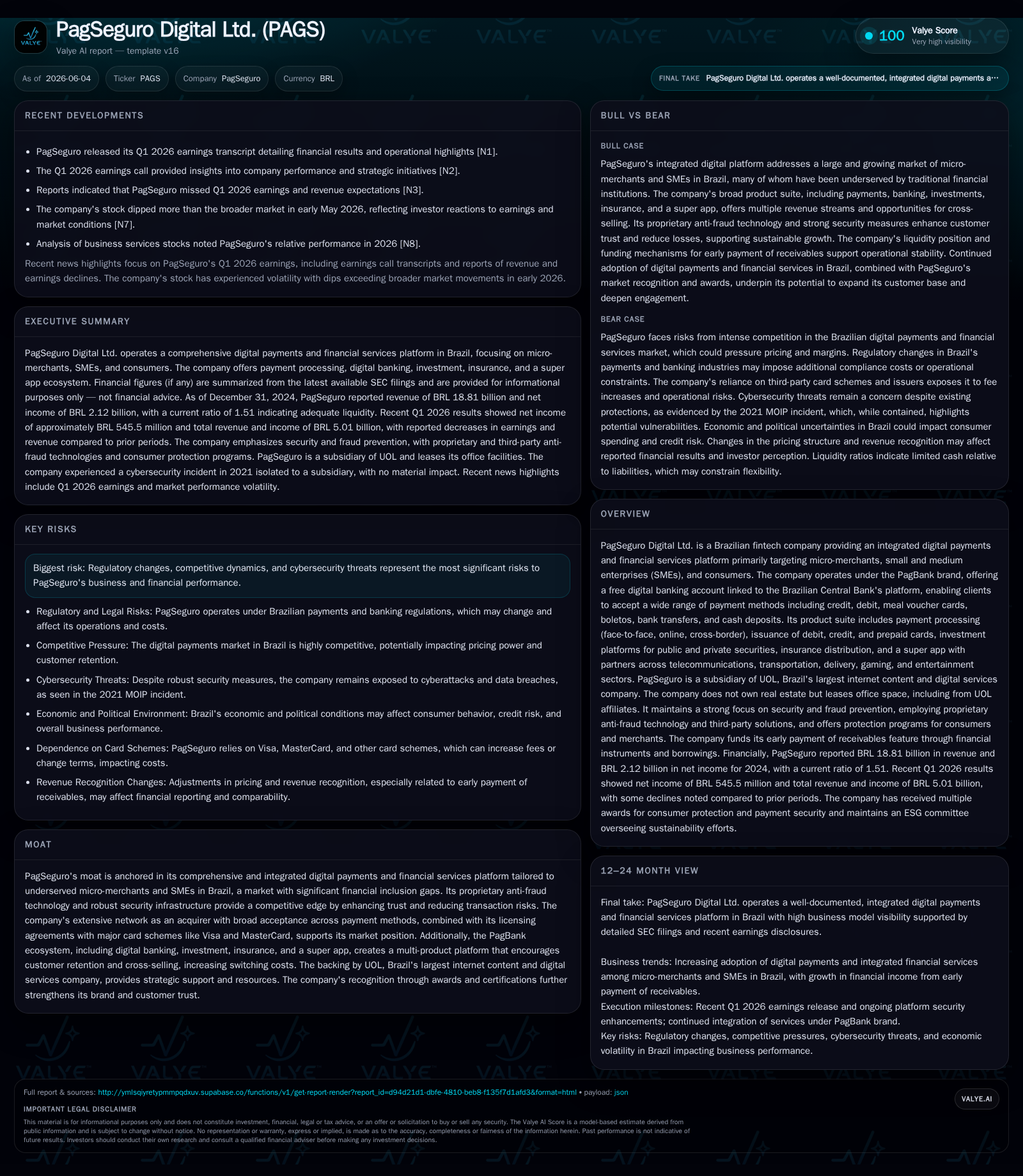
PagSeguro’s Q1 2026 results demonstrate sustained transaction volume growth and expanding client engagement amid strategic investment in credit and platform services.
In its latest quarterly filing dated May 29, 2026, PagSeguro Digital Ltd. reported a 3.2% year-over-year increase in total revenue and income, driven primarily by growth in transaction volumes and early payment of receivables usage among micro and small-to-medium sized enterprises (SMEs). The company’s integrated PagBank ecosystem continues to deepen client relationships through a mobile-first platform offering payments, banking, investment, and insurance products. While macroeconomic conditions presented some margin pressure, the company maintained stable operating leverage and progressed on its strategic credit portfolio expansion. Key risk factors include heightened regulatory scrutiny and evolving cybersecurity threats, but PagSeguro’s proprietary anti-fraud technologies and broad payment acceptance network underpin a robust market position within Brazil’s underpenetrated digital payments space.
Q1 Operating Performance: Evidence from Latest Filing
PagSeguro’s latest quarterly filing dated May 29, 2026 ([S2]) alongside the May 12 detailed financial disclosures ([S3], [S11]) paint a picture of continued momentum in the company’s core digital payments business in Brazil. Reported total revenue for Q1 reached approximately R$5.0 billion, reflecting a modest advance of +3.2% year-over-year despite broader macroeconomic headwinds including elevated interest rates influencing funding costs.
The core driver behind revenue resilience is the growth in Total Payment Volume (TPV), which increased nearly 9.7% quarter-over-quarter to R$142.4 billion as micro-merchants and SMEs deepened their engagement with PagSeguro's point-of-sale (POS) devices and merchant services ecosystem ([S11]). This expansion is complemented by increased utilization of the company’s early payment of receivables feature—an important revenue contributor derived from fees associated with merchants receiving funds ahead of standard settlement cycles ([S1], [S18]).
Non-GAAP profit before tax advanced by approximately +6.8% year-over-year, signaling that operating leverage benefits began offsetting margin pressure stemming primarily from higher funding expenses linked to prevailing Brazilian SELIC rates ([S11]). The operating expense ratio improved marginally despite increases in R&D investments related to technology development and enhancements in data security measures.
PagSeguro’s Integrated Platform and Revenue Model Explained
At its heart, PagSeguro operates an integrated ecosystem melding digital payments with ancillary financial services targeted mainly at Brazil’s underserved micro-merchants and SMEs—a segment historically overlooked by incumbents ([S1],[S18]). Revenue stems predominantly from commissions tied to electronic payment intermediation—fees charged per transaction processed—and from financial income realized via the early payment of receivables facility that helps merchants access working capital rapidly ([S1],[S18]).
PagSeguro possesses proprietary anti-fraud technologies underpinning high transaction approval rates near 79%, aiding merchant confidence while maintaining net chargeback rates at an impressively low 0.03%, down over 20% from the prior year ([S1]). This combination enhances customer retention given the trust customers place in secure processing.
Complementing transactional revenues are services embedded within its PagBank brand including digital bank accounts free of charge, issuance of debit/credit/prepaid cards, investment platforms (public/private market securities), insurance distribution partnerships, and a super app that integrates verticals such as telecommunications and gaming—effectively creating cross-selling synergies that broaden lifetime value per customer ([S18],[N2]).
Digital Payment Landscape in Brazil: Industry Context and Competitive Positioning
PagSeguro operates within Brazil's dynamic fintech environment characterized by structural growth drivers but also evolving competitive pressures. Approximately 56% of household consumption was via credit/debit/prepaid cards in 2025 (ABRCS data), amounting to over R$3 trillion in transaction volume—a figure projected to rise above R$5 trillion during the current year ([S1]).
Despite a relatively high overall financial inclusion rate (~86%), there's systemic under-banking among lower-income populations where PagSeguro has successfully focused its efforts—mirroring broader Latin American fintech trends addressing inclusion gaps ([S18]). Mobile commerce accounted for nearly two-thirds of e-commerce sales in Brazil during 2025 indicating strong consumer acceptance of mobile-first payments—demand PagSeguro leverages through its mobile-optimized solutions ([S1]).
Key competitors include regional players like Mercado Pago and StoneCo; however, PagSeguro distinguishes itself through its combined merchant-focused payment acceptance network augmented by an increasingly comprehensive banking ecosystem (). Its extensive licensing arrangements with major card schemes Visa, Mastercard, Hipercard ensure broad acceptance footprint.
Key Operational Metrics and Business Quality Indicators
Core performance KPIs reported affirm business quality stability:
- Transaction approval rate stable at ~79%, supporting seamless customer experience.
- Net chargeback rate falling by over one-fifth YoY to ~0.03%, underscoring robust fraud detection capabilities.
- Early payment of receivables growing steadily within merchant financing mix benefiting TPV monetization.
- Merchant onboarding trends remain positive driven by product familiarity facilitated via POS device placements.
These operational parameters feed into customer retention dynamics critical for sustaining recurring revenue streams amidst rising competition; the favorable chargeback environment particularly enhances operating margins relative to peers who face higher fraud-related losses ([S1],[N2]).
Growth Catalysts: Merchant Base Expansion & Super App Development
PagSeguro's roadmap emphasizes continued scaling among Brazil's micro-merchant base coupled with deepening service penetration via its multi-product PagBank platform ([N2],[S18]). New customer additions to POS terminals serve as entry points bringing clients into the broader suite of financial services.
Strategically notable is the accelerated expansion of credit offerings targeting SME working capital needs. The company disclosed substantial expansion (+170% YoY) in unsecured loan originations largely comprising payroll-linked products moving progressively from pilot phases into full commercial rollout during Q1-Q2 2026 ([S21]). This aligns closely with global fintech trends where embedded finance ecosystems integrate payments with lending seamlessly.
The super app initiative bundles telecommunications, transportation, delivery services alongside traditional banking functions seeking to foster stickiness through daily-use utilities beyond pure finance—a model mirroring successful Asian counterparts but still emergent locally (,[N2]).
Risks to Consider: Regulation, Competition, and Cybersecurity Threats
While growth fundamentals appear solid, PagSeguro faces several watchpoints:
- Regulatory: Evolving Central Bank policies governing credit provisioning rules, liquidity coverage requirements for fintechs, and dividend taxation affect capital deployment flexibility ([S15],). Potential tightening could influence cost structures or limit certain product expansions.
- Competition: Large Brazilian incumbents alongside nimble fintech startups compete aggressively on pricing commissions as well as on product breadth; sustaining moat requires continuous innovation especially around fraud prevention technology (,[S1]).
- Cybersecurity: Despite advanced anti-fraud measures maintaining market recognition for secure transaction handling, increasing sophistication in cyber threats poses ongoing risks threatening brand trust if breached (,[S1]).
Looking Ahead: Upcoming Milestones and Market Signals
Management forecasts improving macroeconomic conditions driven by expected easing cycles in SELIC interest rates which should mitigate funding cost pressures materially impacting margins thus far ([S11],[N2]). Monitoring upcoming quarterly indicators on merchant acquisition rates for POS devices, credit portfolio seasoning quality metrics particularly on new payroll-backed loans rollout will be critical demand markers.
Further regulatory developments related to liquidity coverage requirements and credit risk mitigation may present both compliance challenges and potential opportunities if navigated prudently [N2][S15]
Financial Summary and Capital Structure Snapshot
Though the bulk of this analysis focuses on operational insights anchored in recent filings,[F1] summary financials provide context: As of December 31, 2024 PagSeguro held cash & equivalents totaling approximately R$928 million with a current ratio near 1.5 indicating healthy short-term liquidity management.[F1] Operating cash flow generation remained resilient boosting capacity for further platform investment while managing borrowings prudently against rising interest rate environments.[S3] Non-GAAP ROAE improved modestly reflecting efficiency gains despite cost headwinds letting management maintain shareholder value focus.[S11] Capital allocation priorities remain oriented toward technology development supporting POS innovation plus measured expansion of credit product suite which bodes well for sustainable growth trajectories.
This analysis reflects information contained within SEC filings up to May 29, 2026 alongside corroborating disclosures from company earnings calls held through May 2026. It does not constitute any form of investment advice or research view but serves as an independent assessment grounded in verified public data resources.
Disclaimer: This is research-only, informational analysis and not investment advice. It may include AI-generated interpretation and general industry context. Always verify important details using primary sources.

Comments