
Palo Alto Networks: Navigating Platformization and AI in a Crowded Cybersecurity Landscape
Palo Alto Networks advances its integrated AI-driven cybersecurity platform amid intensifying competition and strategic acquisitions.
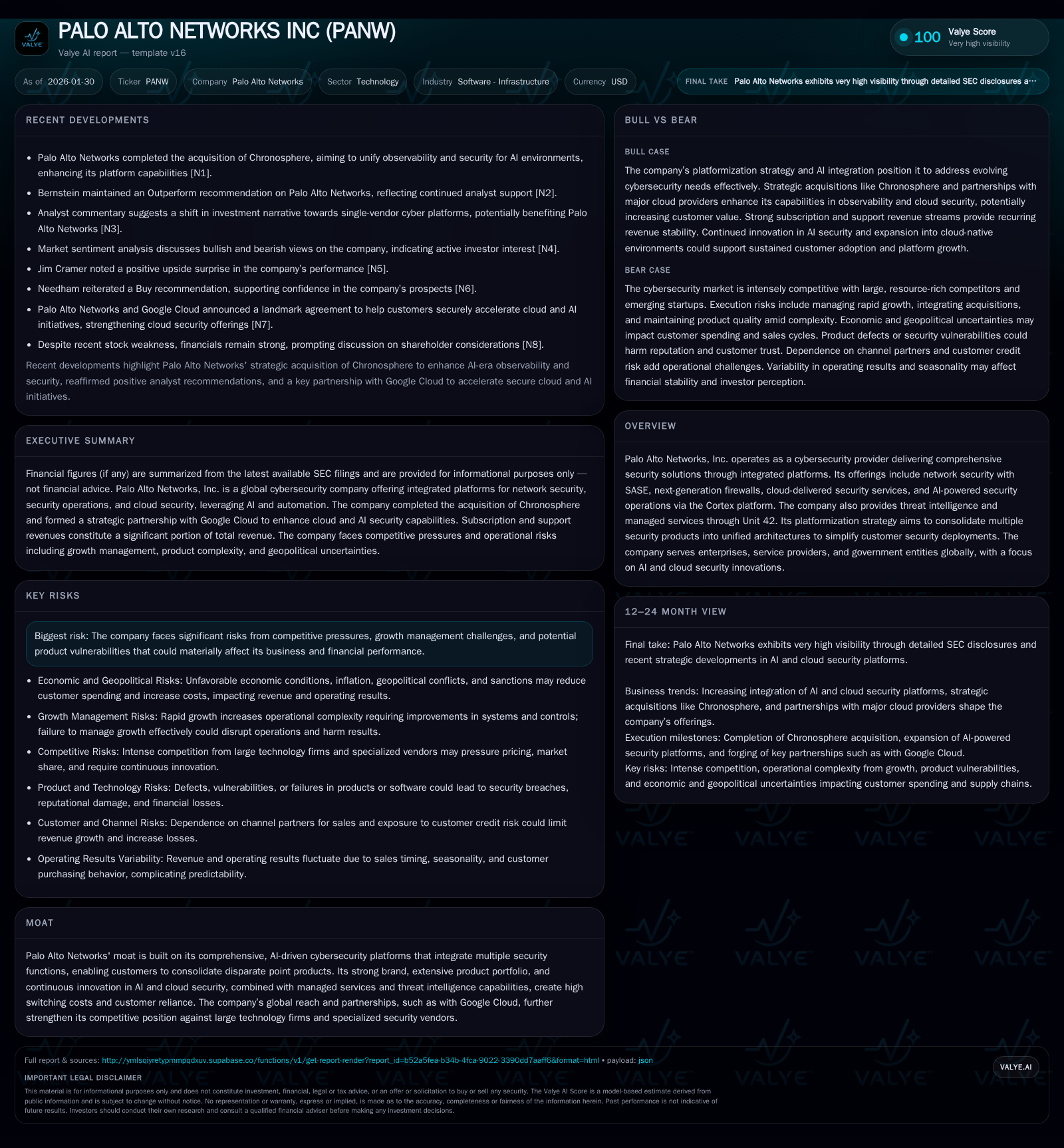
Palo Alto Networks continues to execute on its platformization strategy, integrating recent acquisitions like Chronosphere to unify observability with security for AI-era challenges. The company’s expansive portfolio and partnerships, notably with Google Cloud, position it well in the evolving cybersecurity market dominated by cloud adoption and AI threats. However, risks around competitive pressures, integration costs, and evolving threat landscapes remain significant. Operational execution, customer acquisition, and managing channel dependencies are pivotal as the company scales.
What Changed Recently
In the past 45 days, Palo Alto Networks (PANW) finalized its acquisition of Chronosphere, a move aimed at integrating observability with cybersecurity tailored for AI-era challenges, enhancing its platform capabilities [N1]. This acquisition aligns with the company’s strategic platformization initiative, aiming to unify disparate security functions and monitoring tools under one architecture. Additionally, PANW announced a landmark partnership with Google Cloud to help customers securely accelerate cloud adoption and AI initiatives, reflecting a strategic focus on cloud security and AI-driven solutions [N5].
The deal activity and AI tailwinds prompted Guggenheim to raise its rating on PANW, signaling growing analyst optimism about the company’s competitive positioning amid evolving cybersecurity demands [N2, N3]. Conversely, some market commentary has raised concerns about the costliness of recent acquisitions and the challenges of integrating these new assets effectively [N4]. Analyst sentiment remains generally positive but cautious, emphasizing the complexity of growth management and competitive pressures [N6, N8, N9, N10].
Business Model as a System
Palo Alto Networks operates primarily as a cybersecurity platform provider, delivering a comprehensive suite of products and services that span network security (including next-generation firewalls and SASE), cloud-delivered security, AI-powered security operations via its Cortex platform, threat intelligence, and managed services through its Unit 42 team [overview].
The company’s revenues derive predominantly (over 80%) from subscription and support offerings, reflecting a recurring revenue model that emphasizes customer retention and long-term contracts typically spanning one to five years [S2, S3, S10, S11]. This model requires continuous innovation and high service reliability to maintain renewals, with pricing pressures and mix shifts posing risks to gross margins [S9, S10, S11].
PANW’s go-to-market system relies heavily on channel partners, including distributors and resellers, which together account for the vast majority of sales. However, the concentration of revenue and receivables with a small number of distributors (three distributors representing roughly 40-45% of revenue and receivables) introduces operational risk related to channel performance and alignment [S9, S11, S13]. The company supports these partners with training and incentives but faces competition for channel mindshare from rival vendors [S13].
Product development is central to the business model, with ongoing investments in R&D—particularly in AI—to enhance product capabilities and respond to rapid technological change. However, these investments carry risks related to market acceptance, regulatory compliance, and potential reputational impacts if products fail to perform or suffer vulnerabilities [S5, S15, S17].
Operational challenges include managing software vulnerabilities (e.g., the 2024 GlobalProtect command injection flaw), ensuring interoperability amid complex and heterogeneous customer environments, and mitigating risks from geopolitical cyber threats such as increased Russian cyberattacks [S1, S17, S18]. These factors underscore the importance of robust product quality and rapid incident response in maintaining customer trust.
Industry Map & Competitive Battlefield
The enterprise cybersecurity market is highly competitive and rapidly evolving, with competition coming from four primary categories [S4, S6, S7]:
- Large technology companies such as Cisco, Microsoft, and Alphabet, which integrate security features into broader IT and cloud offerings and have substantial resources to compete aggressively.
- Independent security vendors like Check Point, Fortinet, CrowdStrike, Zscaler, and Wiz, which offer focused security solutions with varying product depth.
- Startups and point-product vendors that provide innovative or niche security tools, often capitalizing on emerging threats or technologies.
- Public cloud vendors and startups specializing in cloud security for private, public, and hybrid environments.
PANW’s moat derives from its AI-driven integrated platform approach, which aims to consolidate multiple security functions—network, cloud, endpoint, and security operations—into a unified architecture that simplifies deployment and management for customers [overview, moat]. This platformization strategy attempts to increase switching costs and customer reliance by providing breadth and depth in security capabilities.
Strategic partnerships, such as the recent Google Cloud alliance, aim to leverage complementary strengths and accelerate adoption in cloud-centric environments [N5]. However, PANW faces challenges from competitors able to bundle security features into larger platforms or offer lower pricing, as well as from entrenched legacy vendors with deep customer relationships [S4, S6].
Where the Economics Become Real
Unit economics for PANW hinge on securing and renewing subscription contracts, managing pricing pressures, and controlling costs associated with sales, R&D, and integration of acquisitions. Subscription and support revenues form the majority of total revenue, underscoring the importance of contract renewals and upsell opportunities [S2, S3, S10].
The company’s channel-heavy sales model creates leverage but also concentration risk: three distributors account for roughly 40-45% of revenue and receivables, meaning any disruption in channel performance could materially impact cash flow and revenue recognition [S9, S11, S13]. Training and incentivizing channel partners is therefore a critical operational focus.
Pricing pressures are an ongoing concern amid intensifying competition and mix shifts toward cloud-based offerings, which may have different margin profiles [S9, S10, S11]. The company anticipates that sales prices and gross profits may decline over product life cycles, necessitating continuous innovation and cost management to sustain profitability.
R&D investments, particularly in AI, are substantial and integral to maintaining competitive differentiation, but their success is uncertain and subject to evolving regulatory and ethical scrutiny [S5, S15, S17]. The company’s ability to anticipate and respond to technological shifts, including cloud adoption and complex network requirements, is a key determinant of long-term economics.
Geopolitical risks and macroeconomic factors, such as inflation, supply chain constraints, and regional conflicts (e.g., Russia-Ukraine war), may cause customers to delay security spending or extend sales cycles, impacting revenue growth and cash flows [S2, S14, S16]. Additionally, cybersecurity threats targeting the company’s customers create ongoing risk exposure and potential liabilities.
Diligence Questions / Disconfirming Signals
How effectively can PANW integrate Chronosphere and other recent acquisitions without diluting management focus or incurring prohibitive costs? What are the milestones and metrics for realizing synergies?
Given the heavy dependence on a limited set of channel partners, what contingencies exist to mitigate distributor concentration risk? How is channel partner loyalty maintained against competitive pressures?
How resilient is the platformization strategy in the face of competitors bundling security features into larger ecosystems or offering single-vendor solutions at aggressive pricing?
What is the incidence rate and impact of software vulnerabilities and outages on customer retention? How robust are remediation and communication protocols to preserve trust?
To what extent do macroeconomic and geopolitical disruptions influence customer purchase cycles, contract renewals, and pricing dynamics in the near- to medium-term?
How is the company navigating evolving AI regulatory, ethical, and IP risks in its product development and deployment?
What are the critical KPIs that reflect AI and cloud security adoption within the installed base, and how do these correlate to renewal rates and upsell potential?
How does PANW address the challenge of interoperability across varied customer environments with multi-vendor legacy infrastructure to minimize deployment friction?
What is the trajectory of R&D spend relative to revenue growth, and how are returns on these investments measured internally?
How significant are risks related to potential litigation, product liability, and regulatory compliance in the cybersecurity domain, considering recent vulnerabilities and geopolitical tensions?
This analysis incorporates public news and company disclosures as of early 2026 and should be considered informational rather than advisory. Forward-looking outcomes are inherently uncertain, and readers should conduct further due diligence aligned with their specific objectives and risk tolerances.
Disclaimer: This is research-only, informational analysis and not investment advice. It may include AI-generated interpretation and general industry context. Always verify important details using primary sources.

Comments