
Palo Alto Networks Advances Integrated AI-Driven Cybersecurity Platforms in Q3 2026
Strong Q3 execution highlights strategic progress in AI-powered platform integration amid competitive and macro challenges.
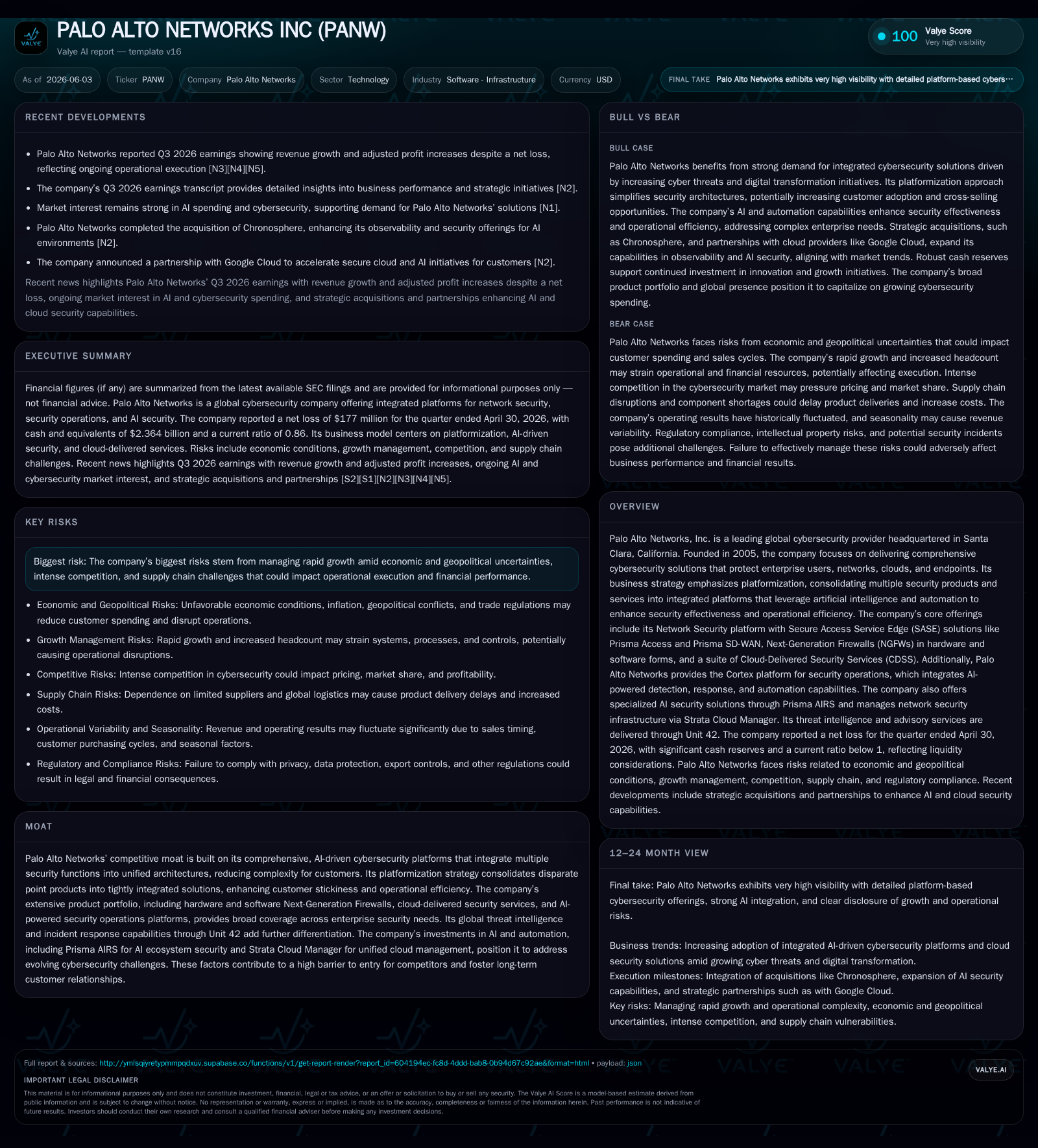
In its Q3 FY2026 10-Q filing, Palo Alto Networks reported robust operational momentum driven by expanding subscription demand and platform consolidation initiatives, notably advancing integration of recent acquisitions like CyberArk. The company's strategic shift to AI-enhanced cybersecurity platforms, including its SASE, NGFW, and Cortex offerings, strengthens customer retention through expanded product bundles and automation capabilities. However, execution risks persist due to competitive pressures from hyperscalers and legacy vendors, supply chain dynamics, and evolving regulatory landscapes surrounding AI security. Liquidity remains solid with over $2.3 billion in cash, supporting continued investment in growth and innovation.
Q3 Operating Performance Spotlight
Palo Alto Networks’ latest 10-Q for Q3 FY2026 dated June 3 confirms continued traction in its recurring revenue base anchored on subscription expansion within integrated platforms [S2], [S3]. Although the filing does not disclose explicit quarterly revenue numbers, external reports highlight that Palo Alto beat revenue estimates driven by strong demand for bundled solutions that combine hardware Next-Generation Firewalls (NGFWs), SaaS-delivered Secure Access Service Edge (SASE) components—Prisma Access and Prisma SD-WAN—as well as Cloud-Delivered Security Services (CDSS) [N4], [N5]. The company has intensified efforts around AI-enabled operations particularly through Cortex platform enhancements and growing adoption of Prisma AIRS for securing AI ecosystems. These developments propel durable growth via upselling across existing enterprise accounts and seat expansion in multi-product contracts.
Seasonality remains a factor that contributes to quarter-to-quarter variability; however, Palo Alto’s diversified product mix which includes software subscriptions alongside hardware appliances aids in smoothing revenue streams over time [S2]. Channel partners continue to be a critical distribution node, with company disclosures emphasizing their role in new customer acquisition and renewals despite inherent risks related to performance variability within the indirect sales model [S2], [S21].
Platform-Centric Business Model Driving Growth
Palo Alto Networks has positioned itself as a platform-centric cybersecurity vendor integrating multiple defensive layers into unified architectures backed by artificial intelligence (AI) and extensive automation capabilities [S1], [S20]. At the core lies its network security platform encompassing ML-powered NGFWs securing on-premises environments and software NGFWs protecting cloud workloads. Complementing this is an expanding SASE stack combining Prisma Access with SD-WAN functionality that delivers end-to-end zero trust access to hybrid workforces.
The company’s suite of Cloud-Delivered Security Services (CDSS)—from Advanced Threat Prevention to Enterprise Data Loss Prevention—add modular flexibility enabling customers to tailor coverage while benefiting from centralized management through Strata Cloud Manager (SCM) [S1]. SCM leverages AI-based analytics to proactively identify vulnerabilities and recommend real-time remediation actions, reducing operational burden on security teams
The recent acquisition of CyberArk signals a deliberate extension into identity security, enriching Palo Alto’s platform with privileged access management capabilities crucial for securing increasingly complex digital environments [S4]. This move aligns with the firm's strategic aim to consolidate disparate point solutions into cohesive platforms enhancing switching costs and deepening customer relationships.
Competitive Positioning and Industry Dynamics
Palo Alto Networks competes in a dynamic cybersecurity market characterized by rapid technology evolution, intensifying competition from cloud hyperscalers like Microsoft and Alphabet who leverage scale and R&D firepower to encroach on enterprise security domains [S6], [S13]. Specialty cybersecurity firms such as CrowdStrike and Okta have carved niches around endpoint protection and identity governance respectively, pushing incumbents like Palo Alto to accelerate innovation particularly in AI integration.
Legacy firewall manufacturers face pressure as enterprises seek more comprehensive cloud-native security solutions; here Palo Alto's broad portfolio offers an advantage by delivering end-to-end protection including network, cloud workloads, endpoints, and identity vectors through integrated offerings. Nevertheless, price competition persists due to vendor consolidation trends where clients prefer single-vendor suites especially amid tighter budget constraints [S5], [S13]. Emerging entrants focusing on observability or niche threat detection add layers of competitive complexity requiring constant technological vigilance.
Synergies and Challenges from Recent Acquisitions
Integration efforts following the CyberArk acquisition present significant growth opportunities but also pose short-term execution challenges [S4]. CyberArk brings privileged access management depth which is complementary yet distinct from Palo Alto’s existing network-focused solutions. Effective assimilation demands aligning sales strategies, harmonizing platforms, system integration, retaining key talent from acquired firms, and managing overlapping product roadmaps.
Chronosphere acquisition likewise adds observability capabilities aimed at enhancing threat detection efficiency across distributed environments. While these moves diversify the portfolio and reinforce client value propositions through cross-selling synergies, there is risk around operational disruptions diverting management focus or delays in realizing projected financial benefits. The company acknowledges possibility of goodwill impairments or contingent liabilities from acquisition-related adjustments emphasizing cautious outlook during integration phases [S4], [S8].
Growth Catalysts: AI Integration and Customer Expansion
AI represents a pivotal growth accelerator for Palo Alto Networks. The deployment of Prisma AIRS introduces comprehensive protection for customers’ AI infrastructures encompassing model scanning, posture management, run-time defense against adversarial threats, and agent-level security ensuring holistic defenses in an AI-powered future, [S1]. Additionally, Strata Cloud Manager with AI-co-pilot functionalities streamlines network security operations by enabling predictive vulnerability identification enhancing speed-to-remedy.
This AI infusion deepens value for existing customers facilitating net retention improvements through greater usage intensity of advanced modules combined with seat expansions across multi-product contracts. New customer segments valuing proactive AI-driven threat frameworks are anticipated to expand addressable markets in cloud-native sectors.
Risk Factors and Execution Watchpoints
Palo Alto faces multiple risks highlighted explicitly in the latest filings: macroeconomic volatility could dampen IT budgets affecting sales cycles; channel partner reliability remains a dependency risk; supply chain uncertainties could impact hardware shipments; pricing pressures from intensified competition threaten margins; regulatory developments around AI usage entail compliance costs; acquisition integration may disrupt ongoing operations or delay synergy realization; cybersecurity incidents targeting the company itself pose reputational damage threats [S2], [S4], [S15], [S16].
Human capital retention is critical given rapid headcount increases—including significant increases post-CyberArk buyout—and technical specialization requirements necessary to maintain innovation velocity without quality compromise [S26]. Market perceptions regarding AI’s impact on cybersecurity incumbents versus new entrants create additional volatility unrelated directly to fundamentals but influential on investor sentiments [S16].
Forward-Looking Indicators to Monitor
Investors should track indicators signaling execution momentum including quarterly net new Annual Recurring Revenue (ARR) gains especially from multi-product bundles reflecting platform adoption depth; renewal rates particularly on CyberArk-enabled identity solutions showing cross-sell effectiveness; announcements regarding enhanced Cortex AI pipelines or expanded Strata Cloud Manager deployments indicating continuous innovation; progress updates on seamless integration timelines for recent acquisitions mitigating disruption concerns [N2], [N4], [S3]. Channel partner productivity metrics will also be instructive given their material sales contribution.
Financial Health Overview
As of April 30, 2026, Palo Alto Networks holds approximately $2.36 billion in cash and equivalents against total debt estimated near $2.0 billion based on best available data from mid-2023 filings resulting in a modest net cash position of roughly $365 million [F1]. The company's current ratio stands at 0.86 reflecting current liabilities exceeding current assets moderately—a common condition for fast-growing software-oriented firms investing heavily in R&D and sales headcount expansion concurrently with deferred revenues typical in subscriptions accounting.[F1]
Profitability progresses without explicit quarterly income figures available here but adjusted profit improvement was noted externally suggesting operational leverage starting to materialize despite ongoing investments driving elevated headcount primarily due to acquisition-related increments totaling over 4,000 since prior fiscal year-end [N5], [S26]. Liquidity resources appear sufficient to support ongoing growth initiatives even amid moderate short-term working capital pressures.
This analysis utilizes information extracted directly from SEC filings as well as corroborating industry news sources as cited. It aims exclusively at providing an informed perspective on Palo Alto Networks' latest operating environment without issuing investment research views or price guidance.
Disclaimer: This is research-only, informational analysis and not investment advice. It may include AI-generated interpretation and general industry context. Always verify important details using primary sources.

Comments