
UiPath’s Solid Profits and Liquidity Carve a Niche in AI Automation Evolution
UiPath achieves profitability and maintains strong liquidity while pioneering agentic AI orchestration within its platform.
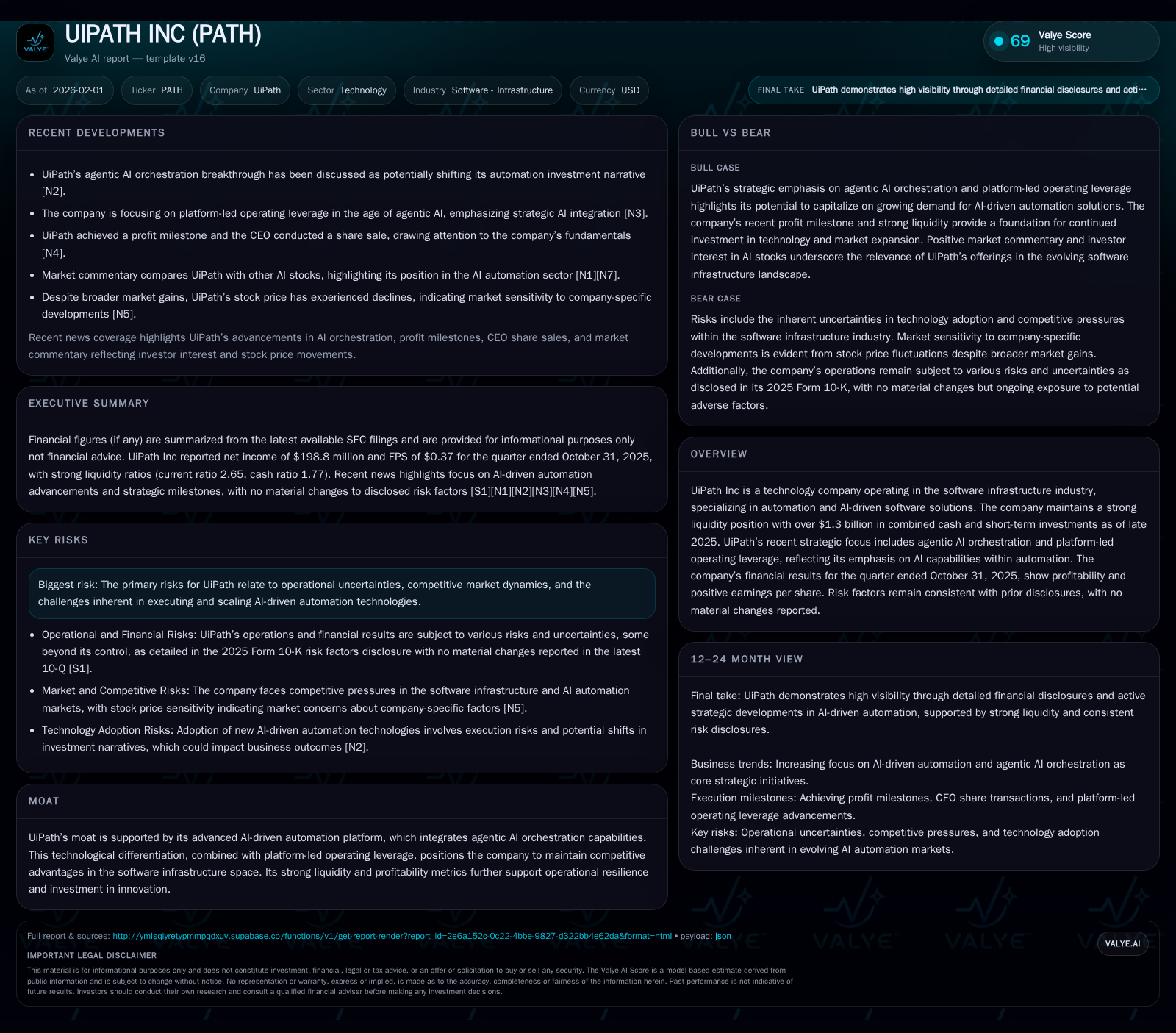
Despite notable stock volatility and insider share sales grabbing headlines, UiPath's robust Q3 2025 net income of nearly $199 million signals a crucial profitability turning point. The company’s deepening integration of agentic AI orchestration distinguishes its automation platform from peers, underpinning a growing technological moat. Coupled with a platform-led operating leverage model and a $1.3 billion-plus liquidity cushion, UiPath is positioned for resilient innovation and measured growth amid competitive pressures.
Profitability Milestone: Turning the Corner on Sustainable Earnings
UiPath's financial evolution reached a defining moment in the quarter ended October 31, 2025, when the company reported net income of approximately $198.8 million [F1]. This milestone breaks away from prior periods marked by losses and underscores a tangible shift toward sustainable earnings. It is tempting to view profitability as merely a checkbox but here it signals something deeper: operational discipline meeting accelerating revenue quality. Market coverage at the time spotlighted this inflection amid skepticism over AI automation hype cycles [N4]. Could this be the moment where UiPath turns from an aspirational disruptor into a durable software infrastructure player? The data suggests so.
Agentic AI Orchestration: Defining UiPath’s Technological Moat
At the core of UiPath’s rising competitive moat lies its aggressive embrace of agentic AI orchestration—an innovation that blends autonomous decision-making AI agents with automation workflows to deliver seamless outcomes [valye_report_excerpt][N6]. Unlike conventional RPA tools that automate repetitive tasks in isolation, agentic AI enables adaptive and proactive orchestration across complex environments. Industry discourse highlights this as a transformational narrative that shifts customer value beyond incremental efficiency toward strategic business enablement [N12][N5]. The ability to weave autonomous intelligence into platform fabric not only raises switching costs but fuels superior operating leverage.
Platform-Led Growth: The Operating Leverage Advantage
Strategically, UiPath has doubled down on a platform-led model intending to drive margin expansion through scalable software economics [valye_report_excerpt][N5]. By layering broad capabilities atop core automation pillars, it creates network effects where acquisitions and new modules add incremental revenue at relatively fixed costs. Analysts have noted this structural shift as a cornerstone behind improving free cash flow generation and operating margin headlines [N12]. In an industry where SaaS models traditionally excel in structural scalability, UiPath’s approach appears well-aligned with long-term sustainable unit economics rather than purely growth-centric metrics.
Liquidity Snapshot: Financial Strength for Innovation and Expansion
Liquidity matters profoundly for any technology player maneuvering through rapid innovation cycles. As of late 2025, UiPath boasts approximately $743.7 million in cash and equivalents alongside over $2 billion in current assets against roughly $789 million in current liabilities—yielding a current ratio near 2.65 [F1]. Such balance sheet strength affords ample runway to fund research & development initiatives critical for advancing agentic AI capabilities while exploring strategic M&A moves if attractive opportunities arise [valye_report_excerpt]. This financial buffer effectively insulates the company from short-term market volatility impacts.
Market Sentiment and Stock Dynamics: Dissecting Recent Volatility
January 2026 brought a jarring 23% drop in UiPath’s share price despite evident fundamental progress [N13]. Investors confronted several headwinds simultaneously: broader tech sector sell-offs stoked risk-off moods; CEO stock sales stirred questions about insider confidence; and shifting macroeconomic narratives fueled short-term sentiment swings [N4][N7]. Yet when scheduled earnings beat expectations and fundamental metrics improved meaningfully, the dislocation invites reflection—does market noise potentially obscure longer-term value? This divergence between price action and operational data typifies complex public equity puzzles often requiring patient analytical scrutiny.
Leadership Moves: Interpreting the CEO’s Share Sale
In concert with quarterly results, news surfaced that UiPath’s CEO sold approximately $2 million worth of shares [N4]. Insider transactions inevitably trigger interpretive friction points—are these routine liquidity diversifications or signals of concern? Context matters enormously: within a company freshly reporting profitability running strong cash balances and articulated growth strategies, such transactions can reflect personal portfolio rebalancing rather than waning conviction. Indeed, some market commentators frame it as noise against otherwise resilient organizational execution [N7]. The leadership narrative thus remains nuanced rather than starkly binary.
Comparative Edge: UiPath Among AI Automation Peers
When set beside contemporaries like Appian (APP) or other emerging agentic AI purveyors, UiPath exhibits distinct strengths—scale maturity paired with cutting-edge technology integration positions it uniquely in what some analysts call an "under-the-radar" leader cohort within the explosive AI automation domain [N1][N3]. While APP benefits from recognized legacy SaaS footholds, UiPath’s vision penetrates deeper into autonomous orchestration architectures driving differentiated value propositions amid accelerating enterprise adoption curves [N9][N10]. Such positioning could fortify moat durability even as competition intensifies.
Risk Landscape: Enduring Factors and Emerging Uncertainties
Per recent SEC disclosures, risk factors remain largely unchanged relative to prior filings—with an emphasis on operational execution risks inherent in traversing fast-evolving AI landscapes alongside competitive dynamics [S2][valye_report_excerpt]. Notably absent are signs of new material risks; however, inherent uncertainties persist around scaling agentic AI workflows safely and adopting new tech amidst shifting client demands. These variables counsel ongoing vigilance alongside measured optimism.
Investment Viewpoint: Balancing Opportunity with Caution
UiPath today lives at the confluence of strong financial footing, technological advancement via agentic AI orchestration, and notable stock-market volatility. For buy-side analysts seeking to piece together an informed perspective beyond headline swings, the picture is compelling yet incomplete. Sustained profitability indicates operational credibility; platform-led growth models promise margin resilience; healthy liquidity supports innovation investments. Yet concentrated execution risks amid competitive pressures remain undeniable realities.
Navigating this landscape demands careful calibration—acknowledging the bright prospects afforded by leading-edge software infrastructure innovation while calibrating expectations for inevitable challenges ahead. UiPath exemplifies both the promise and complexity inherent in the modern AI-driven automation revolution —a story still unfolding amid noisy markets.
This report is intended solely for informational purposes; it does not constitute investment advice or recommendations.
Disclaimer: This is research-only, informational analysis and not investment advice. It may include AI-generated interpretation and general industry context. Always verify important details using primary sources.

Comments