
UiPath Inc Drives 13% Revenue Growth Amid Expanding Automation Demand
UiPath's latest quarter reveals sustained ARR expansion and stable margins, underscoring growing enterprise adoption of its AI-powered automation platform.
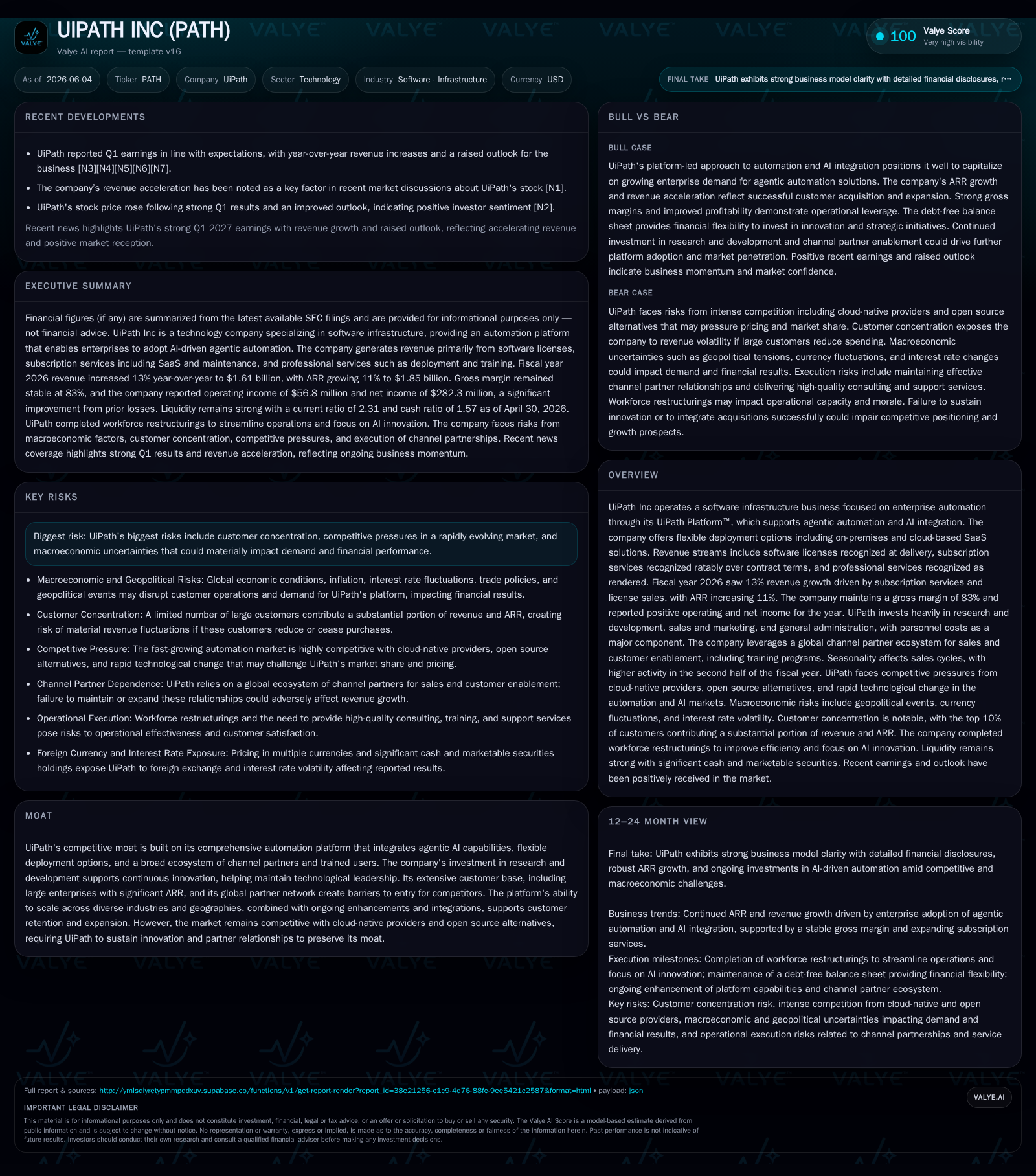
In the first quarter of fiscal 2027, UiPath Inc reported 13% year-over-year revenue growth and an 11% increase in annual recurring revenue (ARR), reflecting strong demand for its agentic automation platform. The company maintains a robust gross margin profile at 83%, driven by its subscription services and license sales mix, supported by a global partner ecosystem. While competitive pressures from cloud-native providers and open-source alternatives persist, UiPath’s strategic investments in R&D and flexible deployment options reinforce its market position. Key watchpoints include continued growth in SaaS adoption, partner expansion, and management execution amid evolving macroeconomic headwinds.
Q1 Fiscal Year 2027 Operating Update Highlights
UiPath’s latest quarterly report filed on June 4, 2026 ([S2]) confirms a continuation of strong top-line momentum characteristic of fiscal year 2026. Revenue advanced by 13% year-over-year aided by robust subscription services growth as well as incremental license sales. Annual Recurring Revenue (ARR), the critical SaaS business indicator denoting committed recurring revenue from subscription licenses and maintenance contracts, expanded by 11% to approximately $1.85 billion ([S1], [S2]). Gross margins remained resilient at a consistent 83%, balancing the cost pressures from increased SaaS hosting alongside a favorable shift toward subscription revenue which generally supports higher lifetime value ([S20]). Notably, while the firm delivered positive operating income for the full fiscal year ending January 2026 ([F1]), operational discipline is evident with recent workforce restructurings aimed at sharpening go-to-market efficiency and prioritizing AI-driven research investments ([S23], [S1]).
Enterprise Automation Platform: Offering and Customer Value Drivers
UiPath monetizes through three principal revenue streams: software licenses—typically term licenses recognized upon delivery; subscription services leveraging its cloud-based SaaS offerings recognized ratably over contract periods; and professional services recognized when rendered ([S1]). This recurring revenue model anchors ARR growth since subscriptions form an increasing portion of total revenue. The UiPath Platform™ itself is designed for enterprise-scale agentic automation integrating AI capabilities with human-in-the-loop controls, enabling developers flexibility while promoting secure deployment within complex IT environments ([S1]). Crucially, UiPath’s platform supports both on-premises deployments favored by some enterprises for control reasons and cloud SaaS options that facilitate faster scaling—a duality creating competitive differentiation among pure play SaaS competitors ([S1]).
The company’s ability to drive adoption relies significantly on its extensive global partner ecosystem comprising channel partners who resell and implement its solutions alongside an active user community fostering broad automation use cases. These elements help reduce sales cycle friction, increase customer stickiness via integration depth, and mitigate switching risks ([S1]). Subscription revenue growth outpaces license sales growth reflecting structural shifts towards consumption-based delivery models common in enterprise software today.
Competitive Environment and Industry Structure Analysis
Within the software infrastructure industry focused on automation platforms, UiPath competes against various cloud-native pure SaaS providers as well as open-source automation tool vendors that offer compelling cost propositions but differ in ecosystem breadth and enterprise readiness. The company’s moat stems from its AI-infused intelligent automation framework that balances developer flexibility with governance controls—an essential feature for regulated industries where compliance is critical ([S1]). Additionally, UiPath’s massive R&D spend ensures ongoing innovation cycles necessary to maintain leadership amid rapid technological advancements accelerating AI integration across enterprise workflows ([N4], [S11]).
Pricing power remains moderate as customers negotiate based on platform capabilities versus emerging open-source options; however, UiPath leverages contractual multi-year terms to secure predictable revenue streams. Cloud capacity commitments introduce fixed cost layers that require efficient utilization to avoid margin compression—a known structural challenge in hybrid deployment models ([S1]). Channel partner penetration acts as a key competitive lever to broaden geographic reach without proportionally increasing direct selling expenses.
Evolving Growth Drivers Amid Market Opportunities
Key vectors propelling UiPath’s growth include accelerating enterprise digital transformation initiatives prioritizing automation that augments human productivity—key amid escalating labor cost pressures globally ([N3], [S1]). The company’s strategic focus on embedding agentic AI functionalities enhances platform value by automating more complex cognitive tasks beyond repetitive rule-based processes.
As enterprises transition workloads to cloud architectures, UiPath benefits from rising SaaS adoption trends outpacing traditional perpetual license sales—a shift powering ARR gains. Expansion of channel partnerships continues to drive new customer acquisition especially in international markets where local reseller relationships matter ([N2]). Sales productivity improvements deriving from prior workforce restructurings are expected to amplify returns on go-to-market investments over time.
Moreover, ongoing enhancements like low-code development environments attract citizen developers broadening user base while deeper product integrations promote account expansions. Internationalization efforts further diversify revenue geographies lending resilience against localized economic shocks.
Key Risks and Constraints to Monitor
Despite promising traction, several risks loom. The industry’s fragmentation with increasing entrants offering open-source or specialized AI-enabled workflow tools could erode market share or compress margins ([S1]). Moreover, customer concentration risk is material given reliance on large enterprises whose IT budgets may contract amid macroeconomic volatility including inflationary pressures or geopolitical uncertainties impacting procurement cycles ([S2], [S24]).
Fixed commitments to third-party cloud providers elevate operational leverage risk if usage does not keep pace with capacity payments—potentially pressuring profitability amid slower-than-expected growth ([S1]). Execution risks around timely innovation leadership must be managed carefully as falling behind could weaken long-term competitive positioning given rapid technology shifts in AI-enhanced automation.
Lastly, regulatory compliance demands especially in government or highly regulated sectors add complexity to sales cycles and product development requirements potentially limiting addressable markets or increasing costs ([S22]). Insider stock sales under Rule 10b5-1 trading plans highlight liquidity strategies but may influence short-term market perceptions ([S3]).
Looking Ahead: What to Watch for in Next Quarters
Investors should closely track UiPath’s renewal rates within ARR segments as indicators of customer retention quality amid intensifying competition ([N6], [N7]). Shifts in contract composition favoring longer-term SaaS deals versus shorter licenses will signal durable recurring revenue foundations.
Expansion of the channel ecosystem particularly in emerging markets will be a bellwether of global penetration success. Management commentary during earnings calls about AI roadmap progressions or new product launches integrating generative AI techniques may reveal catalysts for accelerating adoption.
Operational metrics related to sales productivity enhancements post-restructuring will be critical to assess if prior organizational changes yield efficient revenue growth. Potential margin pressure from rising cloud service expenses should be monitored for signs of sustained profitability trends.
Any adjustments to guidance provided in upcoming earnings releases would also warrant attention given prevailing macroeconomic uncertainties impacting enterprise IT spend patterns.
Concise Financial Summary
UiPath remains financially well-positioned with $632 million in cash and cash equivalents backed by a healthy current ratio of approximately 2.31 indicating solid short-term liquidity support as of April 30, 2026 ([F1]). The company reported operating income for fiscal year 2026 signaling progress toward sustainable profitability while maintaining gross margins near 83%, demonstrating effective cost management amidst transitioning business mix toward SaaS subscriptions ([F1], [S2], [S20]). This financial stability enables continued investment in R&D focusing on AI-enabled automation capabilities alongside go-to-market initiatives critical for driving future growth trajectories.
This analysis relies exclusively on publicly available SEC filings and contemporaneous news sources as cited within the text. It does not constitute investment advice or research views.
Disclaimer: This is research-only, informational analysis and not investment advice. It may include AI-generated interpretation and general industry context. Always verify important details using primary sources.

Comments