
Public Company Management Corp's Strategic Pivot Amid Shell Status and Healthcare Real Estate Talks
PCMC transitions from management consulting shell to exploring healthcare real estate acquisition under challenging financial and regulatory conditions.
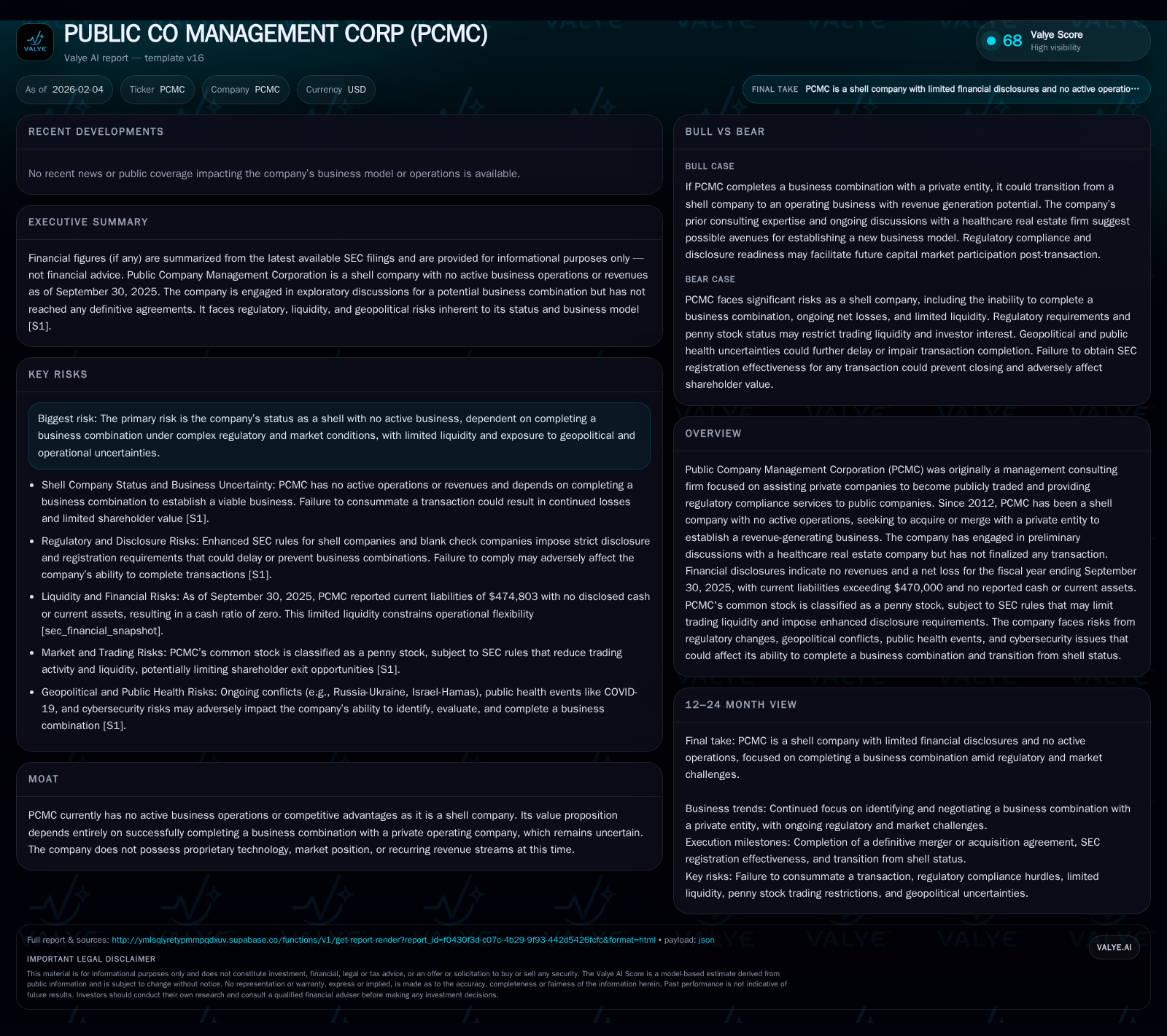
Public Co Management Corp (PCMC) has journeyed from a niche management consultancy focused on aiding private companies into public markets to a dormant shell company with no active revenues since 2012. Currently engaged in exploratory negotiations with a healthcare real estate firm, PCMC aims to secure a business combination that could revive its operations. However, the company’s precarious financial footing, lack of current assets, and penny stock classification amplify risks inherent in completing such a transformative deal. Navigating regulatory demands and market uncertainties will be critical if PCMC hopes to materialize tangible shareholder value from this pivot.
From Management Consulting Pioneer to Dormant Shell: PCMC’s Historical Arc
Public Company Management Corporation was originally incorporated in 2000 as MyOffiz, Inc., eventually rebranding to its current name in 2004. It positioned itself as a specialist management consulting firm aimed primarily at assisting private companies seeking access to capital markets through going public — offering educational products, startup consulting, compliance services, and regulatory assistance. These services were often executed via subsidiaries such as GoPublicToday.com and Pubco WhitePapers. The company generated revenue largely from fees paid by clients seeking guidance on capital market participation.[S1]
However, the firm's trajectory took a stark turn following the global economic recession beginning in 2008. Triggered by the subprime mortgage crisis and subsequent housing bust, the downturn precipitated severe capital market contraction. This macroeconomic shock severely constrained access to capital for businesses and intensified competition within the consulting industry itself. As one of many firms in a crowded space encompassing investment banks, venture capitalists, financial advisors, and compliance consultants, PCMC struggled to sustain profitability during this period.[S1]
Faced with dwindling client demand amid these adverse conditions, PCMC ceased active operations by late 2012 and effectively transitioned into a 'shell' company — retaining corporate structure but lacking ongoing business activity or revenue streams.[S1] Since then, it has sought opportunities to acquire or merge with an operating entity that could provide a new source of earnings.
A Blank Slate: Financial Realities of Operating Without Operations
The starkness of PCMC’s inactive status is captured unambiguously in its recent financial disclosures for the fiscal year ending September 30, 2025. The company reported zero revenues alongside a net loss approaching $104,000.[F1][S1] This figure reflects operating costs without offsetting income — a common characteristic among shell entities holding only administrative overhead.
Liabilities further underscore this fragile footing: current liabilities total approximately $475,000 with no reported current assets or cash reserves.[F1][S1] This imbalance points to an urgent need for capital infusion or transformational transactions just to maintain solvency short term. The absence of liquid assets impairs day-to-day operations if any were to resume without substantial external support.
Collectively, these metrics confirm PCMC’s present status as an empty corporate shell devoid of business activities — existing solely as a legal entity poised for strategic repositioning through acquisition or merger.
Targeting Healthcare Real Estate: Decoding PCMC’s Strategic Pivot
In an important narrative development reflecting an evolving strategic vision, PCMC has engaged in preliminary discussions regarding a potential business combination transaction with Physicians Capital Management Corporation (PCMC), based in Maryland.[S1] Physicians Capital specializes in acquiring and developing healthcare facilities leased long-term under net lease arrangements that transfer many operational costs to tenants.
This marked departure from PCMC’s former consulting focus reflects an explicit intention to enter the real estate investment sector centered around healthcare properties — an asset class often characterized by steady occupancy rates due to persistent demand for medical infrastructure.[S1] Should this transaction complete successfully, it would provide PCMC access not just to property ownership but ongoing revenue through lease payments tied to healthcare operators.
These conversations remain exploratory without definitive agreements reached as due diligence and regulatory reviews proceed. Notably, the inclusion of Specialty Capital Lenders LLC indicates involvement of finance specialists addressing funding structures potentially required for the deal.[S1]
This pivot represents both opportunity and uncertainty: while healthcare real estate can offer stable long-term cash flows supportive of valuation growth, integration challenges are nontrivial given PCMC’s lack of relevant operational experience.
Risk Amplified: Regulatory, Market, and Industry Challenges Ahead
Operating as a dormant shell company imposes extensive hurdles beyond mere financial scarcity. The company faces complex SEC regulations governing shells—especially given its penny stock classification—which restrict trading liquidity and enhance disclosure obligations aimed at protecting investors but making capital raising more complicated.[S1]
Moreover, industry-specific risks abound when targeting healthcare real estate portfolios. These include sensitivity to changing healthcare regulations, tenant credit quality variations affecting lease performance, interest rate fluctuations impacting financing costs, and broader macroeconomic headwinds influencing commercial property markets.[S1][S2]
Further complicating matters is the uncertainty around identifying a final target business aligned with investor expectations. As PCMC acknowledges in its filings:[S1] “there is no assurance that a transaction will be completed,” underscoring inherent execution risks unrelated solely to market conditions but linked also to due diligence findings or regulatory approvals.
Collectively these factors create an environment where achieving transformation is fraught with potential pitfalls complicating what might otherwise appear as straightforward asset acquisition.
Navigating Uncertainty: The Importance—and Perils—of Business Combinations
For PCMC to move beyond its shell status conclusively hinges upon successfully executing either an acquisition or merger that introduces operating revenues. Yet business combinations involving small cap shells are notoriously complex transactions layered with unknowns—from negotiating acceptable terms amidst competing bidders to satisfying investor scrutiny over valuation fairness.
Current disclosures provide little certainty about timing or scope beyond noting exploratory talks with Physicians Capital Management Corporation and associated financiers like Specialty Capital Lenders LLC.[S1][S2] The absence of definitive agreements places PCMC's future at mercy of protracted negotiations that may be disrupted by shifts in market sentiment or newly uncovered risks during due diligence.
Should this process culminate favorably, it could unlock latent value derived from acquiring cash-generative assets otherwise inaccessible at PCMC’s scale alone. Conversely, failure could entrench continued dormancy—potentially eroding shareholder equity further—or precipitate forced liquidation if liabilities outstrip available resources.
Investors aware of frequent volatility around shells’ merger gambits must balance hopefulness about upside possibilities against acknowledging failure probabilities intrinsic in such speculative ventures.[S1]
What Financial Data Reveals About PCMC's Current Health
Quantitative analysis solidifies concerns raised qualitatively about PCMC’s predicament. Negative net income alongside sizable current liabilities well exceeding any liquid asset position signals imbalance fundamentally undermining operational viability absent significant capital injection or transactional success.[F1][S1]
Specifically reported figures show net loss near $104K (ending Sept 30, 2025) counterpointed by $474k+ current liabilities comprising unpaid obligations likely linked to administrative upkeep expenses.[F1] Not reporting any current assets or cash reserves emphasizes an absence of short-term buffers typically needed for routine disbursements or bridging funding gaps.
Such parameters emphasize why pursuing business combinations swiftly is not merely strategic but existential — timing pressures compound risk dimensions considerably when working capital is effectively zero.
The Penny Stock Paradox: Trading Limitations and Investor Considerations
Classified as a "penny stock," PCMC shares fall under SEC regulations designed explicitly to curb abusive trading practices prevalent among low-priced securities. Enhanced disclosure requirements necessitate comprehensive publicly-available information but complicate trade execution through limited broker-dealer willingness to facilitate transactions freely.[S1]
Liquidity constraints thus arise naturally; volumes tend toward thinness making entry or exit expensive relative to underlying share price values — thereby heightening volatility even if substantive news emerges positively supporting eventual turnaround prospects.
For investors weighing exposure here, awareness that standard market-making mechanisms may face impediments is critical. This condition amplifies risk while demanding patience applied through monitoring ongoing corporate developments meticulously rather than assuming tradeability comparable with larger stocks.[S1]
Contextualizing PCMC’s Position in the Broader Small Cap Landscape
Shell companies within small cap universes represent a distinct investment niche marked by elevated uncertainty balanced against potential step-change gains upon consummation of mergers introducing sustainable operations. Many such entities face protracted intervals struggling between identification of suitable targets and navigating regulatory complexities typical within U.S. securities law enforcement frameworks.
While not unique individually,[S1][S2] they collectively contribute sizeable turnover within OTC markets where speculative sentiment gravitates toward stories promising revival through acquisitions—especially where targeted sectors like healthcare real estate deliver perceived recession resilience.
PCMC evidently exemplifies typical dynamics: starting strong historically but succumbing under external pressures prior to repurposing itself toward promising yet unproven domains pending successful transaction closure.
Investor Takeaways: Patience, Caution, and Opportunities for PCMC
For stakeholders observing Public Company Management Corporation at this juncture: caution remains advised given substantial downside risks tied directly to lack of operational revenue coupled with pronounced balance sheet weaknesses.[F1][S1]
However keen attention is warranted around emerging newsflow relating to progress in negotiations with Physicians Capital Management Corporation and affiliated lenders indicating possible strategic realization routes ahead. Signposts will include formal announcements regarding definitive agreements or capital raises necessary to sustain post-transaction activity levels.
Forward-looking statements embedded throughout filings serve both as reminders that projections are inherently uncertain[S1][S2] while underscoring management’s intent framework potentially opening pathways toward renewed viability conditional upon successful complex deal-making amidst challenging environments.
Consequently evaluating PCMC demands balancing skepticism over historical erosion against measured openness toward transformative change contingent on future corporate actions producing verifiable operational metrics rather than prior conceptual aspirations alone.
Disclaimer: This is research-only, informational analysis and not investment advice. It may include AI-generated interpretation and general industry context. Always verify important details using primary sources.

Comments