
Peoples Bancorp’s Earnings Ebb and Capital Strategy in a Challenging Rate Environment
Examining Peoples Bancorp's recent financial performance, interest rate risk management, regional franchise, and shareholder returns.
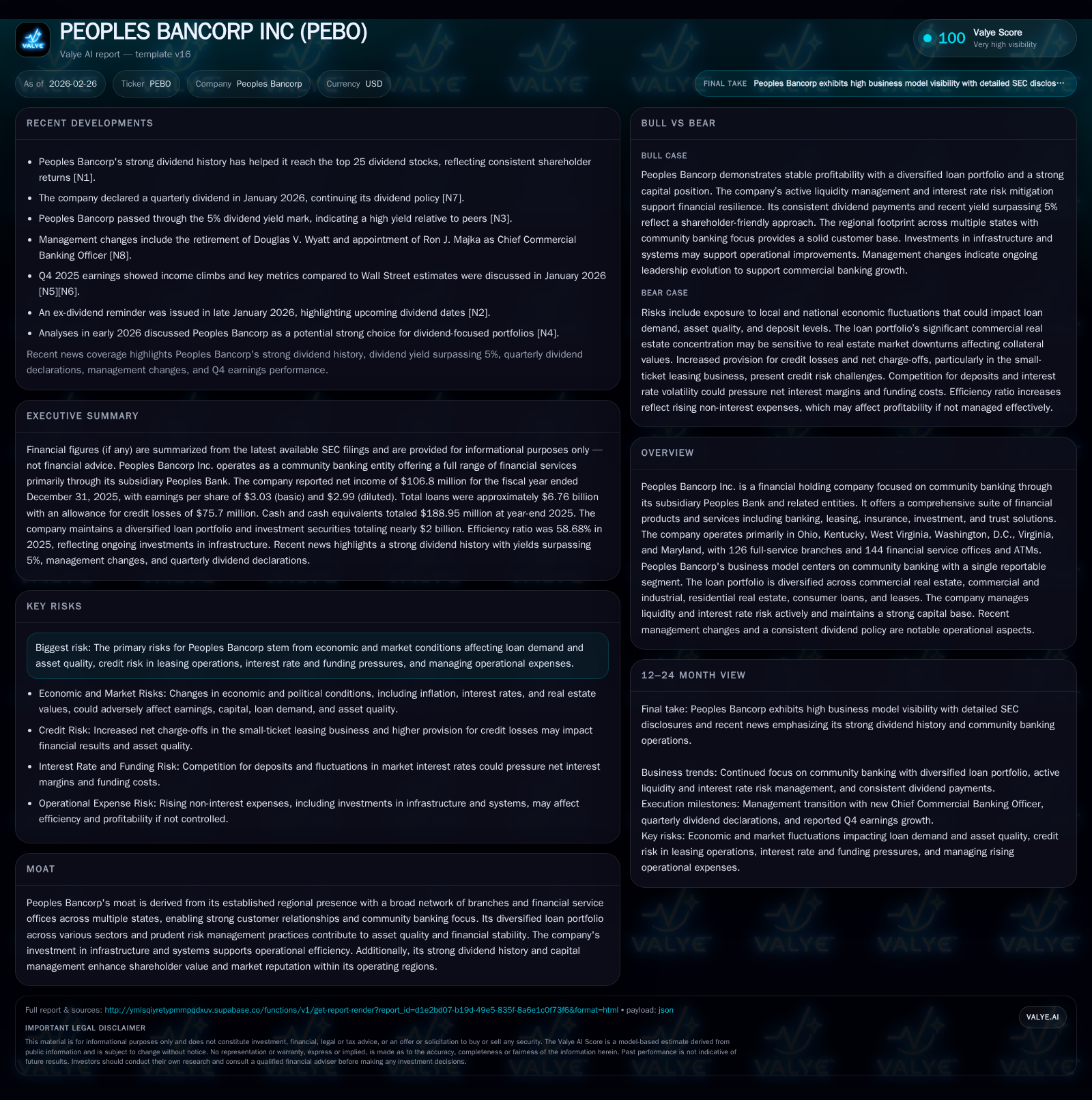
Peoples Bancorp reported a modest decline in operating and net income for fiscal year 2025 despite stable operating cash flows, reflecting challenges from loan expense pressures and interest rate dynamics. The bank’s asset-liability committee (ALCO) applies rigorous interest rate risk modeling incorporating parallel and non-parallel yield curve scenarios to protect net interest margins. Its geographically diversified community banking network across several mid-Atlantic and Midwest states supports credit quality via broad regional footprint and deep customer relationships. Capital allocation emphasizes a steady dividend with limited buybacks, underpinning an approximate 8.8% ROE while navigating macroeconomic headwinds such as constrained loan demand and funding cost sensitivities. Upcoming earnings disclosures and investor meetings will be critical for market reassessment of growth drivers amid evolving credit conditions.
Historical Earnings Performance: Drivers and Challenges
In fiscal year 2025, Peoples Bancorp faced modest declines in profitability metrics amidst ongoing operational challenges. Reported operating income decreased by roughly 9.8% year-over-year to about $134.8 million while net income declined approximately 8.9% to $106.8 million [F1]. This contraction coincided with an increase in loan-related expenses driven predominantly by costs associated with its Down Payment Assistance Program along with elevated collection and underwriting outlays described in SEC filings [S1]. Marketing expenses notably dropped in comparison periods due to reduced advertising activities.
Despite earnings pressures, operating cash flows remained strong at $134.7 million (down about 5.9%), underscoring resilient core cash generation capabilities [F1]. Capital expenditures were also scaled back by roughly 11.7% to $6 million in line with conservative investment spending [F1]. This mix of rising loan costs against controlled operating expenses paints a nuanced picture of durable but stretched margin dynamics within Peoples’ community bank model.
Historical performance (annual)
| FY | Net ($mm) | CFO ($mm) | OpInc ($mm) | Capex ($mm) | Net YoY |
|---|---|---|---|---|---|
| 2025 | 107 | 135 | 135 | 6 | -8.9% |
| 2024 | 117 | 143 | 149 | 7 | +3.4% |
| 2023 | 113 | 144 | 145 | 13 | +11.9% |
| 2022 | 101 | 120 | 129 | 7 |
Source: SEC companyfacts cache [F1].
Capital returns and efficiency (annual)
| FY | Div ($mm) | Buybacks ($mm) | FCF ($mm) |
|---|---|---|---|
| 2025 | 58 | 1 | 129 |
| 2024 | 56 | 3 | 136 |
| 2023 | 52 | 3 | 130 |
| 2022 | 42 | 7 | 113 |
Source: SEC companyfacts cache [F1].
Table compiled from audited filings [F1]; revenue figures not explicitly reported.
Assessing Interest Rate Risk and Balance Sheet Management
Interest rate risk stands as one of the most pivotal exposures for Peoples Bancorp, given the sensitivity of net interest income (NII) to repricing mismatches across assets and liabilities [S1]. The company’s Asset-Liability Committee (ALCO) implements a robust IRR management framework centered on simulation modeling that evaluates immediate and sustained shifts — both parallel and non-parallel — in the yield curve over a two-year horizon.
The simulations start from a base case with current balance sheet positioning and prevailing rates held constant before layering scenarios involving upward or downward rate pressures differentially impacting short- versus long-term instruments [S1]. This approach captures realistic repositioning effects such as prepayment speeds on loans or early withdrawals on deposits that can alter repricing durations.
ALCO establishes explicit risk tolerances limiting potential adverse movements in projected twelve-month NII forecasts as well as the economic value of equity (EVE). Notably, the bank is positioned favorably to benefit from rising long-term yields relative to short-term stable borrowing costs—a bear steepener scenario that historically results in improved margins [S18]. Moreover, interest rate swaps designated as cash flow hedges mitigate volatility associated with brokered deposits totaling $45 million notional as of end-2025 [S12].
Loan Portfolio Composition and Asset Quality Considerations
Peoples Bancorp's loan book is notably diversified across commercial real estate, commercial & industrial (C&I), residential real estate, consumer loans, leasing assets, among others [S19]. This segmentation underpins credit quality by reducing concentration risks common among single-line lenders.
As of December 31, 2025, allowance for credit losses expanded materially to $75.7 million from $63.3 million a year earlier—reflective of portfolio growth coupled with recalibrated loss expectations amidst a softening economic outlook [S4][F1]. Leasing-related exposures warrant particular caution due to inherent operational credit risks tied to equipment residual values under pressure.
Allowance allocations reveal significant provisions concentrated in commercial real estate ($19.7M), C&I ($18.8M), leases ($16.4M), followed by residential real estate segments collectively exceeding $7 million [S19]. These dynamic loss reserves embody prudence amid evolving borrower repayment capacity concerns.
Regional Footprint and Competitive Moat Analysis
Peoples Bancorp commands a broad presence through its network of approximately 126 full-service branches alongside numerous financial service offices and ATMs distributed across Ohio, Kentucky, West Virginia, Washington D.C., Virginia, and Maryland . This multi-state footprint fortifies its community banking moat by embedding close local ties fostering customer loyalty.
Such geographic diversification provides cyclicality dampening benefits though underlying local economies are described as modest relative to national averages [S2]. Depository franchise strength stems partly from managing volatile governmental accounts whose inflows fluctuate seasonally but offer sizable deposit bases when tax receipts are collected [S12].
Operational scale enables cost efficiencies through common infrastructure investments while preserving the flexibility characteristic of regional banks focused on personalized client service—a competitive advantage against both megabanks and smaller specialty lenders.
Capital Allocation: Dividends, Buybacks, and Shareholder Returns
Peoples Bancorp maintains disciplined capital deployment centered primarily on dividend continuity complemented by modest share repurchases consistent with regulatory constraints applicable to community banks [S15]. Dividend payouts escalated to $58.1 million in fiscal year 2025 marking an increase aligned with earnings growth moderation but further bolstering an attractive yield profile surpassing the critical five percent threshold noted recently by market commentators [N6][N9][F1].
Share repurchase activity was minimal at $0.84 million in the same period compared with multi-million-dollar buybacks triggered during prior years signaling conservative capital retention strategies amid uncertain macro conditions [F1]. Total common equity expanded nearly nine percent reaching $1.21 billion at year-end translating into an approximate return on equity near 8.8%—a reflection of rising capital bases post-acquisition integrations tempering immediate profitability ratios [F1][S25].
This allocation balancing act evidences efforts to sustain shareholder yield without compromising capital adequacy or future organic growth initiatives.
Future Growth Prospects and Macroeconomic Headwinds
Management commentary highlights inflation persistence coupled with regionally muted economic growth as primary constraints on loan demand expansion—key drivers behind cautious earnings outlooks [N4][N14][S2]. Interest rate sensitivity manifests especially through elevated short-term funding costs pressuring net interest margins despite opportunities presented by long-term rate rises.
Credit quality vigilance remains paramount given exposure variability in leasing segments alongside potentially adverse shifts in underwriting standards triggered by slower repayment trends [S19]. Deposit retention initiatives emphasize lower-cost stable funding including migration toward ICS network products that reduce collateral pledging requirements enhancing liquidity profiles [S12].
While macroeconomic headwinds temper near-term performance visibility, focus remains on optimizing asset mix through earnings accretive deployments supported by calibrated liquidity buffers regularly stress-tested under ALCO oversight.
What to Watch: Upcoming Milestones and Market Sentiment
Between February and March 2026, Peoples Bancorp’s management team has scheduled investor presentations alongside Q4 earnings releases offering critical forums for assessing market reactions around discussed themes including interest rate risk posture adjustments and emerging credit trends [N3][N4][S3].
Watch for updates regarding ALCO policy refinements particularly related to hedging strategies as well as forward-looking commentary on dividend declarations conforming to measured yield targets amid shifting regulatory environments.
Furthermore, monitoring allowance for credit loss trajectories will provide early indicators concerning potential shifts in borrower stress levels or economic forecast revisions inherent within CECL modeling frameworks.
This analysis synthesizes publicly filed disclosures ([F1],[S#]) alongside recent news reports ([N#]) without offering investment advice or price forecasts but aims to present an institutional-quality perspective tailored for buy-side evaluation purposes.
Disclaimer: This is research-only, informational analysis and not investment advice. It may include AI-generated interpretation and general industry context. Always verify important details using primary sources.

Comments