
GrabAGun’s Tech-Powered eCommerce: Balancing Innovation and Compliance Challenges
Analysis of GrabAGun Digital Holdings Inc.’s financial trajectory, AI-driven platform, newly launched logistics services, and regulatory risk landscape.
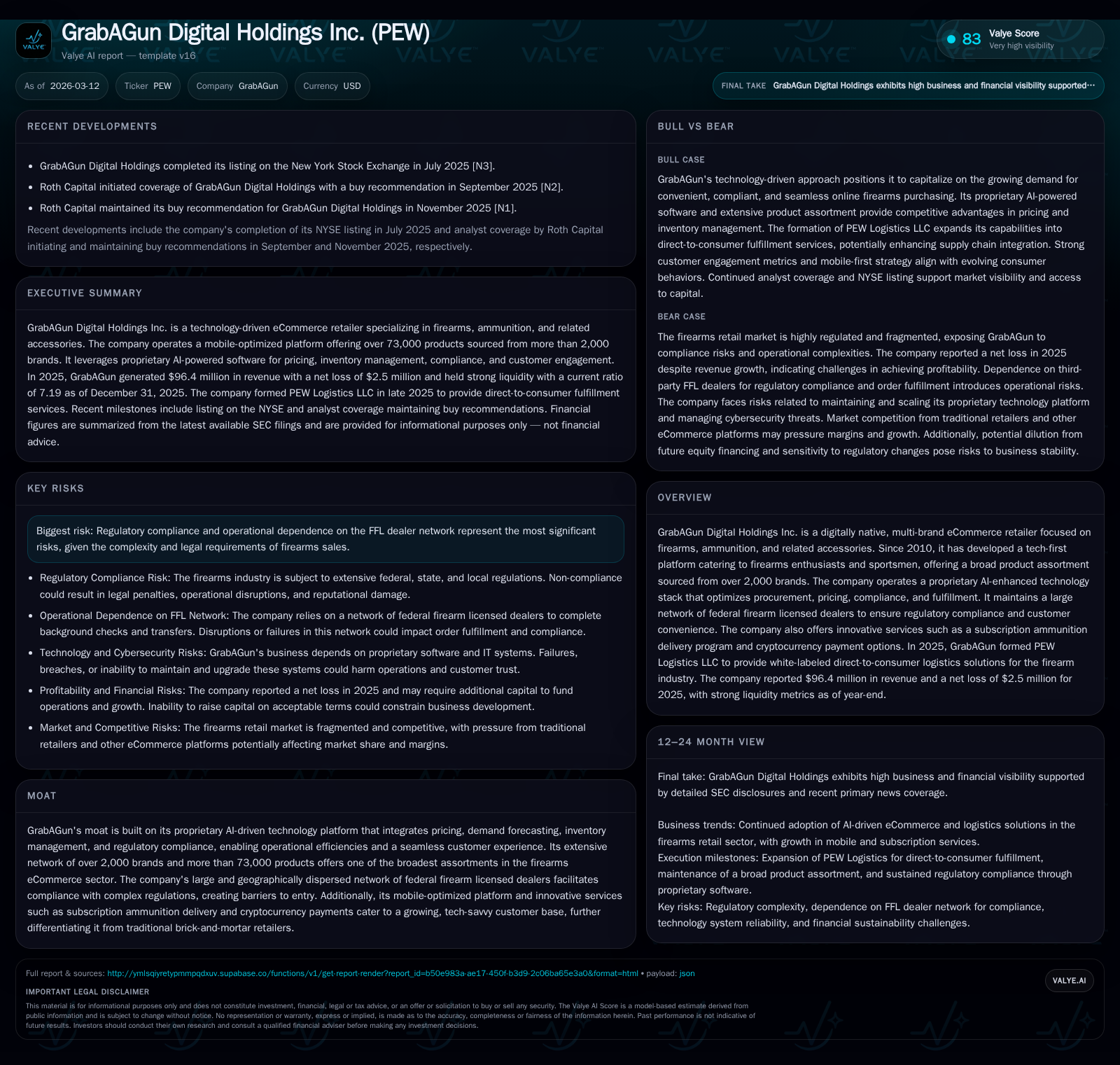
GrabAGun Digital Holdings Inc. reported modest revenue growth to $96.4 million in 2025 alongside a swing to a net loss of $2.5 million, reflecting margin pressures and elevated costs despite a strong product assortment exceeding 73,000 SKUs. The company’s proprietary AI-enhanced platform underpins efficient procurement, dynamic pricing, and regulatory compliance, differentiating it in the traditionally slow-to-digitize firearms retail sector. The launch of PEW Logistics LLC in late 2025 expands its footprint into regulated direct-to-consumer logistics services for the firearm industry. Operational risks remain focused on vendor concentration and the complexity of Federal Firearm License dealer compliance requirements. Capital structure shows liquidity strength but negative free cash flow and return on equity losses underscore ongoing investment and operational challenges.
Historical Performance: Revenue Growth and Profitability Fluctuations
GrabAGun Digital Holdings Inc., a leading multi-brand eCommerce retailer specializing in firearms and accessories since 2010, demonstrated moderate top-line growth with revenues rising from approximately $93.1 million in fiscal year (FY) 2024 to $96.4 million in FY 2025 — an increase of roughly 3.5% [F1], [S16]. This growth was supported by continued expansion of its broad product assortment capturing over 73,000 SKUs sourced from more than 2,000 brands including Smith & Wesson Brands and Sturm Ruger.
Despite revenue gains, profitability experienced a notable contraction as net income deteriorated from a positive $4.5 million in FY24 to a net loss of $2.5 million in FY25 [F1]. Operating income similarly turned negative at -$4.36 million for the latest year [F1]. Drivers behind this decline include elevated costs tied to supply chain logistics amidst inflationary pressures and possible margin compression due to competitive pricing dynamics managed through its AI platform [S1], [S15]. Additionally, changes in vendor terms or credit conditions may have increased working capital demands offsetting some operational efficiencies.
Historical performance (annual)
| FY |
|---|
| 2025 |
Source: SEC companyfacts cache [F1].
The numbers reveal that while GrabAGun’s model continues to attract incremental sales, operating expenses including fulfillment and regulatory compliance likely increased materially.
Technology as a Competitive Moat: AI-Enhanced Platform and Supply Chain Innovation
Central to GrabAGun's differentiated value proposition is its proprietary AI-enhanced technology stack which orchestrates procurement automation, dynamic pricing algorithms incorporating competitor data refreshed every few minutes via APIs, demand forecasting powered by AI models trained on purchase history datasets spanning over a decade, and automated regulatory compliance verified by ATF-approved software [S7], [S24].
The company's New Inventory Program (NIP) exemplifies this integration; it calculates product purchase quantities based on real-time distributor inventory synchronized every few minutes alongside an AI-derived ranking reflecting demand signals and margin priorities [S7]. Pricing optimization balances price floors against competitor rates to dynamically adjust prices maintaining competitiveness while preserving margins where feasible.
Moreover, GrabAGun offers the Shoot & Subscribe™ service providing recurring ammunition deliveries under subscription terms at discounted rates—a pioneering move within firearms retail embracing consumer loyalty tools common across broader eCommerce sectors [S7]. Complementing this is acceptance of cryptocurrency payments responding directly to tech-savvy customer preferences enhancing checkout flexibility [S7].
This technology not only drives operational efficiencies but also enhances user experience—including mobile-first UI/UX features accounting for approximately 72% of website traffic originating from mobile devices—as well as personalized marketing via integrated customer analytics [S10], [S27].
New Frontiers: The Launch of PEW Logistics and Expanding Service Offerings
In October 2025, GrabAGun established PEW Logistics LLC as a wholly owned subsidiary aimed at providing next-generation white-labeled direct-to-consumer fulfillment tailored explicitly for the firearms manufacturing ecosystem [S4], [S6], [S7]. This venture represents strategic vertical integration extending beyond traditional retail operations into third-party logistics infrastructure.
PEW Logistics offers comprehensive warehousing solutions along with inventory management, order pick-and-pack operations, shipping coordination with carriers experienced with sensitive products like firearms/ammunition, and returns handling all compliant with stringent federal regulations applicable to firearm transport and sales [S6]. By enabling manufacturers and brands to operate their own digital storefronts while leveraging PEW's fulfillment platform for backend logistics support, GrabAGun positions itself as a critical enabler across the entire supply chain fabric.
This expansion targets significant growth opportunities given general market fragmentation compounded by complex logistical demands around regulated product categories—particularly important given growing direct-to-consumer sales trends within firearms distribution.
Operating Risks: Vendor Reliance and Regulatory Compliance Complexities
Operational dependency on three primary wholesale distributors—Sports South LLC (30%), Chattanooga Shooting Supplies LLC (11%), and Lipsey’s (10%)—constitutes roughly half of GrabAGun's total purchases by product cost as of December 31, 2025 [S1], [S19]. While long-standing relationships exist without formal long-term contracts typical for this sector, these arrangements rely heavily on non-binding standard purchase orders defining prices and quantities only.
This exposes GrabAGun to risks including unexpected termination or restriction of product access by vendors who continue selling directly through alternate channels disrupting availability or pricing structures adversely impacting margins or customer satisfaction [S1], [S29]. Vendor credit term changes could also strain working capital requirements.
Regulatory risk is equally pronounced: GrabAGun operates within an intricate legal framework governed primarily by Bureau of Alcohol Tobacco Firearms & Explosives (ATF) oversight entailing mandatory background checks executed via an extensive network of federal firearm licensed (FFL) dealers dispersed nationwide—with coverage reaching within fifteen miles of approximately 97% U.S population—ensuring legal transfer compliance under hundreds of localized laws varying state by state [S6], [S23].
Compliance audits conducted annually without warrant present risk for license revocation or penalties if infractions emerge despite internal controls supported by proprietary software [S5], [S25], [S29]. Furthermore intellectual property infringement claims related to software systems or litigation surrounding firearm policies represent lingering operational uncertainties [S5]. Potential class actions related to background checks practices or regulatory adherence could result in material adverse impacts.
Capital Efficiency: Analyzing Return on Equity, Cash Flow Trends, and Capital Allocation
Financially GrabAGun maintains robust liquidity reflected by cash & equivalents totaling approximately $110.4 million at year-end December 31st, 2025 against current liabilities near $16.8 million yielding an exceptionally strong current ratio near 7.19—demonstrative of high short-term solvency capacity amid working capital demands largely fueled by inventory holdings at year-end [F1].
Nonetheless free cash flow (FCF), defined here as cash flows from operating activities minus capital expenditures—which funds growth investments—is negative at about -$8.9 million for FY25 indicating capital consumption possibly related to PEW Logistics buildup or inventory investment amid supply volatility [F1].
Return on equity (ROE) sits at an approximate -2.3% reflecting operating losses offsetting shareholder equity during FY25 highlighting challenges in converting revenue growth into profitable returns amidst competitive pressure and compliance expenses [F1].
No dividends or share buybacks were declared or noted signifying any capital returns are deferred pending operational stabilization.
What Lies Ahead: Growth Drivers, Operational Bottlenecks, and Market Outlook
While explicit management guidance is unavailable publicly as of latest filings,[N/A] forward-looking analysis identifies several potential catalysts poised to leverage existing assets:
- Scaling PEW Logistics’ D2C fulfillment service across third-party firearms manufacturers would diversify revenue streams beyond marketplace sales,
- Expansion of Shoot & Subscribe™ subscription ammunition program targeting recurring revenue consistency while deepening consumer engagement,
- Ongoing enhancements incorporating cryptocurrency payment processing likely appealing increasingly younger demographics valuing seamless tech-enabled purchases,
- Sustained mobile-first website optimizations aligned with changing consumer buying habits enhancing conversion rates,
- Acquisitions remain a stated strategic intent potentially boosting technology capabilities or geographic presence though inherent integration execution risks persist.
- Conversely regulatory tightening or adverse litigation would represent downside bottlenecks requiring close monitoring,
- Persisting vendor concentration risks may cap scale if alternative supplier relationships are not cultivated,
- Operating expense volatility associated with ATF compliance inspections remains salient given annual unannounced inspection protocols.
Key Metrics to Watch: Revenue, Profitability, Vendor Partnerships, and Compliance Measures
To gauge GrabAGun's progress balancing rapid technological innovation against operational risks these indicators bear watching:
- Top-line progression benchmarked against gross margin preservation signaling pricing strategy effectiveness amidst competition,
- Vendor relationship stability reflected through purchase volume distribution shifts especially among top three distributors given their outsized importance,
- Health and retention metrics within the FFL network ensuring broad convenient customer access as competitive landscape evolves,
- Frequency and financial impact from compliance audits including any corrective actions or license adjustments documented,
- Growth velocity within new business lines such as PEW Logistics client base expansion measured through contract wins or throughput volumes,
- Cash flow improvements transitioning FCF from negative toward neutral ideally supporting targeted reinvestment without undue balance sheet stress.
This analysis synthesizes available SEC filings ([F1], multiple 10-K sections including S1-S29) alongside contextual industry insights relevant to eCommerce firearms retail modernization efforts spearheaded by GrabAGun Digital Holdings Inc., omitting speculative forecasting due to lack of explicit management guidance disclosures. It underscores the dual-edged nature of leveraging advanced AI technology platforms while navigating complex federal firearm regulations alongside concentrated vendor dependencies requiring vigilant operational oversight.
Disclaimer: This is research-only, informational analysis and not investment advice. It may include AI-generated interpretation and general industry context. Always verify important details using primary sources.

Comments