
Pagaya Technologies Advances AI Credit Network Amid CFO Transition and Expanding Financing Capacity
Pagaya reported solid quarterly results supported by growing network volume and improved fee efficiency while navigating leadership changes and continued capital structure enhancements.
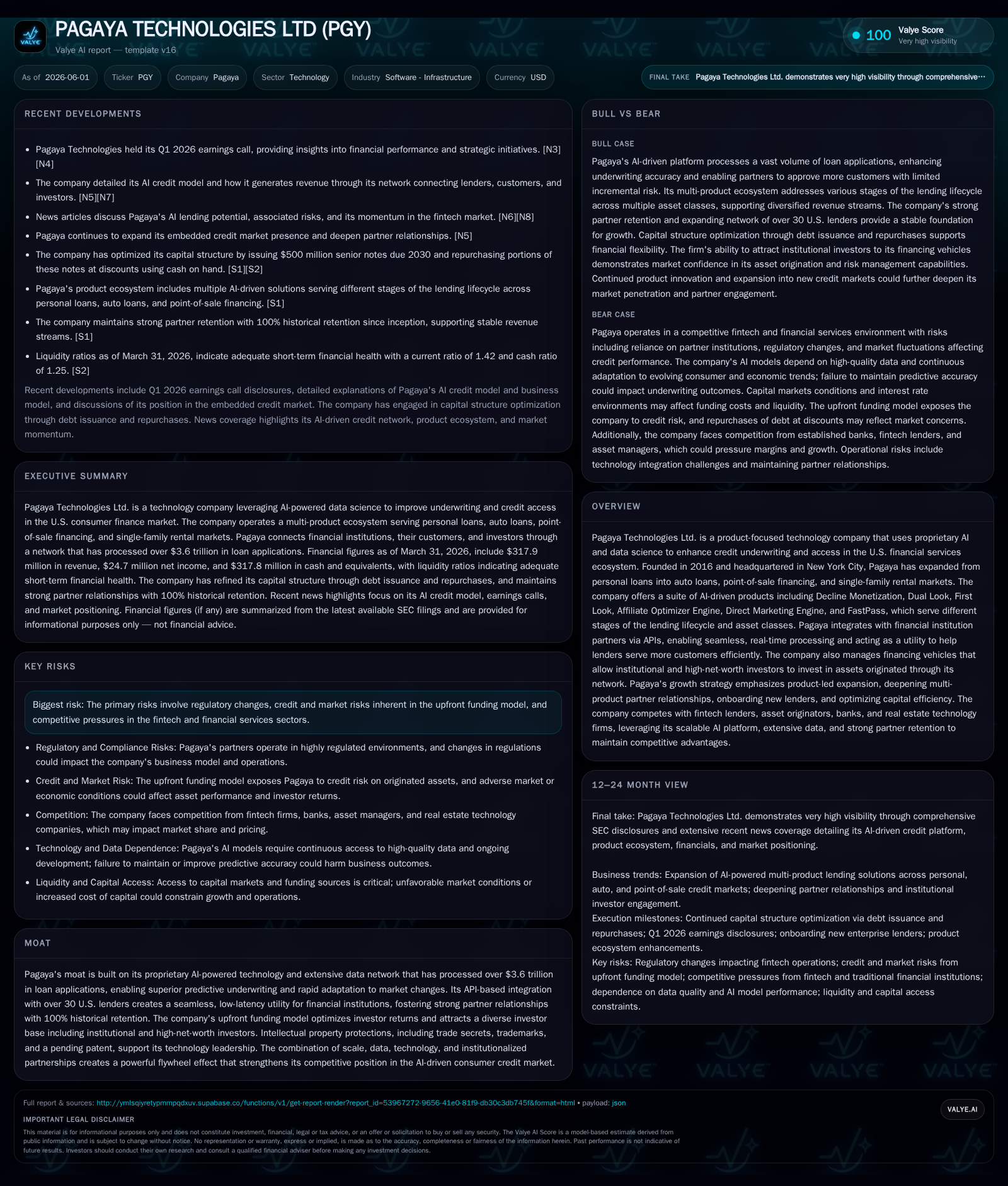
In its 2026 Q1 filing, Pagaya Technologies demonstrated strength in scaling its AI-driven credit underwriting platform with network volume reaching $10.5 billion and improved fee revenue margins. The company continues to deepen integration across U.S. financial institutions, enhancing lender access and investor participation, all while managing a strategic CFO transition. Its business model hinges on proprietary AI technology coupled with leveraged financing vehicles that support asset origination through partner networks. Going forward, growth will depend on expanding partner adoption, broadening asset classes served, and capitalizing on its refined capital and funding apparatus amid regulatory scrutiny and competitive fintech pressures.
Latest Operating Update
Pagaya Technologies provided its first-quarter 2026 operating update on May 7, revealing continued momentum across its core metrics. Network volume — the gross dollar value of assets originated by Pagaya’s lender partners powered by its AI technology — grew to approximately $10.5 billion, an increase from around $9.7 billion in the prior quarter [S7]. This highlights sustained adoption of Pagaya’s underwriting platform among an expanding partner base.
Operational efficiency improved noticeably as fee revenue less production costs (FRLPC) margin climbed to 4.9%, up from 4.2% quarter-over-quarter, signaling better monetization of network activity alongside disciplined cost control [S7]. This metric is critical for assessing how well the company converts scale into fee profits after direct costs.
Parallel to operational progress, Pagaya announced a significant leadership change with CFO Evangelos Perros stepping down mid-June 2026 and Jonathan Dobres — previously Chief Strategy Officer — taking over the role. Dobres brings experience in investment management aligned closely with Pagaya’s capital markets strategies [S3]. This transition appears well-managed without disruption to execution.
Business Model
Pagaya operates as a technology-focused intermediary utilizing proprietary AI and data science to enhance credit underwriting across U.S. consumer finance markets. Its core offering is an integrated platform that connects financial institution partners — spanning fintech startups to incumbent banks — with institutional investors through an expansive network infrastructure. The company generates revenues primarily from fees linked to "Network Volume," which covers the total assets originated by partners using Pagaya’s technology.
Within this ecosystem:
- Partners pay AI integration fees for leveraging Pagaya’s predictive models that allow broader customer approvals at optimized risk levels without raising their incremental funding needs.
- Financing Vehicles, managed or advised by Pagaya affiliates, acquire originated assets enabling investor participation in securitized loan pools.
- Revenue streams comprise network AI fees (integration and execution fees for asset creation/delivery), contract fees, interest income from invested capital, and investment income.
Pagaya's product suite is diverse: it includes Decline Monetization (retrieval of value from applicants initially declined by lenders), Dual Look (enhancing approval odds via alternative data models), First Look (early-stage application analytics), Affiliate Optimizer Engine (partner-specific optimization), Direct Marketing Engine (targeted customer acquisition), and FastPass (streamlined loan processing) [S1]. These offerings target various stages of lending lifecycle across multiple asset classes—from personal loans to auto financing and single-family rentals
The platform's API-based integration supports real-time interactions improving speed and efficiency for lender decision-making processes—effectively acting as a middleware "utility" that marries originators with funding sources seamlessly.
Industry Structure and Competitive Position
Pagaya sits at the intersection of fintech innovation and traditional consumer credit markets amidst contested industry terrain featuring players like Upstart, Affirm, and other emerging AI-driven credit platforms. Unlike pure marketplace lenders or legacy scoring firms relying heavily on FICO models or limited datasets, Pagaya leverages vast alternative data coupled with machine learning trained on over $3.6 trillion worth of loan applications processed historically [S1].
This scale confers a meaningful competitive moat by enabling more granular segmentation of credit risk profiles, yielding improved approval rates without elevated losses—a key value proposition that strengthens partner loyalty evidenced by historical retention near 100% since inception [S25]
Additionally:
- The company's upfront funding model attracts institutional investors seeking efficient access to consumer credit assets vetted via sophisticated analytics.
- Intellectual property protections include trade secrets supplemented by pending patents adding technical barriers for replication.
- Geographic concentration in the U.S., matching where regulatory regimes are well-understood by management teams.
- Strategic partnerships embed Pagaya deeply within client workflows enhancing switching costs relative to competitors reliant on standalone products.
Nonetheless, the competitive environment remains intense with large banks accelerating digitization efforts internally and new fintech entrants innovating rapidly—requiring continuous product enhancement and execution excellence from Pagaya.
Growth Drivers
Key growth channels driving Pagaya's future performance encompass:
- Expanding Partner Network: Increasing number of financial institutions adopting Pagaya's AI-driven underwriting widens Network Volume directly impacting revenues.
- New Asset Classes: Extension beyond personal loans into auto finance, point-of-sale financing, especially single-family rental markets builds Total Addressable Market substantially [N1],[S1].
- Fee Product Innovation: Lender-focused tools such as Dual Look or Affiliate Optimizer Engine can unlock untapped revenue pools per client relationship.
- Capital Efficiency: Enhanced financing vehicles backed by diversified investor groups ensure scalable asset purchases needed to match origination growth.
- API Integration Depth: Seamless tech integration reduces onboarding friction accelerating adoption among digitally native lenders.
Execution across these vectors will also aid margin expansion enabled by higher FRLPC percentages as fixed costs are absorbed efficiently at scale [S7]
Risks and Watchpoints
Pagaya faces several constraints warranting monitoring:
- Regulatory Exposure: Given operating within regulated financial services including securitization activities subject to evolving legislation concerning consumer protection or risk retention requirements poses uncertainty [S17].
- Credit Risk Fluctuations: Reliance on accurate predictive models means macroeconomic shifts causing rapid deterioration in borrower creditworthiness can lead to impairments impacting earnings stability.
- Capital Markets Dependence: Upfront funding model requires sustained investment appetite; disruptions due to rising interest rates or market volatility could constrain capital availability affecting deal flow.
- Competition: Accelerated fintech adoption among peers or incumbents investing heavily in AI may erode Pagaya’s unique edge unless innovation pace is maintained.
- Leadership Transition: While CFO change is orderly presently, execution risk always rises during management shifts involving critical strategic functions.
What to Watch Next
Important milestones shaping near-term outlook include:
- Quarterly updates on Network Volume growth trajectory indicating market penetration success or slowdown trends.
- Expansion announcements covering new partnerships or entry into additional lending verticals—especially deeper penetration into SFR lending which is nascent but fast-growing.
- Fee Margin development tracking enhancements in FRLPC %, signaling operating leverage realization at scale.
- Capital deployment effectiveness via securitization vehicle performance metrics including default rates or investor uptake balance.
- Regulatory filings providing clarity around compliance frameworks especially any changes triggered by heightened scrutiny toward AI-enabled lending solutions.
- Execution quality during CFO transition reflecting corporate governance continuity supporting investor confidence.
Financial Profile Briefly
Looking back at full year 2025 financials helps contextualize recent developments:
- Revenue exceeded $1.3 billion with operating income surpassing $260 million indicating profitable scaling [F1].
- Net income attributable reached positive territory around $81 million reversing prior losses highlighting operational maturity gains [F1].
- Cash liquidity remained healthy over $317 million as of March 31st, 2026 [F1] while total debt stood near $600 million as of June 30, 2025 [F1].
- Adjustments like share-based compensation and impairments impact GAAP income but underlying Adjusted EBITDA provides clearer profitability signals exceeding $370 million for last fiscal year emphasizing strong cash generation capacity [S7].
Overall balance sheet strength combined with diversified funding sources underpin Pagaya’s ability to finance growth investments while navigating market dynamics conservatively.
This analysis synthesizes SEC disclosures alongside sector context without offering investment research views. Readers should consider broader market conditions alongside potential regulatory or execution risks outlined when evaluating company developments.
Disclaimer: This is research-only, informational analysis and not investment advice. It may include AI-generated interpretation and general industry context. Always verify important details using primary sources.

Comments