
Phreesia's Integrated Platform Drives Resilient Growth Amid Healthcare Payment Evolution
Phreesia’s latest quarterly filing highlights strategic refinancing and operational momentum underpinning its integrated healthcare platform’s growth trajectory.
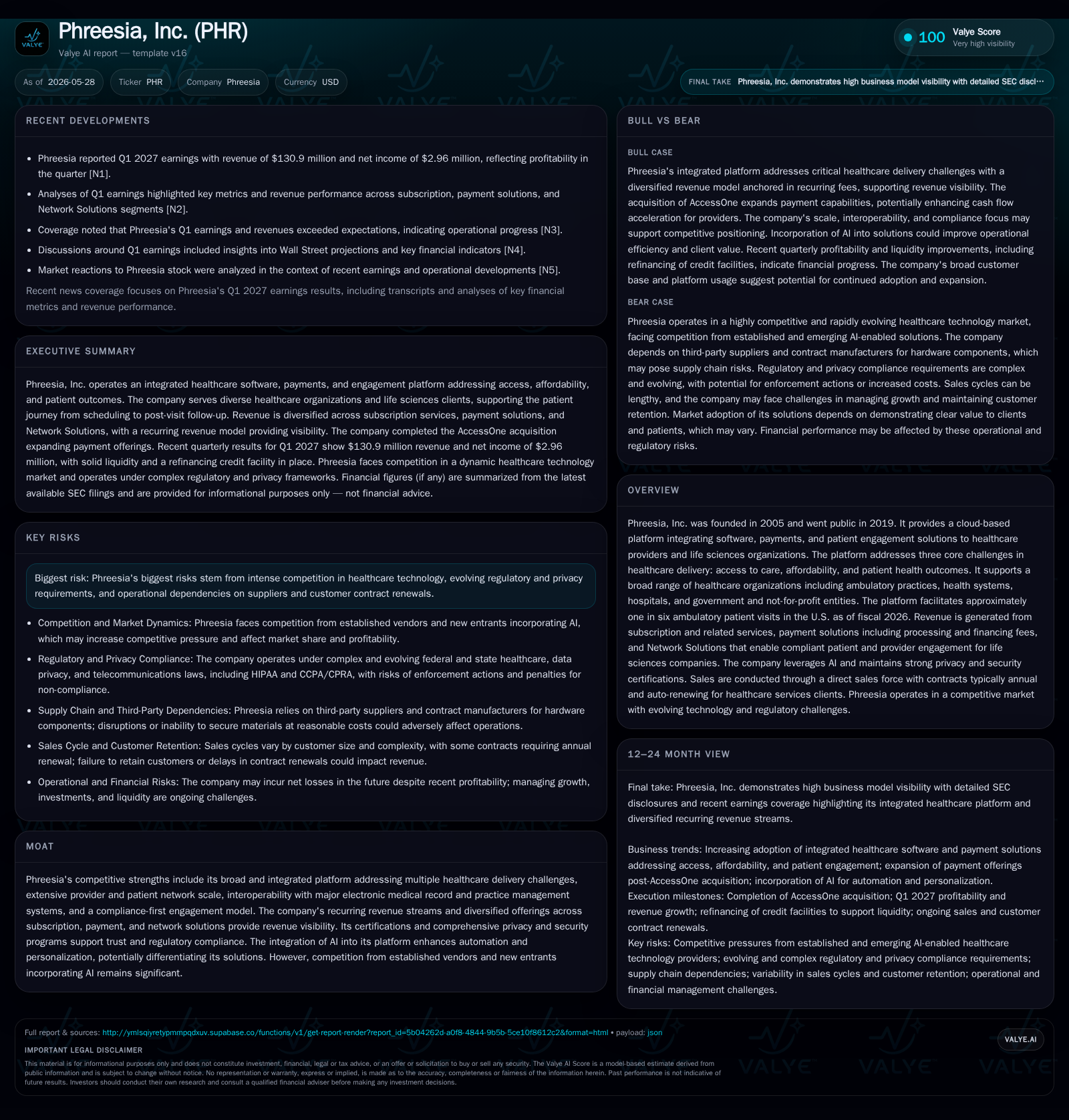
Phreesia, Inc.'s Q1 fiscal 2027 update reveals strengthened liquidity through refinancing its bridge loan into a larger revolving credit facility and a solid cash position of $73.8 million. The company reported a net income turnaround with $2.96 million profit compared to a prior year loss, driven by recurring revenues across subscription services, payment solutions, and network engagement offerings. Its platform, deeply embedded in provider workflows and patient interactions, processes about one in six U.S. ambulatory visits, positioning Phreesia well amidst evolving healthcare payment landscapes. Risks include regulatory shifts affecting medical financing and competitive pressures, while growth drivers focus on expansion of payment products, AI-enabled automation, and increasing adoption within ambulatory care.
Latest Quarterly Operating Update Highlights
Phreesia reported a net income of $2.96 million for the three months ended April 30, 2026, reversing from a net loss of $3.91 million in the comparable prior-year period [S2]. This positive swing reflects not only operational leverage but also improved payment solutions revenue influenced by seasonal patient deductible resets at the start of the calendar year [S2]. The company’s operational cash flow improved materially relative to past results.
Deferred revenue balances increased during the quarter consistent with contract additions and renewal activity—deferred revenue stood at approximately $61.74 million at April 30 versus starting balances signaling healthy forward bookings [S2]. Contract asset roll-forwards lifted net contract assets to about $7.87 million highlighting ongoing onboarding or implementation activity [S2].
Phreesia’s Business Model and Product Ecosystem
Founded in 2005 and public since mid-2019, Phreesia operates a cloud-based healthcare technology platform integrating three core pillars: software-as-a-service subscriptions focused on patient intake and administrative workflow automation; payment solutions including processing fees and financing products following the strategic acquisition of AccessOne Parent Holdings in fiscal year 2026; plus Network Solutions which enable compliant marketing engagements for life sciences clients targeting patients and providers using Phreesia’s ecosystem [S1]
Revenue is diversified but anchored around recurring subscription fees from healthcare providers (ambulatory practices, hospitals), complemented by variable payment-related fees driven by transactional volume including patient payments processed via AccessOne’s MedCard solution [S1]. Network Solutions contributes periodic per-engagement fees primarily aligned with life sciences sales cycles ensuring seasonally stable revenue streams supported by closed-loop reporting metrics
Phreesia’s platform embeds deeply within provider workflows—from appointment scheduling through patient intake forms to payments—reducing friction that traditionally impedes access to care while easing administrative burdens such as data entry errors or claim rework. This integration provides defensibility through “stickiness,” creating switching costs for customers reliant on Phreesia to manage critical front-end processes efficiently [S1]. AI-driven automation within these modules enhances personalization of patient interactions and can auto-triage tasks reducing provider workload incrementally.
The payment innovation angle is strategically important given rising consumer cost-sharing impacting healthcare affordability. AccessOne MedCard offers providers a compliant card-based financing option accelerating payment collection while offering patients extended credit alternatives. This positions Phreesia uniquely amid healthcare technology peers typically focused predominantly either on workflow software or separate payment processing services—not integrated combinations addressing multiple core pain points simultaneously.
Industry Context and Competitive Positioning
Phreesia competes in a crowded healthtech space marked by entrenched enterprise workflow platforms (e.g., Epic Systems integrations), specialty software vendors focusing on niche ambulatory or hospital segments, as well as new entrants leveraging AI capabilities for engagement automation.
Its competitive moat derives primarily from broad interoperability with leading EMR/practice management systems that allows seamless data exchanges without disrupting clinical workflows—a key barrier in an industry noted for legacy complexity. Additionally, compliance-first design emphasizing HIPAA privacy standards combined with stringent security protocols fosters trust among cautious healthcare organizations wary of breaches or regulatory penalties [S1][S13][S16].
Recurring revenue streams across mixed modalities enhance visibility into future cash flows typical of subscription businesses but amplified here by scaled transaction-based payment fees from over approximately 180 million annual patient visits processed—a notable scale advantage representing roughly one-sixth of US ambulatory encounters [S1]. This scale supports lifecycle customer engagement analytics aiding upsell/cross-sell opportunities.
However, the sector faces increasing regulatory scrutiny especially concerning third-party medical financing providers like AccessOne’s offerings due to heightened oversight from consumer protection bodies including CFPB state attorneys general investigations. Ongoing & shifting laws can constrain product feature sets or marketing freedoms impacting total addressable market effectively [S17][S20].
Growth Drivers Shaping Phreesia’s Future
Post fiscal-2026 AccessOne acquisition expansion defines a clear near-term growth driver by broadening addressable markets into payments themselves rather than solely front-end scheduling or intake software [S1]. The scalable nature of card-based payment facilitation accelerates cash collections for providers while introducing financial convenience to patients.
Use case penetration within ambulatory care remains robust as providers increasingly seek digital-first solutions to streamline pre-visit intake amid labor shortages driving efficiency imperatives [N1][N3]. Phreesia’s AI-powered automation tools embedding intelligent routing or personalized messaging are expected to gain adoption thus driving customer retention benefits alongside incremental value creation.
Network Solutions growth aligns strongly with predictable annual life sciences marketing budgets triggering second half revenue upticks driven by pharma manufacturers’ targeted campaigns requiring compliant engagement channels—a niche few competitors address satisfactorily due to regulatory complexity requiring specialized expertise embedded in platform design [S1]
Seasonality is evident: Payment Solutions revenues peak early calendar year driven largely by deductible resets necessitating higher upfront patient payments; Network Solutions see uplift later mirroring pharma budget cycles fostering balanced yearly revenue profiles helping manage operating leverage.
Key Risks and Operational Watchpoints
Competition looms large from both established EMR-integrated vendors who may extend offerings into payments or AI automation features as well as innovative startups leveraging data science & ML heuristics aggressively risking customer wallet share erosion [S13][S15].
Regulatory risks specifically around medical service financing products threaten AccessOne given jurisdictional variability in consumer lending laws raising compliance overheads or restricting go-to-market capabilities potentially curtailing growth expectations [S17][S20].
Customer concentration risk persists as the business derives material portion of revenues from relatively concentrated provider contracts where non-renewal decisions or pricing pressure could materially impact top-line absent effective diversification strategies or new client acquisitions.
Operational dependencies involving third-party suppliers for hardware components (intake kiosks) or service delivery create potential disruption points risking provider satisfaction levels if execution falters during peak demand periods or integration rollouts particularly related to acquired businesses assimilation challenges post AccessOne deal closure noted historically among healthtech M&A transactions [S21].
Privacy compliance is continuously evolving in complexity imposing ongoing investment burdens just to maintain certification levels—any breach incident could incur reputational damage potentially stunting long-term growth aspirations despite current strong adherence record [S13][S16].
Outlook: Milestones and Upcoming Catalysts
Market participants should monitor second quarter fiscal updates for clarity on sustained net income profitability trajectory building off Q1 gains plus any guidance adjustments reflecting macroeconomic demand trends affecting provider investment appetites.
Contract renewal statistics post AccessOne integration will provide vital signals around cross-selling success between subscription software customers adopting the expanded payments products suite offering stickier full-stack solutions [N3][N1].
Adoption rates for newly embedded AI features represent an execution barometer reflecting product-market fit advancements capable of unlocking operational efficiencies prized by healthcare providers grappling with labor cost inflation.
Regulatory developments remain a wildcard affecting medical financing solutions’ remunerative potential given federal/state scrutiny intensification; any legislative action that limits product scope would necessitate strategic repositioning albeit current portfolio diversification mitigates total dependency risk substantially.
Deferred revenue additions offer leading insight into future recognized sales momentum supporting visibility amid inherent seasonality in payments processing volumes tied closely to policy deductibles reset annually common throughout healthcare payer norms.
Brief Financial Profile and Liquidity Status
As of January 31, 2026 cash and cash equivalents stood at approximately $73.8 million providing substantial liquidity room while total debt was effectively zero following bridge loan repayment [F1][S2]. The company maintains a fully available revolving credit facility with unused borrowing capacity surpassing $190 million at April 30 demonstrating robust short-term financial health suitable to fund both organic R&D investments (including AI developments) plus bolt-on acquisition pursuits if opportunistic scenarios arise without immediate capital constraints [S2].
Overall financial strength supports continued reinvestment in product innovation critical against fast-evolving competitor landscapes while safeguarding contractual fulfillment capabilities underpinning recurring revenue reliability.
This analysis utilizes publicly filed SEC disclosures as primary sources alongside recent earnings call extracts per Valye News analytical policy. It does not constitute investment advice but aims to provide an informed perspective on Phreesia's operational positioning within its complex healthcare technology environment.
Disclaimer: This is research-only, informational analysis and not investment advice. It may include AI-generated interpretation and general industry context. Always verify important details using primary sources.

Comments