
J M Smucker Co Faces Margin Pressure and Impairments Amid Shifting Snack Consumer Preferences
The company reports a net loss for fiscal 2026 driven by impairment charges in its Sweet Baked Snacks segment, highlighting ongoing category challenges.
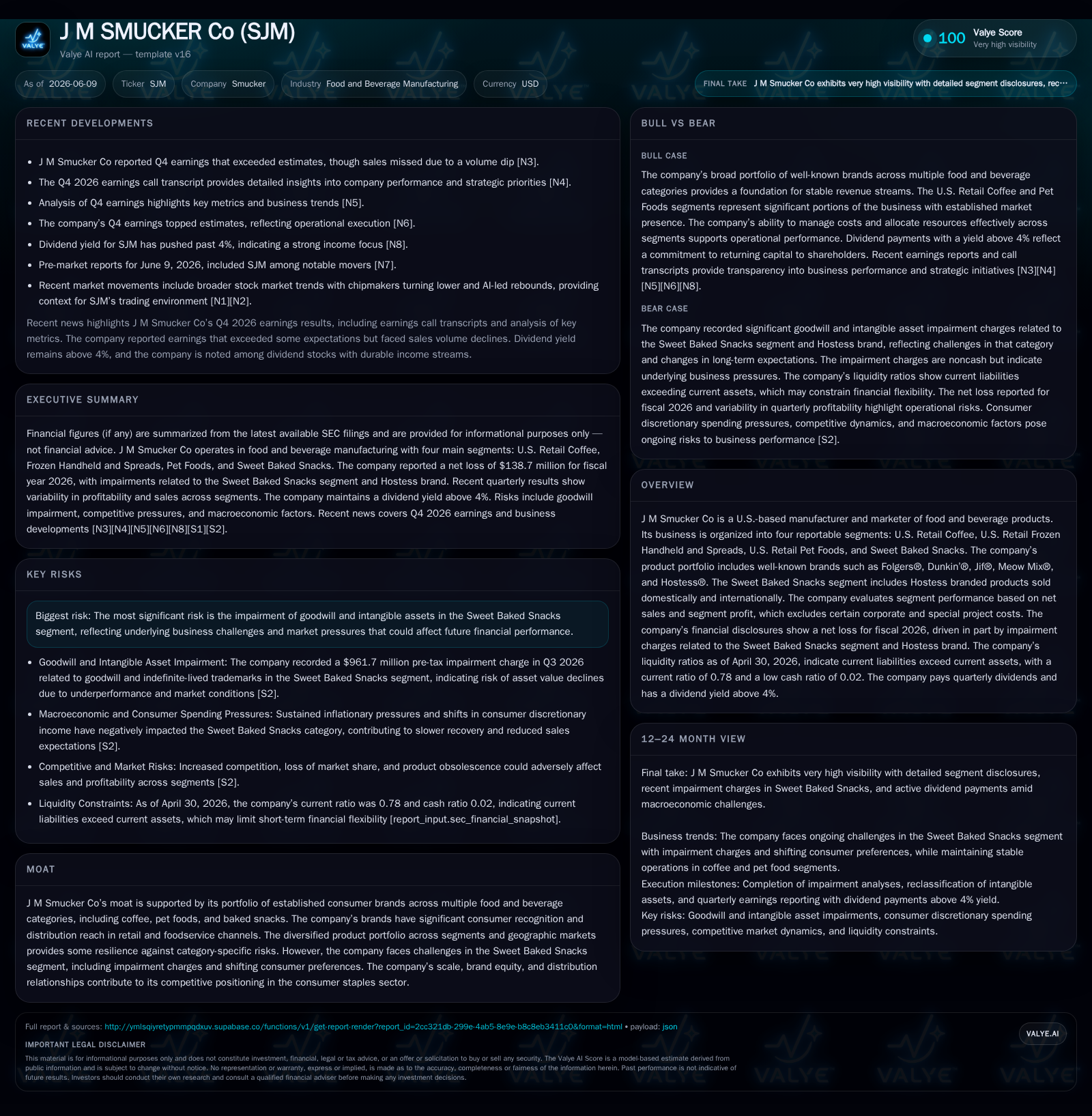
In its latest quarterly filing ending April 30, 2026, J M Smucker Co revealed continued struggles within its Sweet Baked Snacks segment, including significant goodwill impairments and lower-than-expected financial performance. This segment's weakness, compounded by macroeconomic pressures and shifting consumer sentiment away from sweet baked goods, has led to a net loss for the fiscal year despite stable performances in core categories like coffee and pet foods. Smucker's broad brand portfolio remains a competitive strength, but executional and structural issues in snacks warrant close monitoring.
Recent Operating Update
The latest quarterly filing dated February 26, 2026 [S2] anchors the current operating context for J M Smucker Co (SJM). The report highlights a critical development: impairments recognized during Q3 of fiscal 2026 against goodwill and intangible assets linked to the Sweet Baked Snacks segment. Specifically, the Hostess brand was reclassified from indefinite-lived to finite-lived intangible asset status after the impairment charge. This accounting action followed sustained underperformance versus plan influenced by persistent macroeconomic headwinds, including inflation-driven reduction in discretionary consumer spending impacting sweet baked goods consumption.
Segment profit and net sales for this segment fell short of earlier projections during Q3 and forward-looking long-range planning decreased expectations further relative to prior guidance issued in late 2025 [S2]. These trends reflect an ongoing deceleration in the recovery trajectory for sweet baked goods category demand coupled with operational execution challenges detailed by management commentary
Meanwhile, more resilient units like U.S. Retail Coffee and U.S. Retail Pet Foods continued to represent approximately 80% of remaining goodwill and intangible assets valuation [$2.1 billion and $1.6 billion respectively]. These divisions underpin most of the company's asset base and show comparative stability during broader sector volatility.
Business Model Overview
J M Smucker Co operates predominantly as a branded consumer packaged goods (CPG) company with a product portfolio spanning four segments: U.S. Retail Coffee; U.S. Retail Frozen Handheld and Spreads; U.S. Retail Pet Foods; and Sweet Baked Snacks. Each segment derives revenue through sales to retail grocers and foodservice channels where consumers ultimately pay for branded consumables.
Revenue mechanics depend on volume sold and pricing power enabled by brand equity across established names such as Folgers®, Dunkin’®, Jif®, Meow Mix®, and Hostess®. Pricing strategies are balanced against private-label encroachment risks common in grocery retailing; however, Smucker’s portfolio breadth offers cross-category leverage appealing to diverse shoppers.
Margins hinge on commodity input costs (e.g., coffee beans, nuts, wheat), manufacturing efficiency, distribution footprint scalability, and consumer engagement efficacy via marketing investments. Volume/mix shifts significantly impact profitability given fixed-cost structures inherent in processing facilities.
Due to intense competition from private labels and specialist brands, retention depends heavily on consistent consumer loyalty supported by innovation in flavors/formats plus effective shelf presence — aspects where Smucker’s longstanding scale grants some advantage.
Industry Structure and Competitive Position
Within packaged foods, Smucker competes against other large incumbents like General Mills, Kraft Heinz, and Hormel Foods alongside evolving niche competitors specializing in organic or plant-based snacks. The U.S. grocery sector's dynamics feature accelerating private-label penetration putting margin pressure on branded CPGs, coupled with omnichannel retail acceleration requiring adaptation in eCommerce fulfillment and promotional cadence.
Smucker's competitive moat lies chiefly in iconic household brands that have deep shelf space penetration within traditional supermarkets and club stores while growing digital sales channels incrementally. The coffee category remains highly defendable given Folgers' dominant share historically combined with Dunkin’s brand licensing providing additional scale.
Conversely, the Sweet Baked Snacks category is characterized by secular headwinds: consumers shifting towards healthier snacking alternatives has pressured demand for traditional sweet bakery items despite continued market share gains internationally for Hostess products. This divergence manifests operationally with inventory turns slowing and markdown cadence increasing to manage shelf aging.
Growth Drivers
Growth potential for J M Smucker Co is anchored primarily in:
- Coffee & Pet Food Segments: These categories benefit from stable long-term consumer demand driven by habitual purchase behavior, command strong retail positioning, and enjoy periodic product innovation especially in premium/natural segments.
- Brand Extensions & Innovation: Limited but targeted new product launches in frozen handhelds/spreads seek to capture emerging taste trends.
- International Expansion: Especially within Sweet Baked Snacks through Hostess exports which diversify geographic risk.
- Supply Chain Optimization: Continuous focus on cost savings through lean manufacturing initiatives could enhance margins if input cost volatility stabilizes.
However, measurable KPIs such as segment profitability improvements or backlogs are lightly disclosed due to mixed performance; thus the near-term growth outlook leans on recovery execution rather than expansion.
Risks, Watchpoints & Constraints
The clearest risk stems from the Sweet Baked Snacks segment's impaired asset base signalling structural decline rather than transient pressures. This exposes cash flow risk should turnaround measures fail or regulatory environment around nutrition labeling tighten further impacting compliance costs [S29]
Leverage remains high amid challenging operating cash flow generation; total debt approximates $6.5 billion net of cash while current ratio stands modestly below one at 0.78 [F1], indicating working capital constraints that could limit flexibility for aggressive reinvestment or strategic acquisitions absent deleveraging efforts.
Additionally, rising input prices continuing beyond management forecasts could compress margins further unless fully offset by price increases—a delicate balance given inflation-sensitive consumer baskets.
What To Watch Next
Important developments include:
- Subsequent quarter financial disclosures post-April 30 period will clarify whether Sweet Baked Snacks can stem volume losses or realize cost-savings fast enough to improve profitability metrics.
- Management commentary on strategic initiatives addressing category headwinds such as reformulation or portfolio pruning may signal longer-term sustainability efforts.
- Debt refinancing or repurchase activity updates could illuminate capital allocation priorities especially if liquidity tightens under margin pressure [S10].
- Monitoring incremental eCommerce channel penetration data for staple categories such as pet foods will also provide insight into digital transformation progress given retail grocery trends.
Financial Profile Snapshot
At April 30, 2026, Smucker reported an operating income of approximately $360 million yet recorded a net loss around $139 million reflecting aforementioned impairment charges [F1]. The balance sheet shows total debt of roughly $6.54 billion against $1.97 billion in current assets contrasted with $2.54 billion current liabilities constraining short-term liquidity [F1]. Cash reserves are modest relative to debt load.
While operating profit signals underlying business benefits from scale across most segments outside snacks losses, leverage remains a watchpoint amid volatile end-markets.
This nuanced picture demands attention to forthcoming quarterly updates detailing segment recoveries and strategic pivots essential for longer-term resilience in a challenging consumer staples environment.
This analysis is based solely on publicly available filings as of June 9, 2026; it does not constitute investment advice.
Disclaimer: This is research-only, informational analysis and not investment advice. It may include AI-generated interpretation and general industry context. Always verify important details using primary sources.

Comments