
Unveiling PYXUS INTERNATIONAL, INC.: Financial Strength Amid Operational Opacity
A nuanced exploration of PYXUS INTERNATIONAL’s robust financial footing contrasted with limited public business detail.
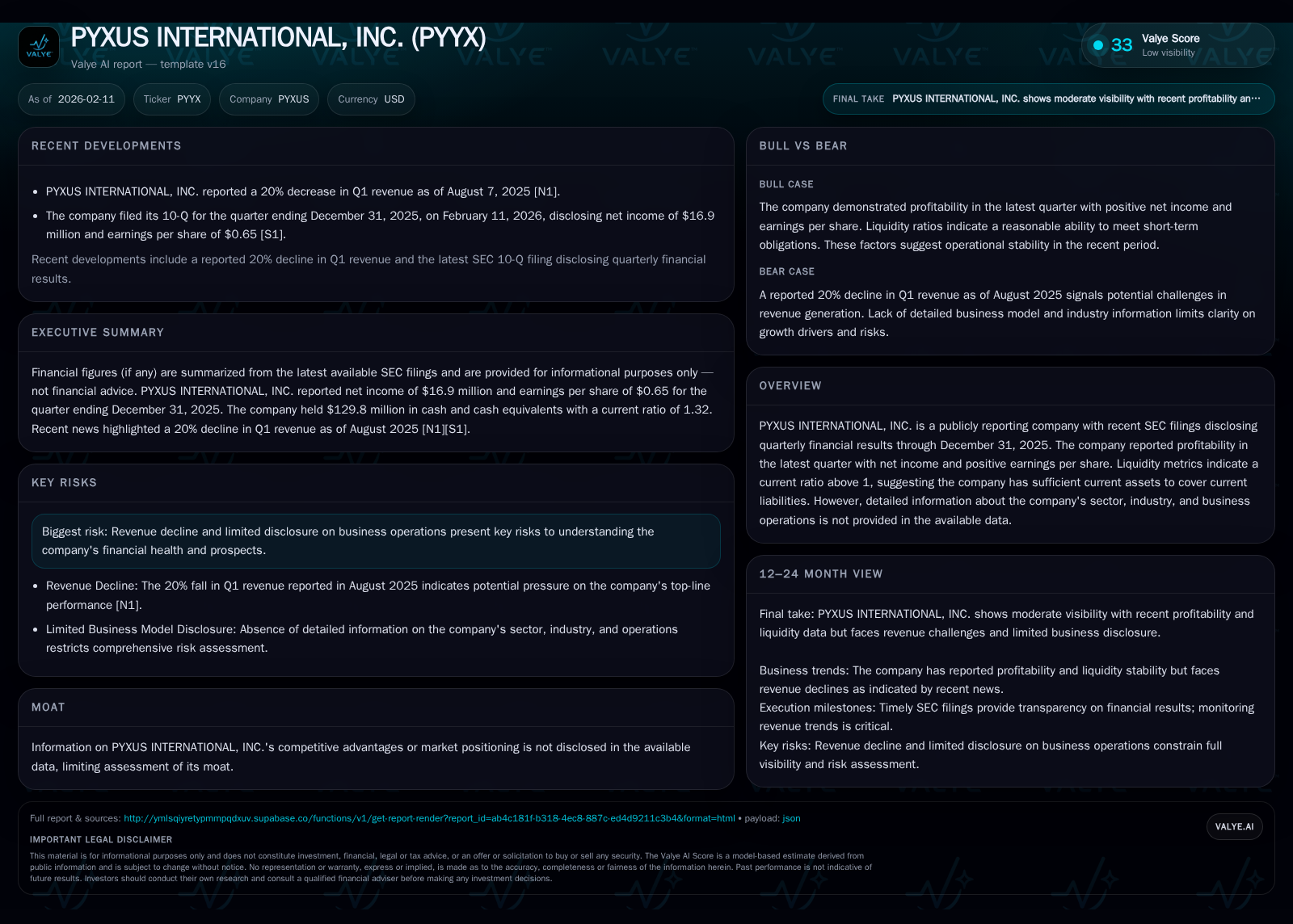
PYXUS INTERNATIONAL, INC. presents a compelling financial profile highlighted by recent profitability and a healthy liquidity position. Despite these encouraging signs, the company’s sparse disclosures on sector, industry, and operational dynamics complicate holistic analysis and risk assessment. This report navigates available data to sketch PYXUS’s financial resilience while underscoring critical unknowns that challenge traditional investment evaluation frameworks.
Reading Between the Lines: PYXUS's Financial Snapshot
The recent SEC filing dated February 11, 2026, provides a rare glimpse into PYXUS INTERNATIONAL, INC.’s financial condition as of December 31, 2025 [S2][F1]. The company disclosed net income of roughly $16.9 million within this period alongside robust liquidity indicators. Total current assets approximate $1.57 billion while current liabilities record near $1.18 billion, yielding a favorable current ratio near 1.32. Such a ratio typically suggests that PYXUS maintains liquidity sufficient to meet its short-term obligations comfortably.
This foundational snapshot is valuable for initiating any analysis because it anchors PYXUS’s standing in tangible numbers rather than conjecture. Despite the absence of operational context or segment detail, these figures imply the company can generate positive earnings and supports ongoing business continuity from a balance sheet perspective.
Profitability in Focus: The Latest Earnings Breakdown
Delving deeper into earnings shows that the $16.9 million net profit marks a clear indicator of bottom-line strength during the latest quarter [F1]. While granular margin data or segment contributions are not provided, achieving profitability amidst unidentified revenue streams suggests underlying cost control or pricing power worth noting. This positive net income is especially noteworthy given scant disclosures on the nature of revenues or expenses.
Such performance could point to either steady operational execution or potentially cyclical strength captured selectively in this reporting window; without historical trends or comparative benchmarks, one must withhold judgment on sustainability but acknowledge current financial success.
Liquidity Position: Stability or Caution?
The liquidity picture is further supported by cash reserves nearing $130 million [F1]. High levels of cash combined with a current ratio above one signal well-managed working capital and operational flexibility to weather short-term fiscal pressures. For companies lacking transparency elsewhere, holding ample cash acts as a buffer against unforeseen disruptions.
However, caution emerges from unknown liabilities or contingent risks unreported within filings. Without clarity on debt composition beyond current liabilities or commitments potentially hidden within footnotes, prudence remains necessary when interpreting liquidity as outright stability.
Decoding the Disclosures: What We Know and What We Don’t
A critical barrier to comprehensive evaluation is the scant disclosure regarding PYXUS’s industry classification and business model specifics [S2][valye_report_excerpt]. The filings omit segment breakdowns, geographic exposures, or descriptions that frame competitive advantages or client bases.
This opacity challenges analysts attempting valuation modeling or scenario analysis since key drivers remain undefined. Traditional tools like peer comparison become ineffective without knowing where PYXUS operates—be it agriculture commodities, consumer goods, industrial sectors, or others.
Such limits also impede assessing macroeconomic sensitivity or regulatory environments impacting future results.
Risk Profile: Navigating Uncertainties with Limited Visibility
PYXUS’s risk disclosures explicitly call out revenue decline as a material threat along with difficulties stemming from incomplete operational insights [S2][valye_report_excerpt]. These factors encapsulate twofold uncertainty: external market pressures on sales streams unknown in magnitude and internal transparency deficits constraining stakeholder confidence.
In the absence of detailed risk mitigation strategies disclosed in filings, these risks underscore straightforward yet impactful challenges confronting the company.
The Missing Puzzle Pieces: Sector and Industry Blind Spots
Without defined industry buckets or sector tags, gauging competitive threats becomes speculative at best [valye_report_excerpt]. Knowing an entity's markets typically guides anticipation of innovation pace, customer concentration risks, supplier dependencies, and technological disruptions.
PYXUS’s blank canvas here stifles efforts to delineate whether it contends with intense rivalry in commoditized arenas versus niche dominance through differentiated offerings—fundamental distinctions shaping long-term durability.
Regulatory risk exposure also remains a blind spot without clarity on geographical footprints or product categories.
Strategic Outlook: Assessing Growth and Competitive Edge
While details remain elusive, PYXUS’s ability to generate profit paired with substantial cash holdings hints at operational competence [valye_report_excerpt]. Such attributes may facilitate incremental growth initiatives if management pursues expansion cautiously.
However, absence of commentary on pipeline projects, R&D investments, client contracts, or product innovation signals opaque strategy communication externally. Investors must therefore infer that any moat development will rest heavily on internal capabilities not publicly illuminated at this juncture.
Investor’s Dilemma: Valuing Strength Amidst Ambiguity
PYXUS INTERNATIONAL presents a conundrum where strong headline numbers convey resilience while pervasive informational gaps veil true business quality [valye_report_excerpt][S2][F1]. For prospective stakeholders, this evokes essential questions: Can reported liquidity cushion cyclical shocks? Is profitability sustainable absent detailed revenue visibility? Does undisclosed operating focus pose hidden risks?
Navigating this ambiguity demands balancing appreciation for solid financial foundations against prudent skepticism necessitated by unexplained operational shadows. Patience for enhanced disclosures might be warranted before conclusive judgments can crystallize.
Disclaimer: This report is based solely on publicly available information as of February 11, 2026. It does not constitute investment advice or recommendations. Readers should perform their own due diligence before making any decisions.
Disclaimer: This is research-only, informational analysis and not investment advice. It may include AI-generated interpretation and general industry context. Always verify important details using primary sources.

Comments