
Pyxus International Strengthens Global Tobacco Supply Chain with Record Crop Inventory
Pyxus leverages its global sourcing scale, agronomic support, and technology investment to grow profitability amid seasonal and regulatory market shifts.
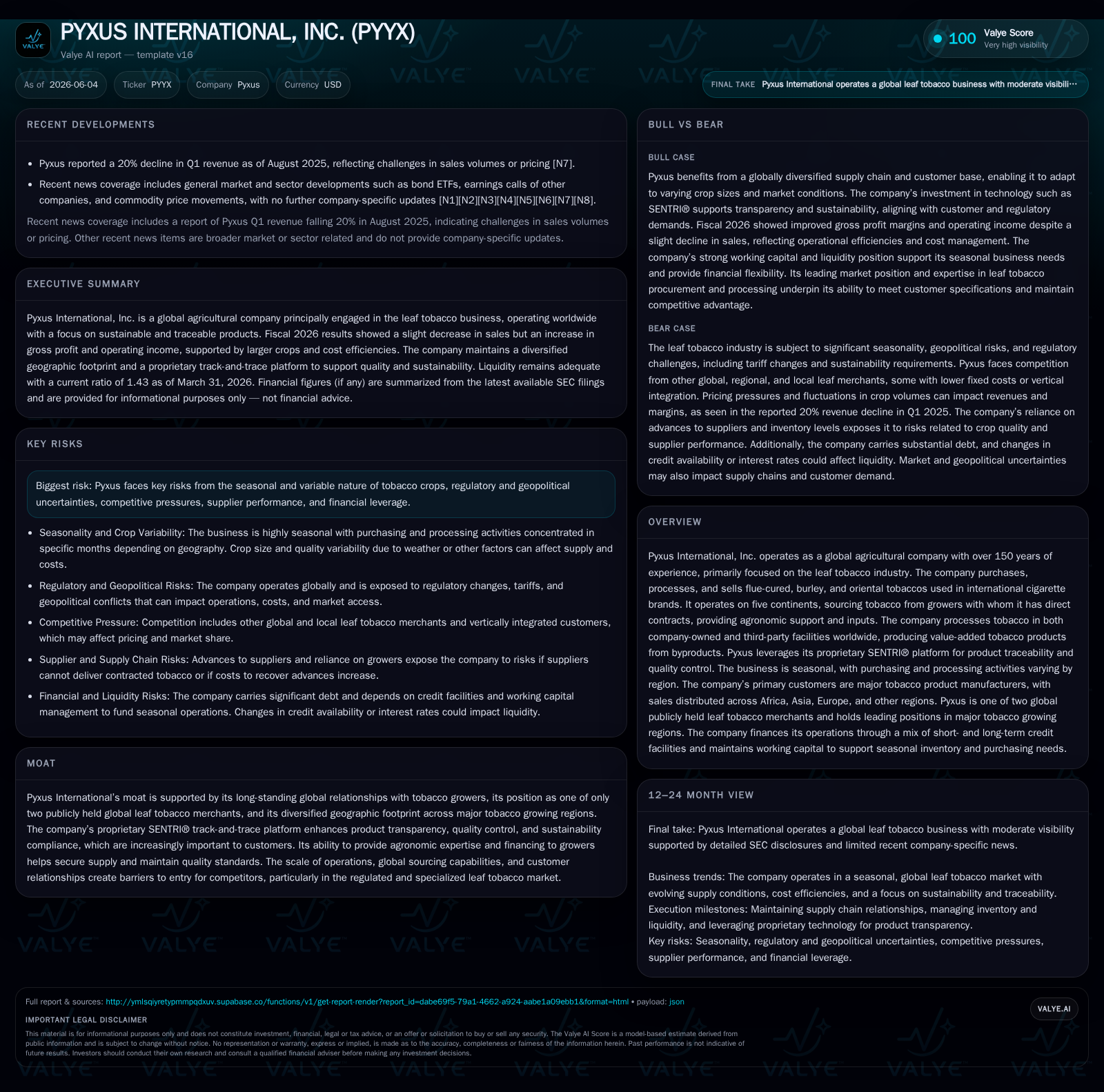
In its latest quarterly filing, Pyxus International reveals a strategic inventory build entering fiscal 2027, supported by record tobacco crops in Africa and South America. This expanded inventory positions the company for carry-over sales despite the global tobacco market shifting from undersupply to oversupply. Pyxus’s unique business model integrates supplier advances, technical agronomy support, and processing scale, reinforced by its proprietary SENTRI® platform that underpins traceability and sustainability compliance. While its diversified global footprint mitigates geopolitical risks, seasonality and financial leverage remain key challenges shaping near-term operational flexibility.
Latest Operating Results Anchor View of Fiscal 2026 Performance
Pyxus International’s latest quarterly report (10-Q filed February 11, 2026) shows a pronounced increase in tobacco inventories heading into fiscal year 2027 — reaching $786.7 million compared with $732.2 million one year earlier [S2], [S1]. This buildup results largely from oversized crops harvested in Africa and South America during fiscal 2026. The increased volume translates into enhanced purchasing scale benefits: lower per-unit procurement costs alongside greater processing volumes that dilute fixed conversion expenses [S1]. Importantly, the global tobacco market shifted over the reporting period from undersupply to a state of oversupply, intensifying pricing pressures but allowing Pyxus to leverage its scale and diversified presence to sustain gross profit expansion and improved operating income versus prior periods [S1].
This inventory glut also sets up the company for elevated carry-over sales in fiscal 2027, mitigating immediate demand risks while requiring capital-intensive working capital deployment ahead of Southern Hemisphere crop purchases already underway [S1]. Management’s commentary underscores a measured buying approach designed to align inventory volumes tightly with customer needs without excessive speculative build.
Leaf Tobacco Procurement Model and Product Offering Dynamics
Pyxus’s business model centers on direct contractual relationships with primarily smallholder farmers across five continents supplying flue-cured, burley, and oriental tobacco types used internationally in cigarette blends [S1]. The company finances many suppliers’ input needs—including seeds, fertilizers, and pesticides—via advances recorded using a cost accumulation accounting method where mark-ups and interest are deferred until crop delivery [S1]. This advance financing not only secures raw material supplies but also establishes effective switching costs through repayable loans tied directly to delivered crop volumes.
Agronomic services represent another differentiator: Pyxus’s technical assistance programs engage closely with growers pre-planting through cure stages to optimize yield quality and output consistency — critical quality signals for cigarette manufacturers [S1]. Upon delivery, raw tobacco enters processing either at company-owned facilities or through third-party processors globally. This flexible capacity mix enables Pyxus to tailor product grades precisely for customer specifications.
Industry Structure: Scaling in a Specialized Global Tobacco Market
Pyxus stands as one of only two publicly held global leaf tobacco merchants—a niche oligopoly shaped by the highly regulated nature of tobacco agriculture and manufacturing supply chains [S1]. The firm’s extensive geographic procurement footprint spanning Africa, Asia, Europe, North America, and South America provides a crucial barrier against localized climatic shocks, geopolitical disruptions, or import/export regulations that might otherwise constrict supplies.
Regulatory scrutiny from multiple government regimes enforces stringent quality standards around chemical residues and sustainability compliance—areas where Pyxus’s operational scale coupled with its supplier relations offers competitive advantage [S1]. The scale also introduces economies of scope that regional or private competitors often cannot match, especially given the seasonally concentrated nature of procurement cycles requiring significant working capital lines.
Leveraging Technology: The SENTRI® Traceability Advantage
Technology investments further differentiate Pyxus within this specialized market. Its proprietary SENTRI® track-and-trace platform delivers a full product provenance record spanning grower inputs through curing processes all the way to shipment [S1]. Such transparency is increasingly demanded by major cigarette manufacturers who face mounting pressure from regulators and consumers alike on sustainability metrics.
By providing independently verified data on agricultural practices and product quality attributes, SENTRI® enhances customer switching costs—manufacturers rely on this traceability assurance as part of their own risk management frameworks. Consequently, it supports higher retention rates amid volatile market conditions while aligning Pyxus strategically with the evolving regulatory landscape focusing on supply chain responsibility.
Growth Drivers: Geographic Diversification and Crop Size Benefits
Growth drivers revolve around Pyxus’s ability to capitalize on large crop years that reduce unit costs via agricultural economies of scale [S1]. Larger harvests in African origins such as Malawi combined with South American expansions provide abundant raw material volumes that bolster negotiating leverage with suppliers while spreading fixed processing overhead across more kilos.
Geographic diversification lets management navigate region-specific risk events — whether political instability or tariffs — without jeopardizing global supply continuity. Moreover, the company applies "measured buying," balancing inventory expansion against capital costs funded primarily through extensive borrowing facilities including foreign seasonal credit lines ($1.05 billion total capacity) complemented by asset-based lending facilities offering an additional $150 million revolver capacity.
Such flexible capital structuring supports seasonal peak funding needs without locking cash into non-productive assets.
Risks and Constraints: Seasonality, Regulation, and Debt Load
Despite strengths, Pyxus faces notable constraints. Seasonality inflicts sharp volatility on working capital profiles: peak quarters coincide with crop acquisition periods demanding surges in short-term borrowings.
This debt-driven operational gearing translates into leverage risks given total debt near $933 million offset partially by $134 million cash balances resulting in net debt around $799 million as of March 31, 2026 [F1]
Regulatory uncertainty compounds risk—the sector confronts shifting tariffs (noted recently), environmental compliance demands tightening globally, plus currency exchange fluctuations impacting cross-border transaction economics negatively affect margins unpredictably [S18].
Forward Look: Key Milestones and Demand Indicators to Monitor
Looking ahead into fiscal 2027 (starting April 2026), key milestones will center on Southern Hemisphere crop buy-ins which are already underway at scale consistent with last year’s large yields [S3], as well as quarterly progress reports on inventory depletion rates indicating demand traction versus carry-over stock accumulation.
Monitoring changes in tariff policies or geopolitical developments affecting primary sourcing countries will be critical since these could quickly influence supply costs or volumes. Tracking agronomy team success via yield outcomes will serve as an early proxy for delivered tobacco quality next cycle—an essential input for maintaining customer satisfaction under tight product specifications.
Liquidity markers such as renewal terms on foreign seasonal credit lines or usage trends under the ABL Credit Facility ($150 million max availability) will offer important visibility into financial flexibility during peak funding windows.
Financial Health Summary: Liquidity, Debt and Capital Resources
As of March 31, 2026, Pyxus maintained a current ratio of approximately 1.43 reflecting current assets around $1.33 billion against current liabilities near $933 million supported notably by robust inventory values [F1]. Cash & equivalents stood at $134 million providing some cushion against short-term obligations although substantial former borrowing usage peaks warrant attention.
The company controls nearly $933 million total debt composed mainly of short-term foreign seasonal lines ($477 million) and long-term senior secured instruments (~$456 million) all governed under various intercreditor agreements specifying lien priorities between revolving credit facilities vs term loans.
Management continues efforts towards optimizing capex (~$38 million planned FY27 including warehouse upgrades) balanced against deleveraging opportunities via potential prepayments or refinancing subject to market conditions confirming pragmatic financial stewardship despite cyclical headwinds [S20]
This analysis is grounded strictly in publicly disclosed SEC filings and validated corporate disclosures as of June 4, 2026 ([S1]-[S29], [F1]). It does not constitute investment advice but aims to elucidate Pyxus International Inc.'s operational dynamics amidst evolving industry structures.
Disclaimer: This is research-only, informational analysis and not investment advice. It may include AI-generated interpretation and general industry context. Always verify important details using primary sources.

Comments