
Quantum Computing Inc.'s Expansion Through Photonics Innovation and Strategic Acquisition
Examining how Quantum Computing Inc.’s proprietary photonics technology and recent Luminar Semiconductor acquisition shape its growth amid financial losses.
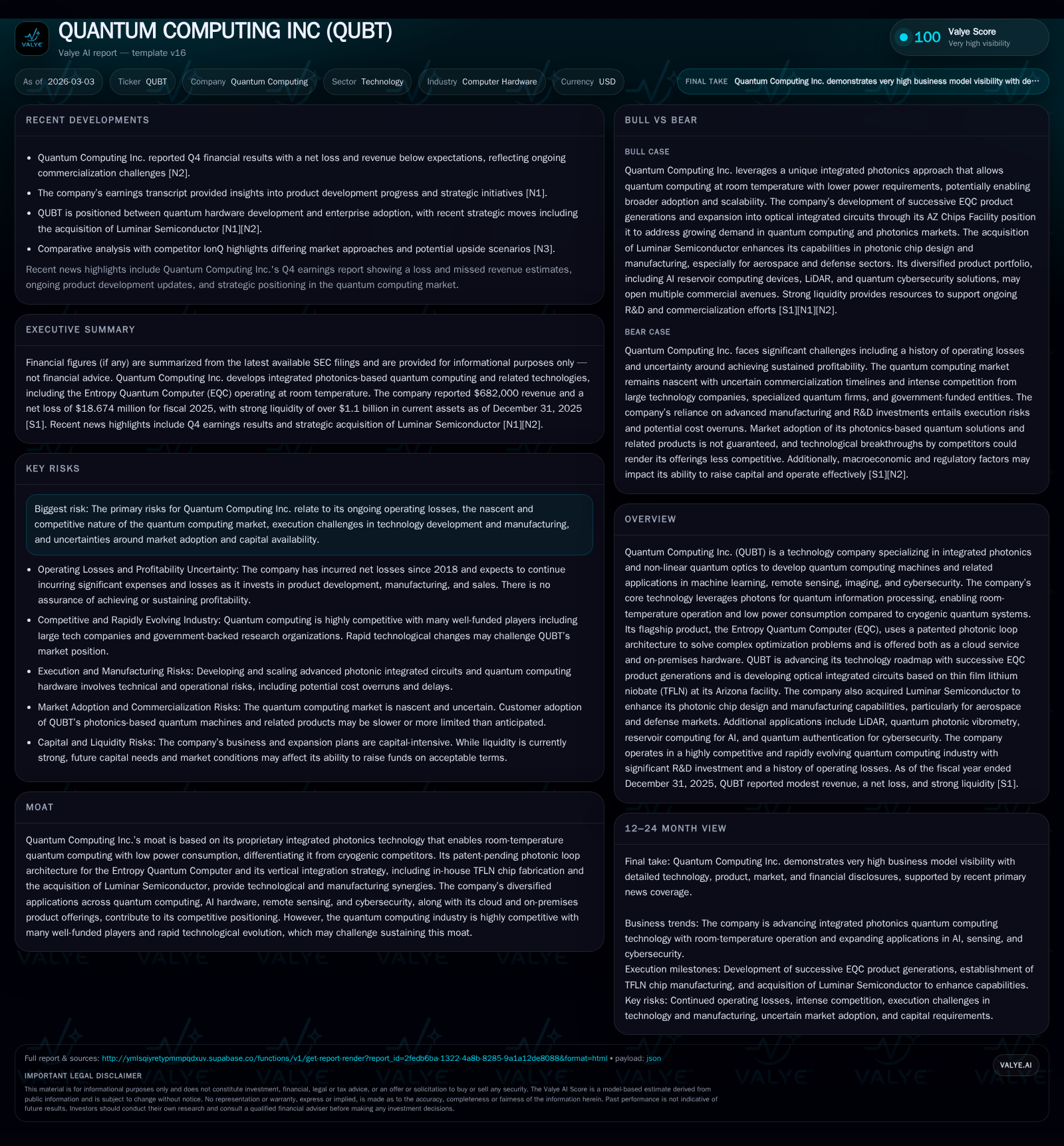
Quantum Computing Inc. (QUBT) pursues growth by advancing integrated photonics quantum computing architectures that operate at room temperature, offering cost and power advantages over traditional cryogenic systems. Despite promising 82.8% YoY revenue growth in 2025, the company continues to face steep operating losses and elevated cash burn as it invests heavily in R&D and manufacturing scale-up. The strategic acquisition of Luminar Semiconductor in early 2026 bolsters QUBT’s vertical integration, enhancing chip fabrication capabilities aligned with its thin film lithium niobate platform. Sustained innovation and market adoption will be critical as competition intensifies from well-funded incumbents and emerging players.
Historical Financial Performance and Growth Drivers
Quantum Computing Inc. has demonstrated notable albeit nascent revenue traction, growing top-line from $373k in FY2024 to $682k in FY2025—a robust 82.8% year-over-year increase backed by initial sales of EQC products and related services [F1]. This growth, while impressive percentage-wise, remains from a very small base reflective of the company’s early commercialization stage.
However, operating income sharply deteriorated, nearly doubling operating losses to -$51.1 million in 2025 from -$25.9 million in 2024 [F1]. This trend underscores significant investment into technology development and operational expansion. Net income improved from a steep -$68.5 million loss in 2024 to -$18.7 million in 2025 but remains negative overall [F1].
Operating cash flow declined by approximately 86.9%, reaching -$30.3 million for 2025 compared to -$16.2 million the prior year [F1]. This rapid cash burn reflects the high costs associated with product research, manufacturing preparations, and sales efforts characteristic of a deep early-stage tech company expanding its photonic quantum computing platform.
Capital expenditures rose modestly to $6.7 million in FY2025 (+10.8% YoY), supporting infrastructure build-out such as its Arizona TFLN fabrication facility and production line enhancements [F1][S23]. Equity ballooned exceptionally to roughly $1.6 billion by end-2025 due to fundraising activities supporting these investments but combined with persistent net losses results in a negative approximate ROE of -1.2% [F1].
Historical performance (annual)
| FY | Rev ($) | Net ($mm) | CFO ($mm) | OpInc ($mm) | Rev YoY | Net YoY |
|---|---|---|---|---|---|---|
| 2025 | 682000 | -19 | -30 | -51 | +82.8% | +72.8% |
| 2024 | 373000 | -69 | -16 | -26 | +4.2% | -153.7% |
| 2023 | 358000 | -27 | -18 | -26 | +163.9% | +30.0% |
| 2022 | 135648 | -39 | -18 | -37 |
Source: SEC companyfacts cache [F1].
Capital returns and efficiency (annual)
| FY | Div ($) | FCF ($mm) | ROE% |
|---|---|---|---|
| 2025 | 215000 | -37 | -1.2 |
| 2024 | 215000 | -22 | -63.9 |
| 2023 | 865000 | -20 | -39.3 |
| 2022 | -18 | -51.5 |
Source: SEC companyfacts cache [F1].
Table: Annual core financial metrics highlight escalating revenues from nascent operations alongside surging operating losses fueled by R&D and capex commitments [F1].
Innovative Technology Platform: Integrated Photonics at Room Temperature
At the heart of Quantum Computing Inc.’s differentiation is its proprietary integrated photonics platform that enables quantum computing without the need for cryogenic cooling systems typical of superconducting or ion-trap qubit technologies [S1]. Using photons for information processing — specifically employing a patented photonic loop architecture embedded within its Entropy Quantum Computer (EQC) — QUBT achieves scalable quantum bits (qubits) operation at room temperature with markedly lower energy consumption.
This approach leverages thin film lithium niobate (TFLN), a mature electro-optic material known for low loss optical modulation capability pivotal for integrated photonic chips [S20]. The company's internal fabrication capabilities at its Arizona facility help ensure tight control over component quality while supporting vertical integration advantages key to maintaining IP defensibility.
Furthermore, the TFLN-based photonic integrated circuits facilitate the gradual replacement of discrete optical components with manufacturable chip-scale devices enhancing product scalability [S21]. This design modularity optimizes performance while potentially lowering unit costs compared to traditional cryogenic models.
Recent Strategic Moves: Acquisition of Luminar Semiconductor
In February 2026, QUBT completed its acquisition of Luminar Semiconductor, an addition that strengthens the company’s semiconductor process prowess complementary to its TFLN photonics foundation [N7]. Luminar brings advanced chip fabrication knowhow, design expertise, testing services, and specialized components particularly relevant to aerospace and defense markets.
This transaction aligns with QUBT’s broader strategy of deepening vertical integration across both material platforms—optical and semiconductor—aimed at creating synergies that accelerate their photonic quantum hardware roadmap [S20]. Combining Luminar’s capabilities supports advanced packaging efforts for integrated devices such as laser diodes and photodetectors tightly coupled with EQC systems.
The acquisition broadens product application horizons including remote sensing modalities like LIDAR and emerges as a foundational pillar enabling the next generation EQC devices slated for future commercialization push [S20].
Market Positioning and Competitive Moat in Quantum Hardware
Quantum Computing Inc.’s competitive moat stems mainly from its distinct room-temperature operational capability sustained by proprietary photonic loop architecture—a contrast to dominant industry players relying on bulky cryogenic apparatuses (e.g., IBM’s superconducting qubits or IonQ’s trapped ion approaches) [S9][S19][N8].
Its dual delivery model offering both cloud-hosted access and on-premises rack-mountable EQC units allows flexibility appealing to institutions constrained by infrastructure or privacy requirements [S21]. Offering standard server room compatibility without special power or shielding needs differentiates it further against competitors requiring costly breaching of data center environments.
Nonetheless, competition is intense with over seven hundred companies globally invested variously across hardware platforms including initiatives by large tech conglomerates such as Microsoft, Google/Alphabet, Amazon, Intel alongside focused startups like Rigetti or PsiQuantum capturing mindshare and venture capital inflows [S9][S19]. Furthermore, specialized sovereign programs add geopolitical complexity that demands rapid technical progress timelines potentially challenging long-term moat sustainability.
Growth Catalysts and Market Constraints Ahead
The sustained rise of high-complexity computational problems tied to AI optimization workloads underpins demand prospects for QUBT’s EQC products targeting "hard problem" classes unsolvable efficiently by classical computing methods [S1][N1]. Moreover:
- Expansion into adjacent fields such as quantum-enabled machine learning hardware accelerators,
- Novel applications leveraging remote sensing/imaging through LIDAR technology pillars,
- Enhanced cybersecurity frameworks featuring quantum-grade authentication solutions, offer additional vectors for diversified revenue streams.
However, key growth constraints remain substantial:
- Difficulty scaling integrated photonics technology complexity beyond prototype stages,
- Slow commercial adoption rates hindered by legacy classical system entrenchment,
- Requirement for ongoing capital infusion given continuous R&D outlays,
- Potential supply chain fragilities exacerbated by evolving export controls and geopolitical tariffs affecting component sourcing [S14][S21][S25][S29], all moderating near-to-mid-term scaling velocity.
Financial Health: Capital Allocation, Cash Flow, and Profitability Trajectory
QUBT strategically channels capital predominantly into intensive research & development efforts alongside incremental capex aimed at expanding its Arizona-based thin film lithium niobate chipmaking capacity [F1][S23]. The company recorded an uptick in capex spending to $6.7 million in FY2025 representing a controlled ramp-up aligned with manufacturing scale aspirations.
Despite this disciplined capital deployment, cash flow remains deeply negative with operating cash flow plummeting almost 87%, while free cash flow settled near negative $37 million reflecting ongoing burn rate without offsetting operational profitability [F1]. Dividend distributions are minimal ($215k reported up through FY2024), consistent with early-stage reinvestment priorities rather than shareholder returns.
QUBT maintains robust liquidity cushioning over $737 million cash & equivalents at year-end providing runway to support development through expected near-term milestones but financial discipline will be critical pending broader revenue uplift [F1].
Near-Term Milestones and What to Watch in Product Development
The company has not issued hard guidance but important focal points include:
- Progression toward commercially viable second-generation EQC products that effectively integrate discrete components onto scalable TFLN photonic chips,
- Deliverables related to Luminar Semiconductor integration encompassing chip-scale device incorporation enhancing system reliability,
- Customer wins especially across enterprises seeking hybrid cloud/on-prem quantum compute deployments amid AI optimization demand surges,
- Demonstration of use cases spanning remote sensing applications such as quantum-enhanced LIDAR implementations validating market readiness claims [N10][N1][S1].
These markers represent operationalization thresholds bridging lab-phase achievements towards scalable commercial traction currently lacking clear timelines thus necessitating careful quarterly progress tracking.
Risks from Execution Challenges to Market Adoption Uncertainties
Quantum Computing Inc faces considerable risks inherent to pioneering nascent technology segments compounded by ongoing significant operating losses raising concerns around financial sustainability if revenue ramps lag expectations [S4][S5][S6][N2]:
- Execution risk looms large given complexity pursuing highly integrated photonics quantum devices requiring multidisciplinary alignment across optics/electronics/fabrication domains,
- Intensifying competitive pressures potentially eroding pricing power impacting margin structures,
- Intellectual property disputes or infringements may arise increasing litigation costs or constraining technology use despite existing patent portfolio protections,
- Market adoption uncertainties pose challenges; customer willingness-to-pay for nascent quantum advantage solutions is unproven especially vs entrenched classical HPC alternatives,
- Dependence on external funds may introduce dilution risks if capital markets turn adverse before profitability thresholds are met.
Legal proceedings including shareholder litigations highlight governance distractions though unresolved cases currently hold limited financial impact threat according to filings [S4][S7][S10]. Supply chain-related geopolitical risks linked to component sourcing must also be closely monitored given relevance of rare materials in TFLN-based fabrication processes [S14][S21].
Disclaimer: This analysis is based strictly on documented filings ([F1]/[S#]) and publicly reported news ([N#]) at the time indicated. It does not constitute investment advice or recommendations but aims to provide a comprehensive factual overview referencing measurable financial data alongside qualitative business considerations regarding Quantum Computing Inc.'s strategy within the dynamic quantum computing sector.
Disclaimer: This is research-only, informational analysis and not investment advice. It may include AI-generated interpretation and general industry context. Always verify important details using primary sources.

Comments