
Ryder System Inc.: Navigating Fleet Management and Logistics Amidst Market Volatility
A comprehensive examination of Ryder’s 2025 financial performance, strategic positioning, and operational risks within the transportation and logistics sector.
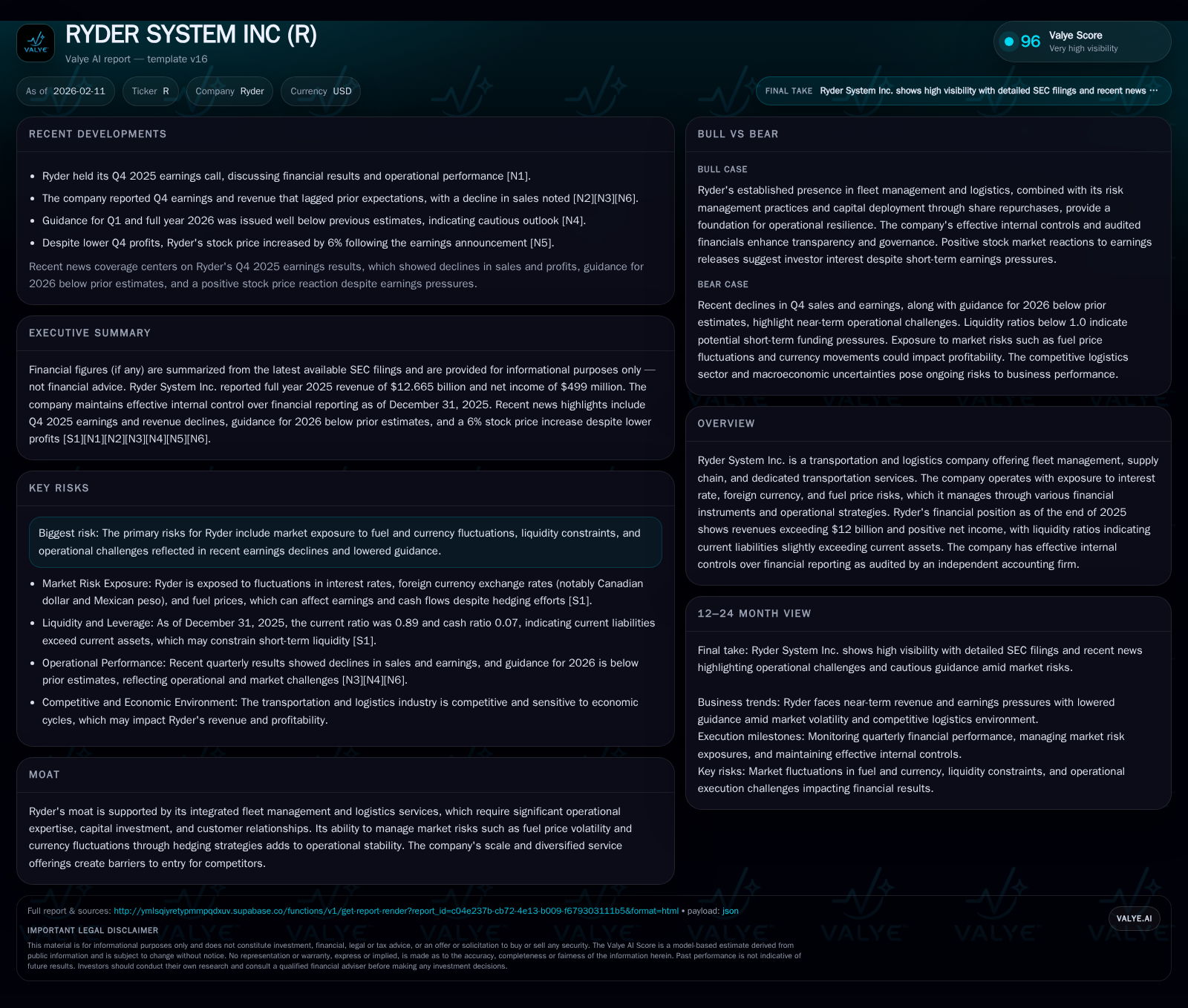
Ryder System Inc. reported $12.7 billion in revenue and net income near $499 million for fiscal year 2025, marking steady top-line growth yet enduring margin pressures amid cost headwinds. The company’s integrated fleet management and logistics business continues to underpin its moat, supported by hedging mechanisms against fuel, interest rate, and currency risks. While liquidity ratios indicate current liabilities slightly surpass current assets, strong operating cash flow generation and prudent capital expenditure management provide cushioning. However, recent earnings missed consensus estimates, accompanied by cautious guidance reflecting a challenging macro environment with elevated fuel price fluctuations and competitive pressures.
Overview of Ryder System Inc.
Ryder System Inc. operates principally in the transportation and logistics arena, offering a range of services including fleet management solutions (FMS), dedicated transportation services, and supply chain consulting. With annual revenues surpassing $12.6 billion in 2025 and positive net income approaching half a billion dollars, Ryder remains a formidable player within its niche despite headwinds encountered during the year [F1]. Its ability to integrate rental fleets, lease programs such as ChoiceLease, and expanded logistics offerings allows the company to provide tailored solutions that create sticky customer relationships and competitive barriers.
The company reported a mixed fourth quarter for 2025: revenues declined relative to expectations while profitability was constrained by external cost pressures—chiefly fuel price fluctuations—and internal operational challenges outlined in its earnings call transcripts [N1][N3]. Despite the hiccup in quarterly results, Ryder issued forward-looking guidance reflective of a cautious outlook but underscored robust operating cash flow levers that have supported its reinvestment strategy.
Financial Performance Highlights
Ryder's 2025 fiscal year showed sequential improvements compared with prior periods on several fronts:
- Revenue: Total revenues amounted to approximately $12.65 billion for 2025, marking steady growth due partly to expansion in fleet management contracts despite softness in certain rental segments.
- Net Income: Earnings stood at around $499 million; while positive, margins reflected pressure primarily from rising costs associated with fuel volatility and inflationary wage adjustments.
- Operating Cash Flow: Net cash provided by operations rose to an impressive $2.6 billion due to better working capital management and lower tax outflows relative to previous years.
- Free Cash Flow: Enhanced free cash flow generation at $946 million was driven by reduced capital expenditure spending compared with prior years' elevated investments [S1][F1].
Capital allocated towards revenue-earning equipment—mainly trucks under long-term leases like ChoiceLease—declined noticeably in 2025 ($1.5 billion) compared with preceding years where it exceeded $2 billion annually. This pullback reflects measured fleet renewal aligned with anticipated demand growth stabilization [S1]. Operating property investments remained modest relative to overall capital employed.
Liquidity & Capital Structure
Despite strong cash flow metrics backing Ryder’s operations, the company’s balance sheet exhibits tight near-term liquidity positioning:
- Current assets stood at approximately $2.47 billion against current liabilities near $2.78 billion resulting in a current ratio of roughly 0.89, indicating marginal short-term coverage [F1].
- Cash plus equivalents totaled about $198 million—a figure that stresses the importance of ongoing cash conversion cycles given working capital needs.
- Ryder addresses this through flexible borrowing strategies including revolving credit facilities alongside a balanced composition of fixed-rate ($6.1 billion) versus variable-rate debt ($1.4 billion), augmented by interest rate swaps designed to insulate earnings from rate swings [S1].
Overall leverage is managed prudently but will require vigilant attention amid economic uncertainties affecting credit markets.
Risk Profile & Hedging Strategies
Interest Rate Risk
The firm holds significant fixed-rate debt bearing a weighted average coupon around 5.10%, buffered by interest rate swap agreements converting portions into variable rates tied to SOFR benchmarks. Scenario analyses show that a theoretical 10% rise in market rates impacts fair value assessments by approximately $83 million with moderate pre-tax earnings effect (~$31 million) — manageable within overall earnings volatility models [S1].
Currency Exposure
Foreign exchange risks arise mostly from Canadian and Mexican operations. These exposures are largely neutralized via matching asset-liability positions denominated in local currencies or through hedging instruments like forward contracts when prudent. Net impacts from shifts (e.g., 10% USD strength) are deemed immaterial to consolidated results given limited transactional volume outside U.S. dollars [S1].
Fuel Price Volatility
Fuel expenses constitute a major input cost subject to broad market fluctuations; Ryder’s contractual arrangements generally permit passing such costs through to customers reducing direct profitability impact during stable periods. However, abrupt fuel price changes can compress margins short term as pricing lags occur due to contract terms or delayed adjustments [S1]. This remains one of the most critical operational risks affecting yearly earnings consistency.
Market Position & Competitive Moat
Ryder's competitive advantage stems from its integrated service offering which combines:
- Extensive leased vehicle fleets enabling predictable revenue streams via multiyear contracts.
- Dedicated transportation services with embedded logistics expertise facilitating complex supply chain solutions.
- Operational scale requiring high capital intensity that deters new entrants while deepening customer trust through integrated technology platforms.
Additionally, its proactive financial risk mitigation approaches addressing fuel cost unpredictability along with currency and interest rate exposures bolster stability amidst cyclical industry challenges [meta overview].
Recent Operational Developments & Outlook
Recent quarterly disclosures revealed adjusted earnings falling short of analyst forecasts attributed primarily to softer freight volumes and durable goods demand slowdown in Q4 2025 [N3][N10]. Consequently, Ryder updated first quarter and full fiscal year 2026 guidance well below consensus expectations citing ongoing macroeconomic uncertainties including inflationary pressures impacting customer budgets or procurement pacing [N11].
Nonetheless, market reaction has shown mixed sentiment punctuated by stock appreciation following the release owing partly to confidence in Ryder’s fundamental resilience backed by strategic leasing portfolio adjustments aiming at longer-term margin improvement [N9][N13].
Capital Allocation & Shareholder Returns
Ryder maintains ongoing share repurchase programs authorized since late 2023 focused on leveraging surplus cash flow without jeopardizing investment capacity for growth initiatives or deleveraging opportunities [S2]. During Q3 2025 alone, the company repurchased over half a million shares averaging around $183 per share across diverse open-market transactions.
Balancing fleet reinvestments—which are expected to rebound moderately toward $2.4 billion in gross capex for 2026—with shareholder returns will remain a key management priority especially considering evolving industry dynamics marked by technology adoption (e.g., telematics), regulatory changes targeting emissions standards, and shifting customer supply chain needs.
Industry Context & Challenges (Analysis)
Transportation and logistics continue undergoing transformative pressures catalyzed by e-commerce expansion demands alongside sustainability imperatives urging newer cleaner fleet vintages creating capital allocation complexities for firms like Ryder. Moreover, labor market tightness across trucking sectors may exacerbate wage inflation limiting margin expansions despite productivity-enhancing automation efforts being tested across operations.
Geopolitical trade patterns shifts influencing cross-border freight flows between Canada, Mexico, and the U.S.—regions central to Ryder's footprint—also add layers of uncertainty impacting contract renewals or pricing models requiring nimble adaptation from fleet managers.
Conclusion
Ryder System Inc.’s position as an integrated fleet management and logistics provider affords it both scale advantages and operational synergies instrumental in navigating volatile markets characterized by fuel price swings, rising borrowing costs, and foreign exchange complexities. While recent earnings results underscore hurdles ahead necessitating prudence reflected in lowered guidance for early 2026 periods, robust cash flow generation coupled with measured capital expenditure discipline supplies foundational support for sustainable service delivery.
The company’s continued focus on hedging financial risks strategically paired with maintaining customer-centric contract structures underpin its moat even as broader transportation industry challenges persist including shifting regulatory regimes and technology disruptions poised to reshape competitive landscapes moving forward.
This analysis is intended solely for informational purposes reflecting publicly available information as of early 2026 without any recommendation on securities transactions or investment decisions involving Ryder System Inc.
Disclaimer: This is research-only, informational analysis and not investment advice. It may include AI-generated interpretation and general industry context. Always verify important details using primary sources.

Comments