
Redwire Corp's Aerospace Ambitions: Intensifying Losses Amid Strategic Expansion
Redwire Corp’s growth through acquisition and technology innovation deepens losses and cash flow challenges despite expanding aerospace and defense capabilities.
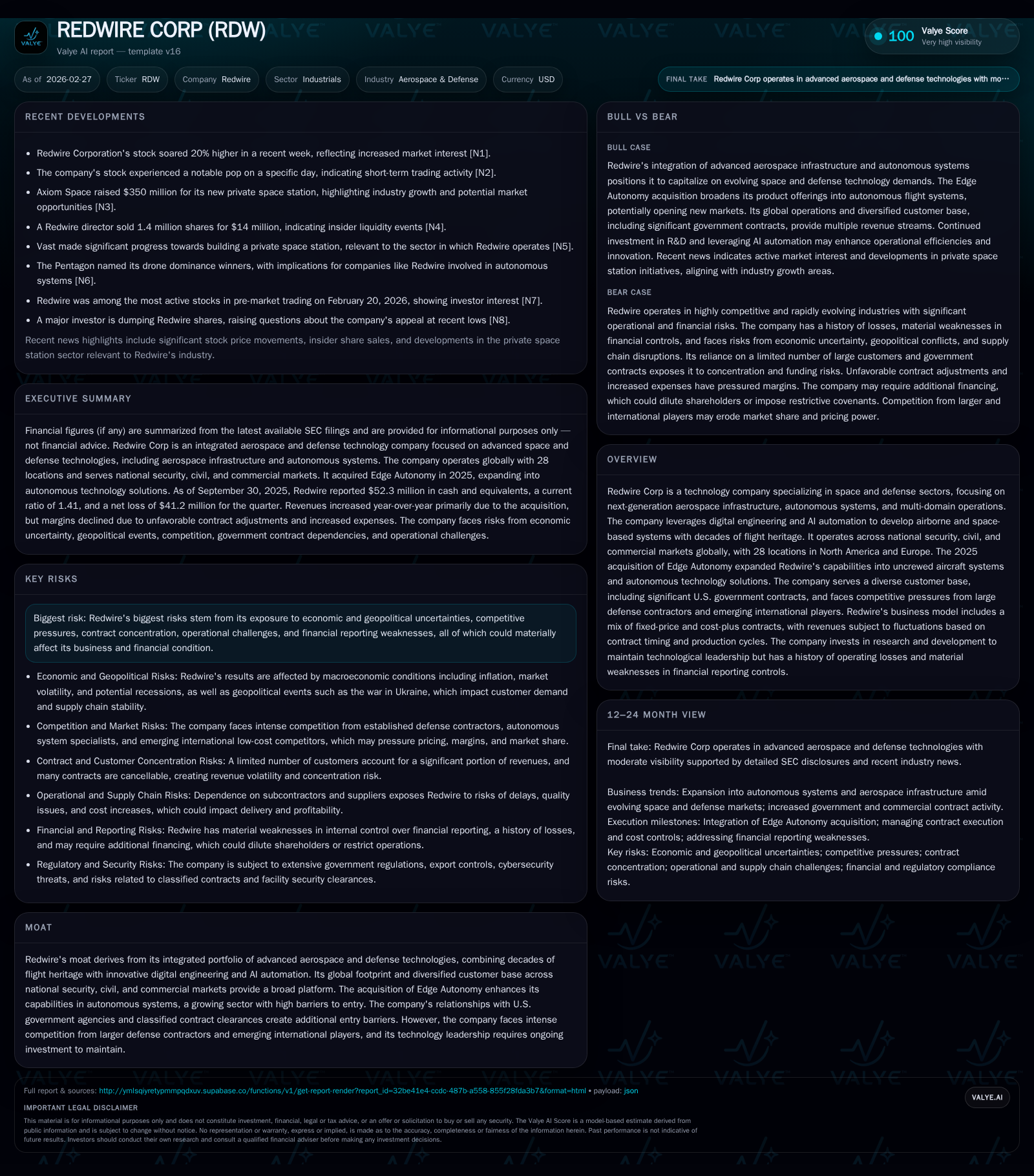
Redwire Corp has positioned itself in next-generation aerospace infrastructure and autonomous systems, notably with its 2025 acquisition of Edge Autonomy. While this broadens product offerings and market reach, the company faces mounting operating and net losses, with operating income deteriorating by over 444% year-over-year in 2025 to a negative $229.7 million. Increased capital expenditures and a significant operating cash flow deficit signal investment intensity amid integration hurdles. Competitive pressures, contract mix volatility, and geopolitical risks compound near-term challenges. Monitoring integration milestones and cash burn will be critical for assessing Redwire's ability to translate ambitions into sustainable financial performance.
Historical Financial Performance
Redwire Corp's financial results over recent years illustrate escalating losses during its strategic aerospace expansion. Operating income declined from a loss of $14.6 million in 2022 to a significant deficit of $229.7 million in 2025—a deterioration exceeding 444% year-over-year [F1]. Net income similarly worsened from -$114.3 million in 2024 to -$226.6 million in 2025.
Operating cash flow swung further negative to -$177.3 million in 2025 while capital expenditures rose sharply by over 110% to $13.5 million, reflecting intensified investment activity concurrent with acquisition integration efforts [F1].
Historical performance (annual)
| FY | Net ($mm) | CFO ($mm) | OpInc ($mm) | Capex ($mm) | Net YoY |
|---|---|---|---|---|---|
| 2025 | -227 | -177 | -230 | 13 | -98.2% |
| 2024 | -114 | -17 | -42 | 6 | -319.3% |
| 2023 | -27 | 1 | -16 | 6 | +79.1% |
| 2022 | -131 | -32 | -146 | 4 |
Source: SEC companyfacts cache [F1].
Capital returns and efficiency (annual)
| FY | FCF ($mm) | ROE% |
|---|---|---|
| 2025 | -191 | -21.4 |
| 2024 | -24 | 60.6 |
| 2023 | -4 | 62.7 |
| 2022 | -35 | 1949.2 |
Source: SEC companyfacts cache [F1].
Note: ROE figure shown for FY2025 only due to negative equity values in prior years impacting meaningful calculation.
Strategic Acquisition: Edge Autonomy Integration
The acquisition of Edge Autonomy in 2025 marked Redwire's entry into autonomous systems and uncrewed aircraft technology markets, diversifying its aerospace portfolio [N1][S1]. This strategic move supports growing demand for multi-domain operations leveraging automation.
However, the transaction introduced integration complexities and incremental costs that have pressured margins in the near term [N1][S2][S6]. Management highlights expenses related to reorganization, system harmonization, and scale-up investments within classified government applications as key contributors to the current financial impact.
Realizing anticipated synergies depends on successfully aligning engineering cultures without compromising established flight heritage quality standards.
Competitive Landscape and Technological Positioning
Redwire operates at the intersection of legacy aerospace expertise and advanced AI-enabled engineering essential for evolving defense capabilities [S7][S9]. Competition spans established large defense contractors with extensive portfolios as well as emerging international competitors exerting pricing pressure particularly in autonomy sectors.
The commercial drone sector's rapid innovation lowers barriers for aerial unmanned systems compared to traditional defense procurement cycles, intensifying pricing competition [S9]. Sustained R&D investment focused on durability, reliability validated through flight history, and regulatory compliance is critical to maintain differentiation.
Revenue Recognition and Contractual Dynamics
The company's revenues are recognized primarily using percentage-of-completion cost-to-cost methods across fixed-price, cost-plus-fee, and time-and-material contracts [S1][S2]. Fixed-price contracts offer higher profit potential but entail risk of overruns; cost-plus contracts provide lower but more stable margins.
Earnings volatility arises from frequent estimate adjustments at completion causing material catch-up entries affecting reported revenues and gross profit within periods [S2]. Concentration among major government customers accounts for approximately 40% of revenue combined with cancellable contracts posing realization risks if programs end prematurely or funding shifts occur [S16].
Liquidity Position and Capital Allocation
As of December 31, 2025, Redwire held approximately $88.4 million in debt alongside $35 million available under revolving credit facilities [F1][S4]. Cash reserves stood near $94.5 million providing a current ratio around 1.62—a moderate buffer for near-term obligations but insufficient for sustained capital-intensive operations absent improved operating cash flows.
Negative operating cash flow totaling $177 million against capital expenditures of $13 million underscores ongoing funding requirements primarily met through internal resources supplemented by debt financing linked to acquisitions [F1][S6]. Debt agreements contain covenants restricting further borrowings without meeting compliance metrics necessitating conservative capital deployment.
Given persistent losses and negative free cash flow generation, no dividends or stock repurchases have been declared; shareholder returns remain subordinate to reinvestment priorities and liquidity preservation strategies [F1][S4].
Outlook and Risks
Geopolitical factors notably influence Redwire’s business environment—sales related to customers impacted by the Ukraine conflict represented about 3% of total revenues in 2025 but may decline if hostilities abate or support changes [N1][S24].
Supply chain inflationary pressures alongside tariffs on raw materials sourced globally could compress margins absent offsetting measures through pricing or efficiency gains [S25][S26]. Regulatory complexities including ITAR compliance add operational burden while emerging orbital debris mitigation regulations may affect product deployment timelines or increase costs [S14].
Customer concentration elevates risk as loss or non-renewal of key contracts could significantly reduce revenues; cancellable backlog terms introduce uncertainty around revenue conversion timing [S16][S21]. Cybersecurity threats related to proprietary data protection and AI usage represent additional operational risks potentially affecting reputation or incurring legal liabilities if inadequately managed [S24].
Forward-Looking Considerations
Key upcoming milestones include progress on Edge Autonomy integration measured by synergy realization versus planned expenses; stabilization or improvement in operating cash flows indicating scaling efficiencies; contract wins demonstrating traction especially within national security segments leveraging autonomous technologies [N2][N3][S16].
Investors should monitor backlog conversion trends given government procurement delays alongside shifts in contract mix between fixed-price versus cost-plus arrangements that directly influence margin profiles.
Maintaining a leadership position in R&D through timely AI technology refreshes remains essential amid accelerated industry innovation cycles to prevent erosion of competitive advantage.
This analysis incorporates publicly available SEC filings through February 2026 along with recent management commentary without offering investment advice or extrapolative forecasts.
Disclaimer: This is research-only, informational analysis and not investment advice. It may include AI-generated interpretation and general industry context. Always verify important details using primary sources.

Comments