
Ring Energy Faces Operational Setbacks and Debt Management Challenges After Years of Profitability
Ring Energy’s 2025 financials reveal a stark operational loss abruptly interrupting years of profit growth, with liquidity strains and leadership shifts emblematic of sector risks.
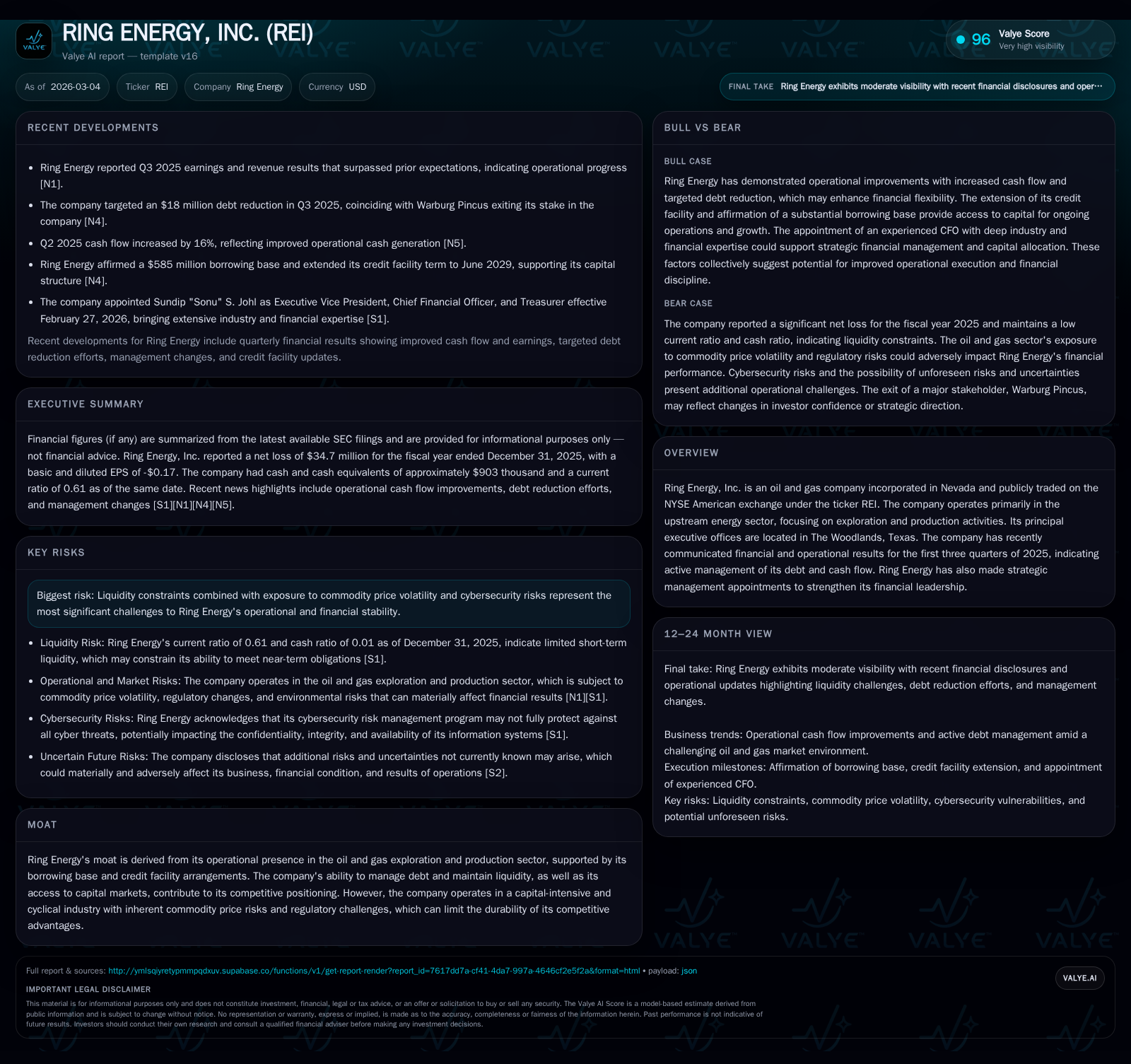
After several years of robust profitability, Ring Energy experienced a sharp reversal in fiscal year 2025, reporting an operating loss of $34.3 million and net loss of $34.7 million. This downturn was accompanied by liquidity pressures evidenced in a sub-unity current ratio and intensified debt management activities. The company’s recent appointment of a seasoned energy finance executive as CFO signals a strategic attempt to stabilize financial governance amidst the challenging commodity price environment and capital-intensive upstream operations. Key forward-looking metrics will revolve around refinancing events, commodity price recovery, and deleveraging progress.
Sustained Profit Growth Until 2024: Drivers and Performance Trends
Ring Energy exhibited robust financial performance across FY2022 to FY2024 marked by consistent and significant operating income expansion. Operating income progressed from $191.7 million in 2022 down slightly to $145.8 million in 2023 before settling at $132.9 million in 2024; despite this softening between 2022-24, profit margins were historically strong within the capital-intensive upstream oil and gas sector where commodity prices can heavily influence returns [F1]. Net income reflected a similar trajectory, with gains diminishing from $138.6 million in 2022 to $67.5 million in 2024 but remaining positive throughout the period.
These years suggest effective upstream operational management, optimized production efficiencies, and perhaps favorable commodity pricing that collectively supported profitability before the downturn.
Abrupt Operating Income Decline and Net Loss in 2025: What Changed?
In stark contrast to prior years’ results, fiscal year 2025 saw Ring Energy plunge into an operating loss of approximately $34.3 million alongside a net loss close to $34.7 million—a swing representing roughly a -125.8% decline in operating income year-over-year and more than -151% decline in net income compared with prior periods [F1]. This substantial reversal signals significant operational difficulties or adverse external factors impacting revenues or cost structures.
Management commentary around this timeframe intimates influences such as commodity price volatility adversely pressuring revenue streams combined possibly with higher operational expenses or impairment charges (details not itemized here). These results underscore the vulnerability inherent within upstream players heavily tethered to fluctuating energy markets.
Liquidity Pressure and Capital Structure Dynamics Amid Market Cyclicality
The company’s liquidity position illustrated pronounced stress entering year-end 2025: current assets totaled roughly $62.1 million against current liabilities approximating $101 million resulting in a low current ratio near 0.61—below the typical healthy benchmark above unity—highlighting potential challenges managing short-term obligations without resorting to asset sales or external financing [F1].
Ring Energy has engaged frequently with its secured lenders throughout late 2025 into early 2026 concerning borrowing base reaffirmations—an industry-standard practice whereby credit availability is recalibrated based on reserves valuations amid price or volume changes—which reflects ongoing efforts to maintain covenant compliance and access liquidity buffers during volatile conditions .
Such active debt management is common within upstream firms confronted by capex commitments alongside cyclical demand swings that complicate consistent cash flow predictability.
New Financial Leadership Appointments and Strategic Responses
Responding to heightened financial scrutiny and operational headwinds, Ring Energy appointed Sundip S. Johl as Executive VP, CFO, and Treasurer effective February 27, 2026 [S22]. Mr. Johl brings more than two decades’ experience specifically addressing upstream oil & gas finance—ranging from investment banking advisory roles concentrated on major U.S. basins like the Permian to broad expertise in mergers & acquisitions, capital markets transactions, valuation techniques, and governance enhancements.
His arrival suggests management’s intent to strengthen financial stewardship during periods requiring disciplined capital allocation decisions, rigorous debt servicing strategies, and transparent investor communication.
Judging Future Growth Outlooks Considering Commodity Price Exposure and Debt Servicing
Risk disclosures embedded within recent SEC filings reiterate ongoing susceptibility to commodity price swings—the primary driver for revenue flexibility within exploration and production companies—as well as regulatory environments that may impose operational constraints or costs [S1], [S4], [S6]. Additionally, Ring Energy explicitly cites cybersecurity risks among its top concerns given increasing threats that such attacks pose to operational data integrity critical for day-to-day field operations and corporate functions alike [S7].
Debt servicing capacity remains constrained given the compressed liquidity profile; thus any rebound or sustained profitability likely depends upon favorable commodity pricing environments combined with effective negotiations on credit terms tied to borrowing base evaluations.
Watchlist: Key Milestones and Metrics to Monitor Post-2025
While explicit forward guidance is limited from disclosed sources, certain key milestones merit close observation:
- Scheduled borrowing base redeterminations which will dictate credit facility availability.
- Quarterly operating results for signs of margin recovery or cost containment.
- Leverage ratios trending towards reduction through positive adjusted EBITDA generation.
- Refinancing or maturity events potentially impacting debt rollover risk.
- Commodity price benchmarks supportive of breakeven cash flow targets.
Investors should also track management commentary regarding capex pacing relative to cash flows despite capex data absence post-2013; prudent spend discipline will be necessary given strained free cash flow capacity currently indicated by liquidity metrics.
Capital Allocation Highlights: Cash Flow Generation versus Returns
Despite losses at the bottom line during FY2025, Ring Energy maintained solid operating cash flows totaling approximately $150.8 million—about a -22% decrease from $194.4 million generated in FY2024—but sufficient enough to cover certain ongoing capital requirements absent significant new investments given previously reported zero capex activity as baseline proxy from earlier historical data [F1].
Return on equity turned negative at an estimated -4.2%, reflecting diminished net income against sizeable shareholder equity near $836 million at year-end reflecting prior retained earnings accumulation rather than immediate earnings yield declines [F1].
No dividend payments or share buybacks were conducted consistent with conserving cash amidst tightening liquidity conditions.
Cybersecurity Risks Within a Capital-Intensive, Cyclical Environment
SEC filings underscore cybersecurity as a material risk factor confronting Ring Energy alongside traditional operational hazards intrinsic to upstream energy production sectors such as fluctuating commodity prices and regulatory dynamics [S7]. Although extensive resources are deployed towards security controls—including procedural defenses against breaches—no system safeguards provide absolute protection against sophisticated cyberattacks threatening not only confidential information but also core operational continuity.
This evolving risk landscape underscores why cybersecurity investments increasingly form part of corporate risk mitigation strategies even within tightly capital-managed contexts typical across small-to-mid upstream operators such as Ring Energy.
Historical performance (annual)
| FY | Net ($mm) | CFO ($mm) | OpInc ($mm) | Net YoY |
|---|---|---|---|---|
| 2025 | -35 | 151 | -34 | -151.5% |
| 2024 | 67 | 194 | 133 | -35.7% |
| 2023 | 105 | 198 | 146 | -24.4% |
| 2022 | 139 | 197 | 192 |
Source: SEC companyfacts cache [F1].
Capital returns and efficiency (annual)
| FY | ROE% |
|---|---|
| 2025 | -4.2 |
| 2024 | 7.9 |
| 2023 | 13.3 |
| 2022 | 21.0 |
Source: SEC companyfacts cache [F1].
*FY25 figures reflect abrupt reversal into losses accompanied by stressed liquidity position consistent with discussion above [F1].
This analysis synthesizes only publicly filed data without projection beyond disclosed information or speculative extrapolation beyond noted trends.
Disclaimer: This report is prepared solely for informational purposes based on documented financial filings and public disclosures; it does not constitute investment advice or recommendation.
Disclaimer: This is research-only, informational analysis and not investment advice. It may include AI-generated interpretation and general industry context. Always verify important details using primary sources.

Comments