
Rent the Runway Struggles with Growth Execution Amid Complex Subscription Dynamics
Q1 2026 results expose subscriber retention challenges and operational strains as Rent the Runway pursues tech-driven growth.
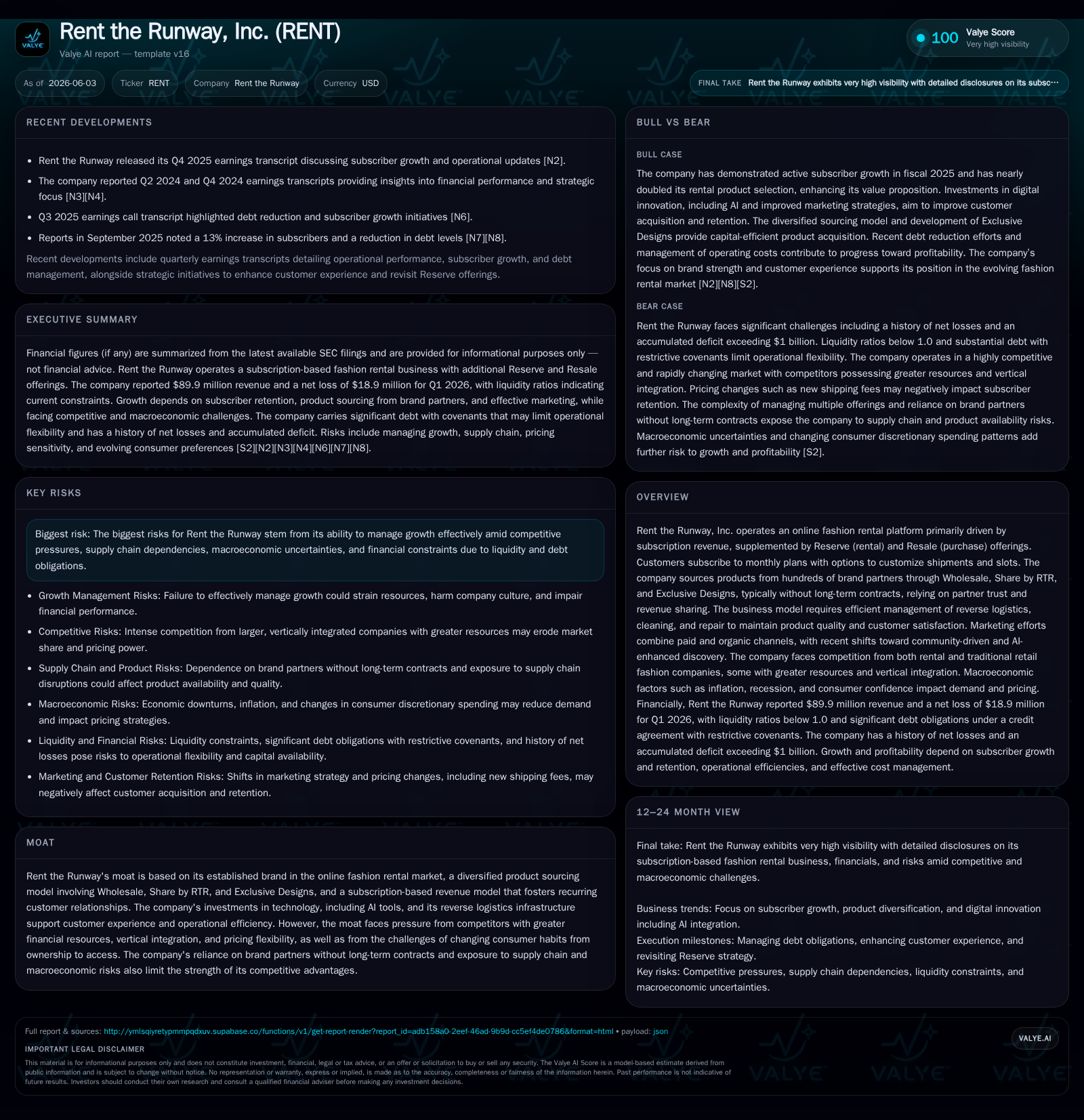
Rent the Runway’s Q1 2026 filing reveals intensifying pressure on subscription renewal rates and marketing efficiency, testing its signature rental business model. The company remains reliant on a mix of subscription offerings supplemented by reserve rentals and resale sales, but navigating volatile subscriber behavior and costly reverse logistics is increasingly fraught. Competitive forces from vertically integrated rental platforms and retail brands experimenting with similar access models add complexity. Meanwhile, Rent the Runway’s financial flexibility is constrained by substantial net debt and restrictive covenants following late-2025 recapitalization.
Q1 2026 Operating Results Spotlight Subscription Volatility
Rent the Runway's first quarter ending April 30, 2026, underscores ongoing volatility in its core subscription subscriber base [S2]. Despite active efforts to optimize subscription packaging—such as mid-month shipment add-ons and tiered spot offerings—renewal rates remain unpredictable. Monthly automatic renewals continue to form the backbone of recurring revenue; however, subscribers can pause or cancel at any point before billing cycles. This structural reality exposes Rent the Runway to churn fluctuations that directly impact revenue stability. Marketing investments remain elevated but show mixed efficiency as the company pivots toward AI-powered consumer discovery tools [S2], [S3]. These emerging technologies are intended to enhance personalized user engagement but have not yet markedly improved acquisition or retention KPIs.
Subscription-Driven Revenue Model & Product Quality Levers
At its core, Rent the Runway operates a hybrid revenue model centered on subscription services contributing approximately 90% of revenues as of FY2025 [S1]. Subscribers pay monthly for access to an "Unlimited Closet" offering thousands of styles sourced via Wholesale deals with hundreds of brand partners, Share by RTR collaborations, and Exclusive Designs created for RTR’s platform. This flexible assortment strategy avoids long-term supply commitments but relies heavily on sustained partner engagement and data transparency.
Reverse logistics form a critical operational challenge due to the need for extensive cleaning, repairing, sorting, and reissuing garments while maintaining high quality standards essential for customer satisfaction. Inventory turnover metrics here must be contextualized against product lifecycle within a rental rather than traditional retail framework—each item cycles through multiple customers before resale or decommissioning. This complexity elevates fulfillment costs relative to typical e-commerce fashion peers.
Competitive Context: Brand Partnerships, Vertical Integration, and Pricing Power
Rent the Runway’s moat rests primarily on its brand established within online fashion rentals combined with its unique multi-sourcing model that enables wide variety without onerous supply contracts [S1]. Yet this competitive posture faces headwinds from newer entrants backed by larger retail conglomerates offering vertically integrated rental-resale hybrids with more aggressive pricing capabilities and broader omnichannel presence. Traditional retailers testing rental or resale channels further fragment market share.
The absence of long-term exclusive agreements with brand partners limits RTR’s pricing leverage and increases vulnerability to supplier attrition or direct-to-consumer shifts by brands targeting RTR's younger subscriber base. Nevertheless, RTR’s data analytics on user behavior provide some asymmetry in inventory planning and marketing.
Growth Catalysts: AI Innovations, Community Engagement, and Offerings Expansion
Recent investments in agentic AI technologies aim to deepen community-driven marketing initiatives by personalizing style research views, anticipating demand shifts, and automating inventory management [S2], [N1]. Although still early stage in impact assessment, these advances could improve organic acquisition ratios versus paid marketing spend if deployed effectively.
Expansion beyond subscriptions into Reserve rentals (one-off event-driven products) and Resale offerings diversifies revenue touchpoints while funneling engaged users through multiple transactional relationships—potentially enhancing lifetime value metrics.
However, technology alone cannot resolve intricate customer psychology around ownership vs access paradigms which underpin fashion consumption patterns—a key structural demand consideration for RTR.
Risks: Resource Constraints, Macro Sensitivity, and Covenant Pressures
Scaling pressures quantified in management commentary highlight challenges in workforce hiring and training required for managing complex operations while preserving culture amid aggressive growth targets [S2]. Macro factors like inflationary labor costs, tariffs impacting procurement expenses, and discretionary consumer spending variations tighten margins.
The company's recapitalization completed late 2025 reduced absolute indebtedness but inserted stringent debt covenants limiting asset sales, additional indebtedness incurrence, dividend payments or major M&A activity [S1], [S9]. Compliance risks linger given liquidity maintenance requirements set to reset at $30 million by February 2027—a demanding threshold considering current cash buffers totaling approximately $37 million against over $340 million total debt recorded earlier [F1]. The sub-1 current ratio (0.75) augments concerns about near-term liquidity strain [F1].
Legal exposures have broadened notably due to rising consumer class actions relating to subscription products specifically [S14], introducing both cost uncertainty and reputational risk.
Forward Indicators: Subscriber Metrics and Logistics Efficiency Milestones
Critical upcoming milestones revolve around measurable improvements in subscriber retention curves—particularly reduction in churn of active accounts—as well as upward trends in organic acquisition ratios signaling marketing optimization gains. Equally important are improvements in reverse logistics cycle times reducing fulfillment expenses while preserving item condition metrics. These factors directly affect inventory turns as interpreted within a rental context where throughput speed correlates with profitability.
Tracking how effectively AI-driven insights translate into enhanced personalization that drives conversions will provide insight into technology’s tangible contribution to customer experience.
Financial Overview: Liquidity Position and Debt Covenant Implications
As of April 30, 2026, Rent the Runway held approximately $37 million in cash alongside current assets totaling $54.7 million against current liabilities of $72.8 million resulting in a current ratio below unity at roughly 0.75 [F1]. Total debt remains at a significant level near $341 million (as of April 2025), translating into an estimated net debt position north of $300 million after cash adjustments [F1].
This tight liquidity profile necessitates rigorous cash flow management especially amid cyclical pressures affecting discretionary fashion spending alongside cost inflation risks embedded in operational infrastructure.
Legal exposures have broadened notably due to rising consumer class actions relating to subscription products specifically [S14], introducing both cost uncertainty and reputational risk.
Forward Indicators: Subscriber Metrics and Logistics Efficiency Milestones
Critical upcoming milestones revolve around measurable improvements in subscriber retention curves—particularly reduction in churn of active accounts—as well as upward trends in organic acquisition ratios signaling marketing optimization gains. Equally important are improvements in reverse logistics cycle times reducing fulfillment expenses while preserving item condition metrics. These factors directly affect inventory turns as interpreted within a rental context where throughput speed correlates with profitability.
Tracking how effectively AI-driven insights translate into enhanced personalization that drives conversions will provide insight into technology’s tangible contribution to customer experience.
This analysis synthesizes Rent the Runway's recent Q1 2026 SEC disclosures with broader industry context reflecting the inherent complexities in sustaining profitable growth within an evolving subscription-based fashion rental market under competitive stress.
No investment advice is offered or implied herein; readers should perform their own due diligence based on full source documents cited.
Disclaimer: This is research-only, informational analysis and not investment advice. It may include AI-generated interpretation and general industry context. Always verify important details using primary sources.

Comments