
RPC Inc Eyes Rebound with Strategic Fleet Upgrades and Diverse Service Lines
RPC reports margin pressures despite steady revenue growth yet positions for recovery via technical innovation and disciplined capital deployment.
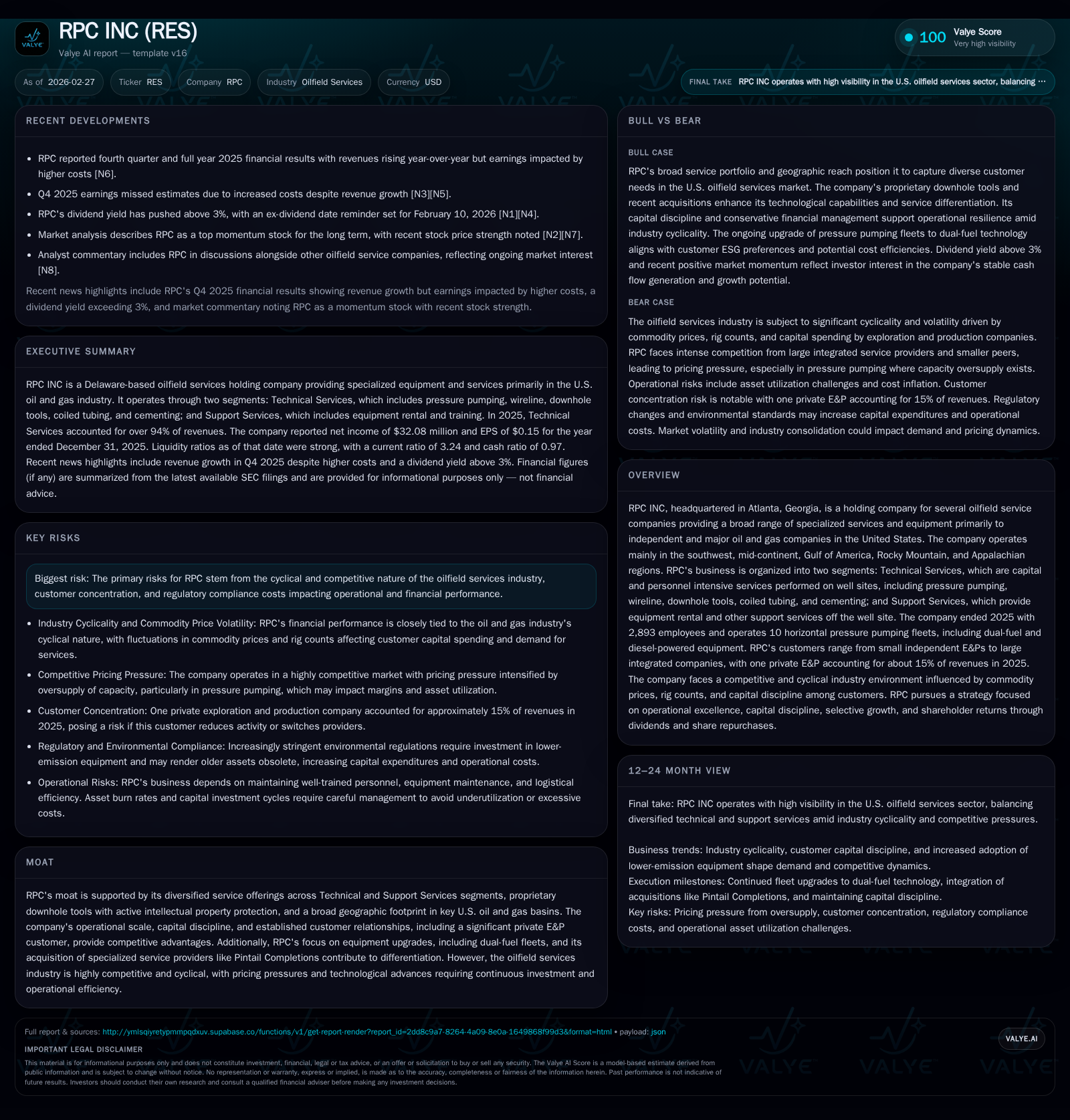
In 2025, RPC Inc sustained robust revenue expansion but faced significant declines in both operating and net income, highlighting margin erosion amid cost pressures. The company's operations hinge on two core segments—Technical and Support Services—with specialized offerings like pressure pumping and proprietary downhole tools powering its competitive moat. Although capital expenditures contracted, RPC is selectively investing in dual-fuel fleet upgrades and strategic acquisitions to adapt to market shifts and emission standards. Dividend payouts remain stable even as buybacks slow, underscoring a balanced capital allocation amid sector cyclicality and intensifying competition.
Revenue Growth and Margin Compression in Context
RPC Inc saw its revenue rise notably in the fiscal year ending 2025 to approximately $1.63 billion, marking a sharp increase of over 22% relative to the prior year [F1]. However, this top-line strength belied considerable profitability challenges. Operating income plummeted by about 54%, settling near $44.7 million [F1], while net income declined by nearly 65%. Such contraction signals substantial margin pressure despite healthy revenue flows.
The most recent quarterly results confirmed these dynamics. According to earnings reports released in early February 2026 [N1][N2][N3], costs rose faster than revenues due to elevated input expenses including personnel costs and maintenance of aging equipment. Pricing competition also intensified especially within RPC's core pressure pumping services.
This divergence between revenue growth and earnings contraction underscores operational headwinds that RPC faces even as underlying activity levels in U.S. oilfield services persist.
Technical and Support Services: Engines of RPC's Operations
RPC organizes its business into two principal segments: Technical Services and Support Services [S1][S4][S5]. The Technical Services segment dominates revenues (over 94% in 2025) and involves capital-heavy operations performed directly on well sites. These services include pressure pumping — fundamental for hydraulic fracturing — along with wireline operations, downhole tools deployment, coiled tubing interventions, and cementing processes [S8][S10][S14].
Pressure pumping accounts for nearly 30% of total revenues with a concentration in the Permian basin region where long horizontal laterals require high horsepower stimulation fleets [S10]. Notably, RPC operates ten horizontal pressure pumping fleets for this purpose, including advanced Tier 4 dual-fuel enabled equipment that mixes diesel with natural gas to lower emissions and operating costs [S1][S14].
Wireline (around 19%) comprises electric line services conveying tools down wells for perforation or plugging tasks integral to completions or abandonment phases. Downhole tools (24%) feature proprietary motors and fishing devices protected by patents utilized throughout well workovers [S1][S14]. These patented innovations—such as the "UnPlug" alternative to traditional bridge plugs—help establish differentiation amid commoditized service lines.
Support Services contribute less than 6% of revenues but offer equipment rental like drill pipe handling tools alongside training programs off well sites [S6][S14]. This diversification enables RPC to capture drilling-related activity indirectly.
Operational Hurdles and Cost Pressures Weighing on Results
The financial setbacks noted above largely stem from several interrelated factors affecting margins. Earnings calls highlighted elevated labor expenses resulting from skilled personnel retention challenges. Simultaneously, fleet maintenance costs have risen as demand for continuous operation forces accelerated asset wear [N1][N2].
Moreover, competition has intensified due to an oversupply of hydraulic fracturing capacity nationally [S7][S15]. Industry trends show increasing efficiency gains allow E&P companies to produce more hydrocarbons with fewer OFS assets, eroding pricing power for firms like RPC that must maintain costly specialized equipment under high utilization.
Pricing pressure is especially acute in the Permian basin where many operators contract competitively and industry consolidation means fewer large clients exert greater negotiating leverage [S16]. RPC’s customer mix includes a prominent private E&P consuming roughly 15% of revenues but smaller spot customers remain highly price sensitive.
Capital Expenditures and Return Metrics Reveal Strategic Priorities
RPC curtailed capital expenditures by about one-third year-over-year to $148 million in 2025 from nearly $220 million previously [F1], reflecting a more cautious investment stance amid profitability contraction [S11].
Capex efforts remain focused around upgrading pressure pumping fleets toward dual-fuel technologies that reduce emissions footprints while achieving fuel cost savings—aligned with rising ESG expectations among large customers [S14][S15]. The firm retains its ten horizontal frac fleets without planned expansion but aims for technological enhancement within this fixed framework.
Return on equity stands near 2.9%, down from historical levels reflecting squeezed net margins despite respectable cash flows [F1]. Operating cash flow declined over 40% to roughly $201 million supporting positive free cash flow around $53 million after capex deductions. This suggests that though earnings diminished, underlying cash generation remains sufficient for operational sustainability.
Dividend Sustainability and Capital Allocation Patterns
Long-term investors can note RPC’s dividends remained stable above $35 million paid in the year [F1] even amidst tightened earnings. The dividend yield recently exceeds 3%, offering a substantial income component supported by decent payout ratio discipline given the prevailing profit environment [N8][N6].
Conversely, share repurchases sharply receded—from nearly $10 million deployed in stock buybacks during 2024 down to just under $3 million in 2025—signaling prudence given reduced free cash flow buffers or elevated market valuations [F1]. This moderation aligns with management’s stated conservative capital allocation strategy balancing growth investments with stable shareholder returns plus maintaining financial flexibility during industry volatility [S11].
Forward-Looking Indicators: Investment in Dual-Fuel Fleets and Specialized Acquisitions
Looking ahead, RPC’s investments target both fleet modernization efforts emphasizing lower-emission dual-fuel assets alongside strategic acquisitions designed to expand technical competencies. The purchase of Pintail Completions during 2025 exemplifies this approach by strengthening wireline perforating services primarily within the Permian basin—enhancing geographic penetration and increasing service line breadth [S14][N7].
Investment momentum around dual-fuel technology is particularly relevant given broader industry trends favoring emissions compliance combined with fuel cost containment. Such assets may provide RPC a competitive edge if they secure longer-term contracts with public E&P operators prioritizing ESG criteria .
RPC currently does not plan incremental frac fleet additions but focuses on extending lifecycle value through selective capex within existing capacity parameters—indicating a calibrated balance between modernization and capital discipline consistent with management guidance [S11][N3].
Industry Risks: Competition, Cyclicality, and Regulatory Challenges
The oilfield services sector remains inherently cyclical—with activity correlated strongly to commodity price fluctuations which impact rig counts and well completions nationwide [S19]. Increased efficiency gains have resulted in oversupply conditions versus demand particularly affecting pricing dynamics across service lines like pressure pumping.
Competition includes global giants like Halliburton, Schlumberger alongside many smaller players who collectively exert pricing pressure forcing continuous operational improvements or equipment innovation investments from participants like RPC [S7][S16].
Regulatory risks persist from environmental laws mandating cleaner technologies raising costs—and evolving well control safety standards requiring ongoing training plus equipment upgrades—all crucial to maintaining customer trust amid possible liabilities or compliance failures [S15][S17].
RPC mitigates such exposures through active patent protection of proprietary tools plus diverse regional operations spanning key basins from Appalachia through Gulf Coast regions offering broad market accessibility [S1][S9]. Nonetheless, regulatory changes or geopolitical disruptions could significantly alter future demand or cost structures.
Historical performance (annual)
| FY | Net ($mm) | CFO ($mm) | OpInc ($mm) | Capex ($mm) | Net YoY |
|---|---|---|---|---|---|
| 2025 | 32 | 201 | 45 | 148 | -64.9% |
| 2024 | 91 | 349 | 98 | 220 | -53.1% |
| 2023 | 195 | 395 | 245 | 181 | -10.6% |
| 2022 | 218 | 201 | 288 | 140 |
Source: SEC companyfacts cache [F1].
Capital returns and efficiency (annual)
| FY | Div ($mm) | Buybacks ($mm) | FCF ($mm) |
|---|---|---|---|
| 2025 | 35 | 3 | 53 |
| 2024 | 34 | 10 | 129 |
| 2023 | 35 | 21 | 214 |
| 2022 | 9 | 1 | 62 |
Source: SEC companyfacts cache [F1].
Note: Revenue figures are shown rounded to billions USD; years reflect calendar fiscal periods.
RPC Inc’s trajectory over these four years highlights the tension between sustaining volume growth while contending with profitability compression triggered by operational cost escalations and heightened market competition.
This analysis synthesizes data drawn solely from RPC's publicly available filings and recent press releases as detailed above without extrapolating beyond reported facts or providing investment recommendations.
Disclaimer: This is research-only, informational analysis and not investment advice. It may include AI-generated interpretation and general industry context. Always verify important details using primary sources.

Comments