
Rexford Industrial Realty: Navigating Southern California’s Infill Industrial Nexus Amid Market Headwinds
Rexford leverages its specialized Southern California industrial portfolio and asset management acumen to sustain growth and preserve quality in a slowing industrial real estate environment.
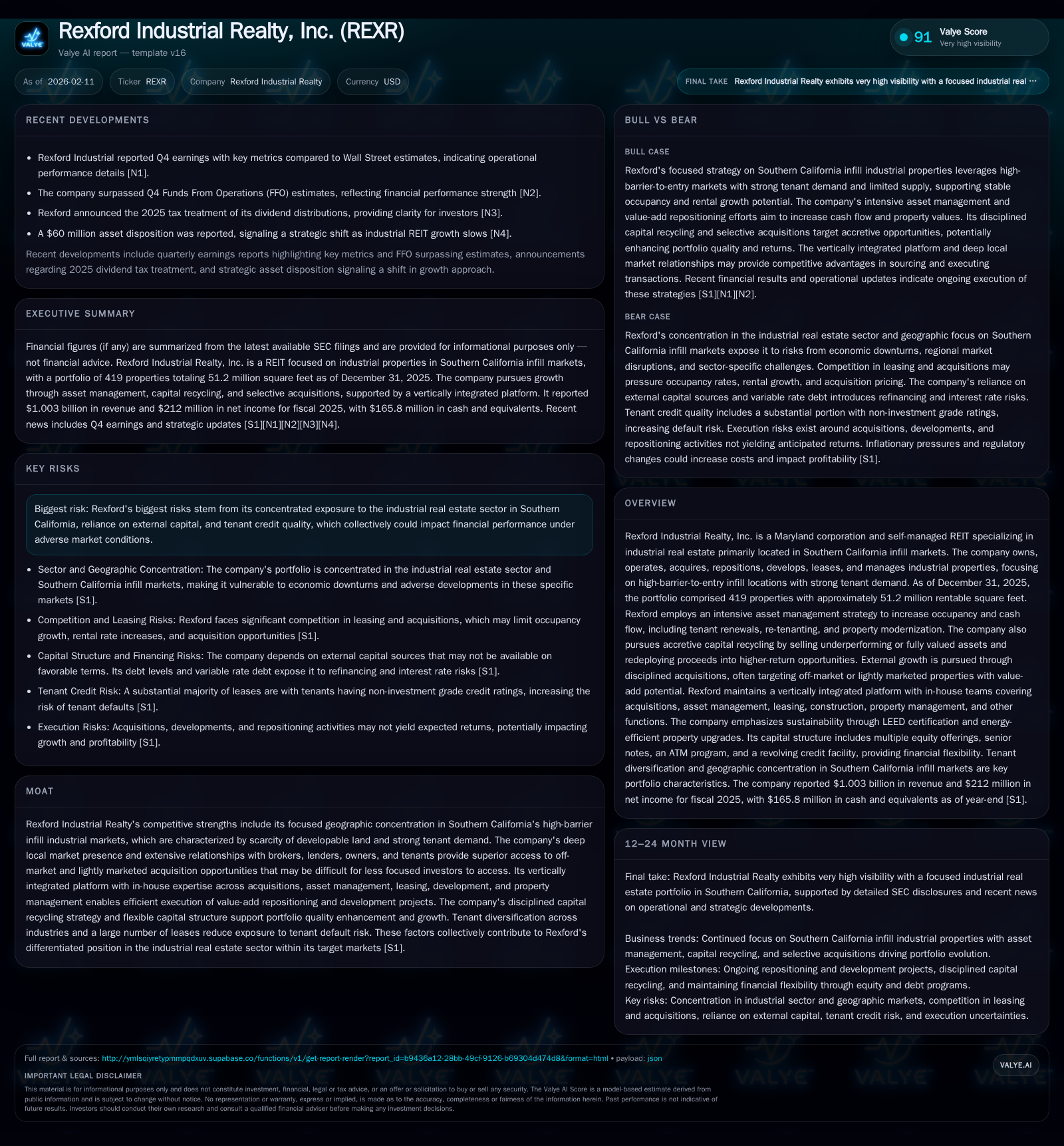
Rexford Industrial Realty, Inc. stands distinct with its deep concentration in Southern California's industrial infill markets, capitalizing on scarce developable land and robust tenant demand. The company’s recent financial results underscore operational resilience, with revenue surpassing $1 billion and outperforming FFO expectations. Rexford’s disciplined asset management, marked by proactive tenant engagement and capital recycling, bolsters cash flows despite sector-wide cooling. However, concentrated geographic exposure coupled with tenant credit quality and rising interest rate risks frame ongoing challenges. Strategic portfolio trimming and well-communicated dividend policies reflect calibrated positioning to balance growth, risk, and shareholder alignment.
Southern California Infill Markets: Rexford’s Geo-Concentrated Moat
Southern California’s industrial landscape is defined by an acute scarcity of developable land within densely populated urban nodes — the infill markets that support last-mile logistics critical to the region's vast consumer economy. Rexford Industrial Realty has meticulously carved out a competitive advantage by centering its portfolio exclusively in these high-barrier-to-entry submarkets. This geographic concentration is no accident but a deliberate strategy underpinning its sustainable moat.
According to the company’s disclosures [S1], their portfolio spans over 51 million rentable square feet across 419 properties as of end-2025, all located in these infill corridors. The competitive edge lies both in location premium and deep-rooted local relationships — Rexford's vertically integrated platform enables them to source off-market or lightly marketed acquisitions inaccessible to broadly diversified peers [valye_report_excerpt.moat]. This insight-driven approach not only secures quality assets but also positions Rexford favorably amid rising construction costs and land scarcity.
Furthermore, the firm’s close ties with brokers, tenants, lenders, and property owners give it a marketplace pulse that facilitates rapid decision-making on acquisition or disposition opportunities. This singular geographic focus tightly aligns with customer demand trends inherent to e-commerce fulfillment and manufacturing supply chains concentrated in Southern California. Thus, Rexford benefits from persistently strong leasing fundamentals that reinforce occupancy levels and rental rate growth potentials even as broader industrial markets cool.
Financial Performance and Earnings Beats in Focus
Despite a backdrop of tightening liquidity conditions and sectoral deceleration nationally, Rexford reported full-year 2025 revenue surpassing $1 billion precisely at $1.003 billion [F1]. Net income recorded was $212 million for the year-end period [F1], reflecting effective cost management alongside top-line resilience. Quarter four earnings further provided proof of operational strength — the company beat consensus FFO estimates according to Nasdaq reports dated early February 2026 [N1][N2].
This performance demonstrates the efficacy of Rexford’s active asset management strategies translating into sustained rental income streams. Moreover, $165 million in cash and equivalents at year-end [F1] underpin a solid liquidity buffer critical for ongoing investment cycles in acquisitions and developments.
Liquidity strength combined with measured leverage levels provides flexibility to navigate external headwinds such as interest rate volatility while maintaining required capital expenditures for modernizing existing assets—a testament to disciplined financial stewardship.
Asset Management and Capital Recycling: Balancing Growth and Quality
At the crux of Rexford's business model is an intensive asset management protocol designed around maximizing occupancy rates and increasing net operating income through value-add initiatives [valye_report_excerpt.overview]. Tenant retention efforts include proactive lease renewals carefully negotiated to minimize vacancy risks while capturing market rent resets where feasible.
The company also undertakes re-tenanting strategies when leases expire—targeting tenants fitting evolving industrial trends like e-commerce logistics—to optimize cash flow generation. Furthermore, modernization programs upgrade older properties to maintain competitive appeal amidst newer developments adjacent in the infill markets.
Crucially, Rexford pursues an accretive capital recycling approach whereby it sells older or fully valued assets with lower return prospects. Proceeds are then redeployed into assets with higher yield potential or into development projects tailored to future demand patterns. This discipline sustains portfolio quality amid slowing industrial sector growth nationally and mitigates stagnation risks identifiable in more static property holdings.
Risk Landscape: Economic Downturns, Tenant Credit, and Interest Rate Pressures
Concentration breeds both competitive advantage and vulnerability. Rexford openly acknowledges the inherent risk tied to its geographic focus in Southern California [S1]. Any adverse economic shock locally can disproportionately impact occupancy levels or rental growth prospects given the limited diversification outside this single regional footprint.
Tenant credit risk represents another material challenge as a sizeable portion of leases is granted to non-investment grade tenants [S1]. While this allows leasing flexibility in a tight market, it exposes Rexford to heightened default probabilities if macroeconomic pressures intensify or if specific industries experience downturns.
Interest rate dynamics compound such vulnerabilities. Rising rates increase interest expenses on variable debt tranches adding pressure on net income margins while complicating refinancing activities given dependency on external capital sources [S1]. Such conditions require vigilant financial management lest leverage ratios impair distribution capabilities or credit ratings.
Taken together, these factors make economic cyclicality an explicit test scenario for Rexford’s operational resilience, placing a premium on strategic foresight and nimble risk mitigation policies embedded within management culture.
Industrial REIT Sector Dynamics: Where Rexford Stands Amid Slowing Growth
The broader U.S. industrial REIT market is experiencing a discernible slowdown driven by cooling demand post-pandemic e-commerce surges alongside macro tightening [N4]. Against this environment, Rexford’s late-2025 announcement of approximately $60 million in targeted asset dispositions signals a deliberate recalibration aligning growth ambitions with evolving realities.
This selective pruning not only locks gains from mature assets but also streamlines capital allocation toward higher-yielding projects within core markets where leasing fundamentals remain robust. Rather than aggressive expansion typical of prior cycles, this approach favors measured scaling ensuring balance sheet health while preserving optionality for opportunistic acquisitions supported by proprietary sourcing networks.
Thus, Rexford exemplifies adaptive strategy execution that respects industrial sector cyclicality rather than overextending during transient upswings—a prudent posture amid uncertainty prevalent across commercial real estate sectors.
Dividend Strategy and Shareholder Alignment
Maintaining investor confidence amid volatile cycles requires transparent communication around shareholder returns. For calendar year 2025, Rexford disclosed precise tax treatment updates for dividend distributions emphasizing compliance clarity for investors [N3]. Such actions reflect governance attuned to sustaining predictable income streams desired by REIT shareholders.
Additionally, monthly dividend cadence paired with public reminders around ex-dividend dates [N5] ensures continuous engagement with stakeholders providing visibility into cash flow generation sustained by solid operational performance rather than near-term speculative gains.
This consistent policy supports alignment between management objectives focused on replicable cash yields alongside measured reinvestment poised to enhance intrinsic portfolio value over time rather than volatile payout swings.
Future Outlook: Acquisition Pipeline and Development Initiatives
Looking forward, Rexford’s ability to capitalize on its deeply integrated platform spanning acquisition sourcing through asset management remains central to expansion plans documented in filings [valye_report_excerpt.overview][S1]. The focus remains resolutely fixed on off-market deals within Southern California infill corridors where competition is otherwise intense yet barriers remain high due to limited available parcels.
Simultaneously, ongoing developments aimed at modernizing existing inventory position the company favorably against emerging tenant demands emphasizing supply chain efficiency enhancements through state-of-the-art facilities.
While macro uncertainties persist — notably inflationary pressures impacting construction costs — Rexford’s capital recycling model buffers incremental risks by reallocating proceeds from sales into projects promising accretive returns aligned with long-term structural demand drivers.
In sum, strategic discipline embedded across acquisition criteria, asset repositioning tactics, plus conservative balance sheet practices sets a foundation for sustaining growth moderated by prudent risk oversight across increasingly complex external environments.
This analysis reflects information derived from publicly available SEC filings and recent news reports as of early 2026. It aims to provide an informed perspective rooted in factual disclosures without rendering investment advice or price forecasts.
Disclaimer: This is research-only, informational analysis and not investment advice. It may include AI-generated interpretation and general industry context. Always verify important details using primary sources.

Comments