
RF Industries: Margin Expansion, Integration Ambitions, and the Test of Telecom Demand
RF Industries’ restructuring and operational focus have yielded recent profitability and margin gains, but the company remains exposed to competitive pressures, integration risks, and variable end-market demand. The next phase will test whether improved efficiency and product breadth can deliver sustainable earnings power in a dynamic telecom ecosystem.
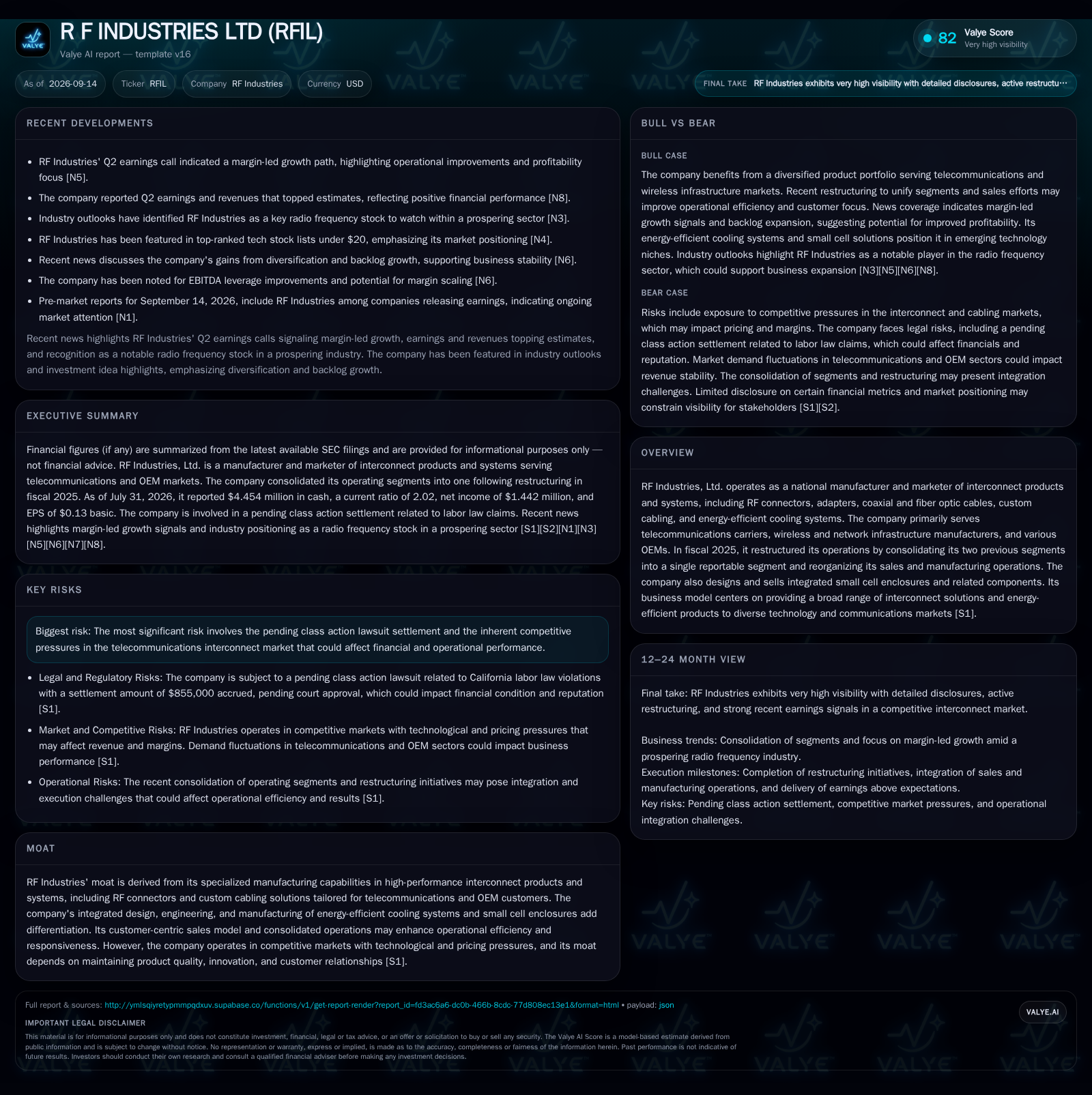
RF Industries has posted recent earnings and margin improvements following a major operational restructuring and segment consolidation. Its product range—spanning RF connectors, cables, small cell enclosures, and energy-efficient cooling—serves telecom and OEM customers, but the company faces competitive threats and integration challenges. Sustained margin-led growth will depend on continued execution, backlog conversion, and stable demand in telecom infrastructure and related sectors. A pending labor law settlement and limited financial visibility on certain metrics add risk to the outlook. [S1] [S2] [N5] [N6] [N8]
RF Industries, a manufacturer of interconnect products and systems for telecom and OEM markets, has recently restructured its business, consolidating segments and revamping its sales and manufacturing operations. This operational overhaul has coincided with improved earnings and margin performance, bolstered by a broad product mix that targets key infrastructure buildouts in telecom and wireless. However, the company’s ability to sustain this momentum will be tested by competitive pressures, integration execution, and the unpredictability of telecom sector demand. Legal and operational risks further complicate the outlook, presenting both upside potential and downside exposure as RF Industries navigates a highly contested market.
Recent Restructuring and Margin Gains Shape the Current Landscape
RF Industries has undergone substantial operational change, consolidating its previous two segments into a single reportable entity during fiscal 2025. This restructuring involved both manufacturing consolidation and a reorganization of the sales function, aiming to drive efficiency and sharpen customer focus. As of July 31, 2026, the company reported $1.442 million in net income for the quarter, with basic EPS of $0.13, and maintained a current ratio of 2.02, reflecting a buffer against short-term liabilities. [S1] [S2]
Recent quarters have seen the company surpass earnings and revenue estimates, with news coverage highlighting margin-led growth and backlog expansion. However, RF Industries also faces a pending $855,000 class action settlement related to California labor law claims, which, while accrued for, remains subject to court approval and could affect near-term potential financial flexibility. [S1] [N5] [N6] [N8]
How RF Industries’ Product Breadth and Operational Structure Drive Profitability
RF Industries generates revenue by designing, manufacturing, and marketing a wide range of interconnect products—RF connectors, adapters, coaxial and fiber optic cables, custom cabling, energy-efficient cooling systems, and small cell enclosures—primarily for telecom carriers, network infrastructure builders, and OEMs. Its revenue mix is shaped by both standard product sales and custom solutions, with the latter often supporting higher margins and deeper customer relationships.
The company’s economics hinge on a combination of volume-driven standard products and higher-value custom assemblies. The recent operational consolidation is likely intended to optimize fixed cost absorption, streamline production, and enable cross-selling, which could enhance operating leverage as volumes scale. However, the capital intensity of manufacturing and the need to manage working capital for a diverse inventory set can create periodic funding pressure, particularly if end-market demand becomes volatile.
Given the company’s focus on energy-efficient and integrated solutions (such as cooling systems and small cell enclosures), there is potential for premium pricing in niche applications. Still, much of the underlying product set remains exposed to commoditization and price-based competition, putting a ceiling on gross margin expansion unless RF Industries can differentiate through technology, service, or integration.
Navigating a Crowded Interconnect and Infrastructure Market
RF Industries operates in a highly competitive landscape that includes diversified interconnect manufacturers, specialized cable and component suppliers, and global electronics assembly firms. The telecom and OEM markets are characterized by both established players and aggressive low-cost entrants, with product commoditization and rapid technology cycles driving ongoing pricing pressure.
The company’s differentiation rests on its ability to deliver custom, high-performance solutions, integrated cooling and enclosure systems, and responsive customer support. However, these advantages are not insurmountable and can be eroded by larger competitors with deeper R&D or by new entrants leveraging lower cost structures.
Switching costs for most interconnect products are moderate—customers may standardize on a particular vendor for a project or design, but long-term exclusivity is rare unless the company can embed itself through custom engineering or proprietary integration. The recent consolidation of sales and manufacturing could improve RF Industries’ ability to respond to RFQs and customer needs quickly, but success will depend on execution and ongoing innovation.
Sustained Margin Expansion Through Execution and Telecom Infrastructure Upswing
In a favorable scenario, RF Industries leverages its operational consolidation to drive throughput, reduce overhead, and extract greater operating leverage from its sales and manufacturing platforms. Backlog growth and diversification—highlighted in recent news—could translate into sustained revenue visibility, especially if telecom carriers and OEMs accelerate infrastructure upgrades and 5G/small cell deployments.
Premium products such as energy-efficient cooling systems and integrated enclosures could gain traction as customers seek to optimize network performance and reduce total cost of ownership, supporting higher margins. If the company continues to beat earnings estimates and demonstrates consistent margin improvement, this would confirm that restructuring efforts are yielding durable efficiency gains.
Evidence that would support this scenario includes ongoing backlog conversion, sequential margin improvement, and new customer wins in high-growth telecom segments. Conversely, a stall in margin gains or a slowdown in telecom capex would challenge the bullish case.
Operational Efficiency Meets End-Market Variability
The most plausible outcome is that RF Industries achieves incremental improvements in operational efficiency and cost absorption from its restructuring, but encounters ongoing variability in order flow and pricing due to competitive pressure and cyclical telecom demand. While recent quarters have shown margin-led growth, the sustainability of these improvements depends on stable infrastructure spending and successful integration of sales and manufacturing teams.
The pending legal settlement and any unforeseen integration challenges could weigh on short-term results, but are unlikely to fundamentally alter the company’s long-term trajectory unless they expose deeper weaknesses. Confirmation of this scenario would be continued modest profitability, steady gross margins, and evidence that the company can maintain or grow its share in core markets. A reversal in margin trends, significant customer losses, or persistent execution missteps would suggest the base case is deteriorating.
Competitive Pressures and Demand Shocks Undermine Recent Gains
In a more adverse scenario, RF Industries’ recent margin improvements prove unsustainable as larger competitors intensify price competition and customers delay or cut back on telecom infrastructure investments. The company may struggle to maintain pricing or volumes, particularly if new integrated solutions fail to gain traction or if standard product lines face commoditization.
Operational integration may encounter setbacks, leading to inefficiencies or customer service lapses. The pending class action settlement, if followed by additional legal or regulatory issues, could further strain financial resources. Confirmation of this scenario would come from declining gross margins, negative earnings surprises, shrinking backlog, and customer attrition.
Milestones and Evidence That Will Shape RF Industries’ Margin and Growth Thesis
Sequential gross margin trends: Sustained improvement or stability would support the thesis that restructuring is driving lasting efficiency gains.
Backlog growth and conversion rates: If disclosed, these would provide visibility into near-term revenue and the stickiness of customer demand.
Customer concentration and new wins: A useful metric would be the proportion of revenue from top customers and evidence of new contract awards in telecom or OEM sectors.
Product mix evolution: Shifts toward energy-efficient cooling systems and integrated enclosures versus standard connectors/cables could signal margin potential.
Execution of restructuring milestones: Progress updates on integration of sales and manufacturing operations would help test the operational thesis.
Resolution and impact of legal matters: Final court approval of the class action settlement and absence of new material legal risks would reduce financial overhang.
End-market spending trends: External indicators of telecom infrastructure capex and OEM demand will remain leading signals for RF Industries’ growth prospects.
Inventory and working capital management: Efficient turnover and avoidance of buildup would support the sustainability of recent margin gains.
Disclaimer: This is research-only, informational analysis and not investment advice. It may include AI-generated interpretation and general industry context. Always verify important details using primary sources.

Comments