
RCI Hospitality Holdings Reassesses Growth Amid Legal Challenges and Operational Focus
Latest quarterly disclosures highlight RCI Hospitality’s emphasis on operational optimization over expansion against a backdrop of ongoing legal issues.
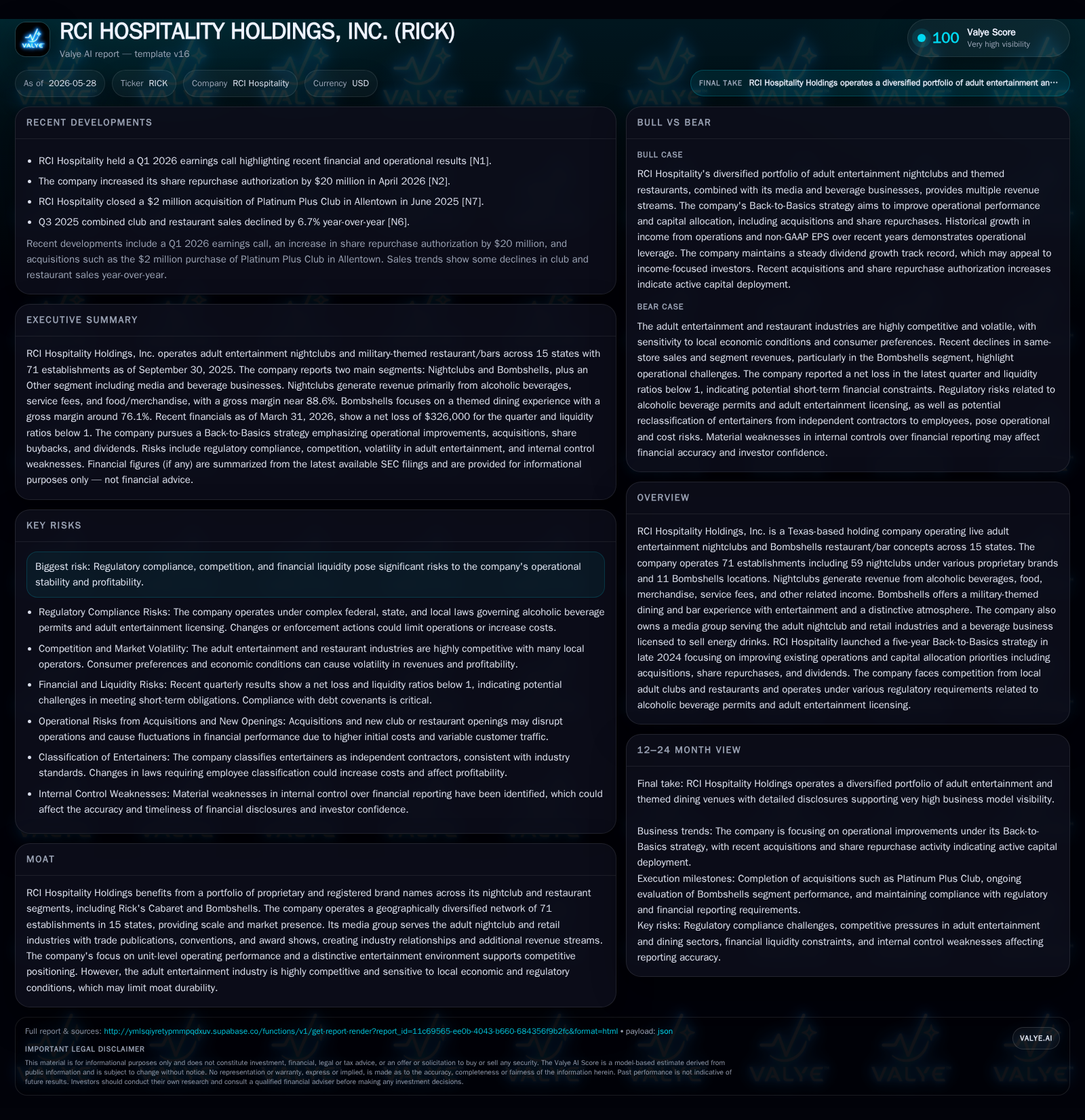
In its most recent quarter ending March 31, 2026, RCI Hospitality Holdings continued to prioritize improving performance at existing nightclubs and Bombshells restaurant units while navigating significant legal and regulatory headwinds. The company maintains a diversified portfolio across 15 states but faces constraining factors including profitability pressure, regulatory scrutiny, and a tight liquidity profile. Its business model centers on proprietary adult entertainment venues supplemented by Bombshells’ themed dining experience and complementary media and beverage operations. Competitive positioning leverages brand recognition alongside scale, yet structural industry volatility and local regulations remain material risks. Near-term growth is expected through operational enhancements and capital allocation discipline rather than unit expansion.
Recent Operating Update
RCI Hospitality Holdings' latest Form 10-Q for the quarter ended March 31, 2026, reflects continued adherence to its five-year Back-to-Basics strategy initiated in late 2024 [S2][S3]. This approach prioritizes improving the performance efficiency of currently operating nightclubs and Bombshells restaurant units rather than aggressive expansion. The company disclosed no plans for new restaurant openings beyond one under construction as of fiscal 2025 year-end [S1]. This reorientation comes during challenging profitability headwinds exacerbated by ongoing legal issues stemming from an indictment filed in September 2025 relating to alleged conspiracy and tax fraud involving New York operations [S4].
Operationally, RCI continues to generate revenue through its adult entertainment nightclubs (59 locations) and Bombshells restaurants (11 locations), collectively operating across 15 states [S1]. The nightclub segment’s revenue streams comprise alcoholic beverages sales, food service, merchandise sales, cover charges, licensing fees, room rentals, ATM commissions, and ancillary sources. Bombshells distinguishes itself with a military-themed casual dining experience blending food service with live entertainment [S1]. This dual-segment model provides some diversification while leveraging proprietary brand value.
Business Model
RCI’s core revenue mechanics stem from attracting patrons seeking adult entertainment combined with social dining experiences. Customers pay primarily for beverages—alcoholic drinks commanding premium pricing due to high margin potential—as well as food items at both nightclub bars and Bombshells restaurants. Payment structures include traditional point-of-sale consumption supplemented by cover charges or service fees reflective of venue amenities such as private rooms or dance performances.
The company's proprietary brands such as Rick’s Cabaret provide consumer recognition that sustains foot traffic in competitive urban markets where adult entertainment options abound. Service quality and distinctive atmospheres at each venue serve as key differentiators relative to independent clubs lacking established brand equity [S1]. Additionally, RCI’s ancillary businesses include a media group offering B2B publications and trade shows aligned with the nightclub industry plus a licensed energy drink beverage operation [S1], providing modest revenue diversification beyond physical venues.
Margins fluctuate based on volume trends influenced by discretionary consumer spending cycles typical in hospitality segments plus regulatory compliance costs impacting labor scheduling and marketing activities. Pricing power appears constrained by competitive local ecosystems where numerous operators vie for similar clientele with overlapping demographic appeal.
Industry Structure and Competitive Position
The adult entertainment nightclub industry is fragmented with numerous locally owned operators competing primarily on price points, location convenience, service level, and ambiance. RCI's scale—operating over seventy venues—and portfolio of registered trademarks across its flagship brands confer a structural advantage among regional competitors lacking comparable geographic breadth or capital resources [S1][S14]. This scale aids negotiating supply contracts for liquor procurement while enabling cross-promotional efforts across venues.
Nonetheless, industry dynamics remain volatile. Revenues are tightly coupled with macroeconomic cycles affecting discretionary income allocation toward nightlife activities. Regulatory oversight bodies impose stringent licensing requirements on alcoholic beverage permits subject to variable local ordinances restricting club siting near sensitive zones (schools, churches) or threshold residential density criteria [S14]. These restrictions create barriers to entry but also elevate compliance risk for incumbents.
Recent years have seen industry shifts including growing demand for hybrid concepts blending dining with entertainment—Bombshells exemplifies this trend aiming to attract a different customer set than pure nightclubs—and increasing emphasis on digital engagement through the company’s media properties [S1]. Competitors range from small-scale single-location clubs to larger hospitality groups focusing solely on nightlife or restaurants but rarely combining both.
Growth Drivers
Given its strategic pivot since late 2024 towards Back-to-Basics operational improvement rather than broad expansion, RCI’s growth drivers primarily lie in:
- Enhancing same-unit sales through operational efficiencies boosting unit economics at nightclubs and Bombshells locations.
- Capital allocation toward selective nightclub acquisitions to bolster market share in existing or adjacent territories within disciplined buyback/shareholder return frameworks.
- Leveraging proprietary brand strength to differentiate offerings amidst intensified competition.
- Expanding ancillary revenue streams via media-related events tailored to the adult nightclub ecosystem.
- Adjusting pricing strategies carefully balancing volume retention against inflationary pressures in labor and supply costs.
These drivers depend heavily on management's ability to navigate a complex regulatory environment while sustaining employee retention given sector-specific workforce challenges noted in risk disclosures [S18][S20]. Customer loyalty programs such as Rick's Rewards may facilitate repeat visitation which supports steady revenue generation despite cyclical volatility.
Risks / Watchpoints / Growth Constraints
Several material risks cloud RCI's growth outlook:
- Legal Proceedings: The ongoing criminal indictment alleging bribery and tax fraud linked to New York clubs represents a significant reputational risk alongside potential financial liabilities or penalties should outcomes be adverse [S4][S11]. The related management changes highlight governance uncertainty impacting investor confidence.
- Regulatory Compliance: Licensing regimes vary significantly state-by-state creating operational complexity; failure to maintain permits or noncompliance could force closures or fines [S14][S20]. Changes classifying entertainers from contractors to employees could spur cost escalations.
- Financial Leverage: With total debt near $238 million against cash reserves under $27 million as of Q1 2026 end [F1], liquidity constraints are apparent. A current ratio of approximately 0.55 indicates tight short-term obligations coverage demanding prudent working capital management [F1][S17].
- Competitive Intensity: Local competition from independent operators plus shifting consumer preferences require constant innovation; price sensitivity limits margin expansion scope.
- Economic Cyclicality: Discretionary spending declines during downturns disproportionately impact nightlife businesses; past pandemic stimulus effects temporarily inflated prior results distorting comparatives [S1].
- Workforce Retention: Recruiting qualified staff amid tight labor markets affects service quality and operating costs [S18].
What to Watch Next
Key developments to monitor include:
- Resolution progress or outcomes from legal indictments potentially influencing public perception and financial provision needs.
- Quarterly operating metrics especially same-store sales trends at nightclubs and Bombshells reflecting efficacy of Back-to-Basics initiatives.
- Capital deployment announcements outlining acquisition targets or changes in dividend/share repurchase policy aligned with stated capital priorities.
- Regulatory shifts particularly regarding classification of entertainers or licensing conditions across relevant jurisdictions.
- Cost structure adaptations addressing inflationary pressures without impairing customer experience.
- Liquidity status updates clarifying ability to meet forthcoming debt amortizations or covenant requirements amidst macroeconomic uncertainties.
Financial Profile Summary
While the company's latest reported operating income included losses attributable partly to ongoing impairments [F1], it has maintained positive free cash flow historically allowing incremental investments in acquisitions alongside shareholder distributions under its outlined capital strategy [S1][N1]. Cash & equivalents stood at approximately $26.9 million at fiscal Q1 end March 31, 2026 against current liabilities exceeding $73 million pointing toward short-term liquidity demands requiring careful management [F1]. Total debt remains elevated near $238 million primarily related to club acquisitions financing enabling scale growth over time but necessitating sustained operating cash flow generation for deleveraging [F1][S17]. Management has emphasized compliance with debt covenants but highlighted macroeconomic risks that could disrupt this balance if adverse conditions persist or intensify [S17][S29].
This analysis synthesizes publicly available SEC filings up to May 28, 2026. It does not constitute investment advice but aims to provide an informed perspective grounded in documented operational developments and industry context specific to RCI Hospitality Holdings’ business dynamics within adult entertainment hospitality sectors.
Disclaimer: This is research-only, informational analysis and not investment advice. It may include AI-generated interpretation and general industry context. Always verify important details using primary sources.

Comments