
Rocket Lab Corp’s Investment in Neutron and Scale-Up Challenges Pressure Profitability
Rocket Lab continues expanding launch capabilities and spacecraft solutions but faces heightened operating losses and execution risks.
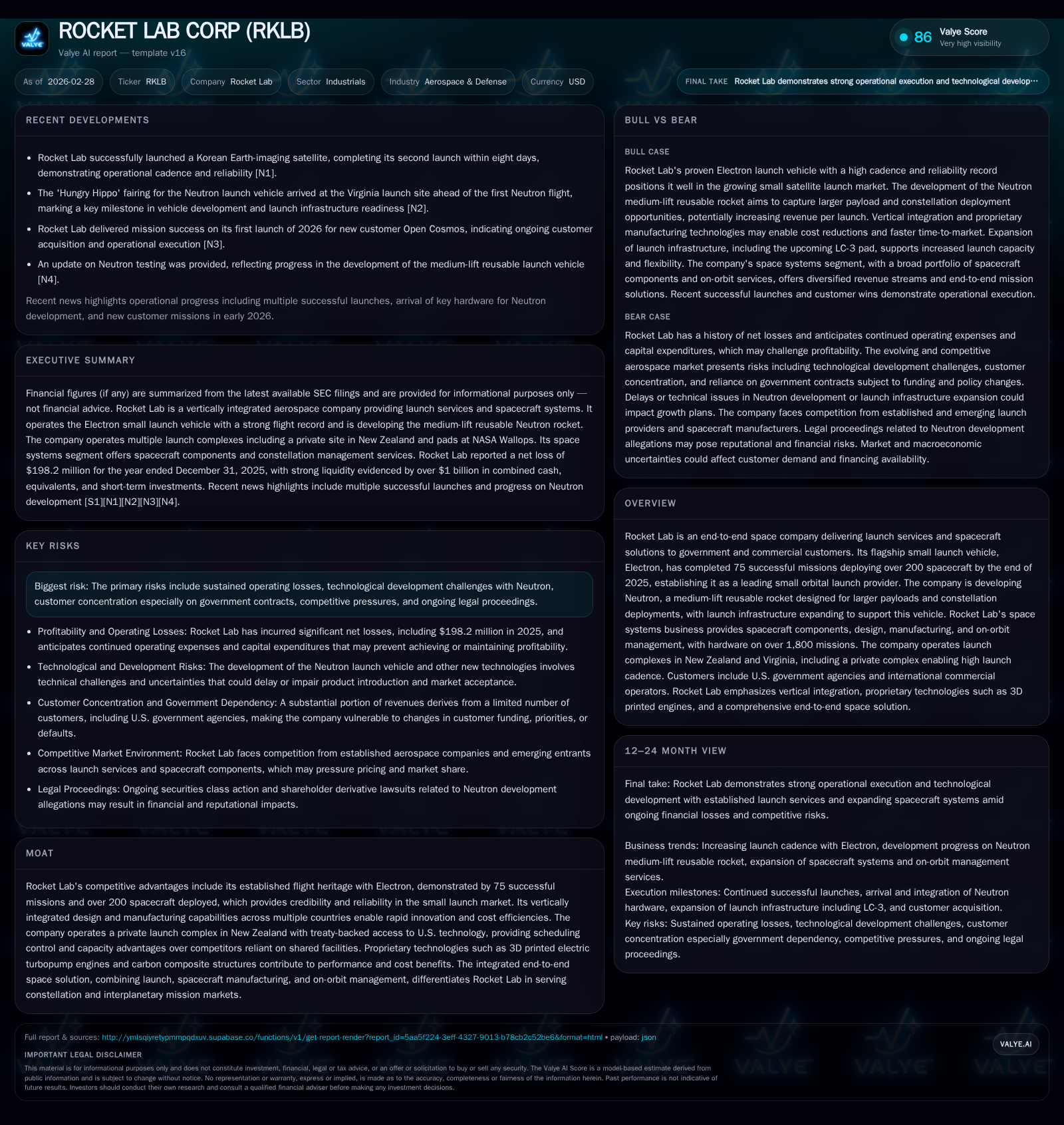
Rocket Lab Corp (RKLB) has established a strong foothold in the small satellite launch market through its Electron vehicle, with 75 successful missions and over 200 spacecraft launched as of end-2025. The company’s future growth hinges on successfully scaling launches and commercializing its medium-lift reusable Neutron rocket, which promises significantly higher payload capacity. However, escalating operating expenses, heavy capital investment, ongoing development challenges, and customer concentration risks have led to widening losses and negative operating cash flows through 2025. Monitoring their operational ramp-up, delivery of Neutron milestones, and margin improvements will be critical to assessing sustainability.
Company Overview and Historical Performance
Rocket Lab Corp is an aerospace company offering integrated space services including dedicated orbital launches with its Electron rocket and spacecraft design and manufacturing solutions. Electron has delivered over 200 satellites through 75 successful flights by the end of 2025, securing Rocket Lab's position as a leader in the small satellite launch segment. This rapid scaling of launch cadence is supported by proprietary manufacturing techniques such as electric turbopump engines made by additive manufacturing and the operation of a private launch complex at Mahia, New Zealand backed by a bilateral treaty with the U.S., ensuring exclusive access to critical technologies and scheduling control [S7][S14].
Financially, Rocket Lab grew revenue markedly from $244.6 million in 2023 to $601.8 million in 2025 reflecting increased launch volumes and diversification of its space systems portfolio through acquisitions of complementary businesses such as Sinclair Interplanetary and Planetary Systems Corporation [F1][S7][S10]. However, despite top-line expansion, the company's operating losses widened from -$177.9 million to -$228.8 million over the same period as costs associated with research & development on new technologies like the Neutron rocket intensified alongside scaling operational expenses [F1]. Net losses similarly remained elevated at -$198.2 million in FY25 [F1].
Historical performance (annual)
| FY | Net ($mm) | CFO ($mm) | OpInc ($mm) | Capex ($mm) | Net YoY |
|---|---|---|---|---|---|
| 2025 | -198 | -166 | -229 | 156 | -4.2% |
| 2024 | -190 | -49 | -190 | 67 | -4.2% |
| 2023 | -183 | -99 | -178 | 55 | -34.3% |
| 2022 | -136 | -107 | -135 | 42 |
Source: SEC companyfacts cache [F1].
Capital returns and efficiency (annual)
| FY | Buybacks ($mm) | FCF ($mm) | ROE% |
|---|---|---|---|
| 2025 | -322 | -11.5 | |
| 2024 | -116 | -49.7 | |
| 2023 | 30 | -154 | -32.9 |
| 2022 | 30 | -149 | -20.2 |
Source: SEC companyfacts cache [F1].
Table: Selected financials for fiscal years ending December [F1]
The company’s free cash flow remained negative with a notable increase in capital expenditures aimed primarily at supporting Neutron's development and expanding launch infrastructure including the upcoming LC-3 pad in Virginia intended to increase capacity beyond New Zealand facilities [F1][N2][S25]. Operating cash flow also deteriorated sharply to -$165.5 million in FY25.
Growth Prospects
Rocket Lab’s core growth driver remains its established small launch vehicle Electron which supports payloads up to approximately 300 kg into low Earth orbit (LEO). In calendar year 2025, Electron was the second most frequently launched orbital rocket worldwide, reflecting efforts to increase cadence leveraging vertically integrated manufacturing processes that include advanced automation techniques and additive manufacturing reducing production cycles [S7][S17].
More transformative for future growth is Rocket Lab’s Neutron medium-lift reusable rocket under active development targeting payload capacities around 13,000 kg for LEO missions with plans for reusability reducing per-launch costs substantially versus expendable designs [N2][N4][S7][S10]. First flight attempts were expected imminently by early 2026 with pre-assembly of key components like the "Hungry Hippo" fairing completed at Virginia sites [N2]. The successful commercialization of Neutron could unlock new markets including large constellation deployments requiring multiple satellite launches per mission increasing average contract sizes considerably.
The Space Systems segment offers diversification — Rocket Lab has grown this area through acquisitions covering spacecraft components used on over 1,800 missions globally from commercial operators to aerospace primes and government agencies including NASA, Department of Defense elements like DARPA and NRO among others [S7][S10]. This segment includes design-to-manufacture full spacecraft buses plus constellation management services enabling recurring revenue potential beyond one-off launches.
However, growth faces headwinds: technological hurdles tied to Neutron’s reusability goals present execution risks given industry challenges; customer concentration remains high with nearly half revenues tied directly or indirectly to U.S. government contracts entailing budgetary uncertainty; intense competition persists with entrenched players such as SpaceX dominating medium-to-heavy lift segments; global macroeconomic uncertainties including trade tariffs impacting supply chains add further complexity [S4][S6][S11][S18].
Milestones and Outlook
While Rocket Lab provides limited explicit quantitative guidance publicly, it has highlighted incremental milestones toward Neutron’s qualification flight planned within calendar year 2026 [N4]. Launch pads LC-2 (Virginia operational) and LC-3 (under development) are intended to accelerate launch cadence beyond the fully utilized New Zealand complex supporting Electron and future HASTE suborbital launches for hypersonic tests [N4][S7].
Operational reliability improvements for Electron remain a focus alongside customer base expansion both domestically—through government agencies—and internationally among commercial satellite operators seeking dedicated rideshare launches tailored to constellation needs [N1][N3]. The pace at which these initiatives convert into sustained revenue growth beyond recent rapid expansion will hinge on resolving developmental delays inherent to Neutron’s ambitious goals.
Capital Allocation and Financial Returns
Return metrics reflect ongoing investment phases: approximate return on equity was negative around -11.5% for FY25 given continued net losses against equity that increased due mostly to equity raises funding expansion efforts rather than profitability so far [F1]. Operating losses worsened about -20% year-over-year while cash burn accelerated considerably — operating cash flow dropped from roughly -$49 million in FY24 to -$165 million in FY25 primarily driven by increased working capital needs aligned with scaling fleet operations plus elevated R&D outlays.
Capital expenditures more than doubled year-on-year topping $156 million primarily for infrastructure build-out such as launch pads including Virginia facilities alongside investments into manufacturing capacity enhancement catering not only for Electron but foundational work on Neutron components leveraging signature additive manufacturing capabilities pioneered within orbital-class engine production [F1][N2].[S25]
No dividends or share repurchases were reported or planned due to prioritization of reinvestment into core development programs; existing debt agreements restrict share buybacks currently while convertible note maturities pose refinancing considerations ahead [F1][S12][S27]. Liquidity remains robust supported by $828 million cash balances but negative free cash flow necessitates disciplined capital deployment going forward.
Competitive Positioning
Rocket Lab holds a defensible position arising chiefly from:
- Proven flight heritage: Electron boasts consistent success (75 missions through end-2025), instilling confidence among customers valuing reliability in small satellite launches amid an industry historically prone to failures.
- Vertical integration: In-house design/manufacturing facilities across US/New Zealand/Canada enable accelerated engineering cycles incorporating advanced materials such as carbon composites providing weight/cost advantages.[S17]
- Proprietary electric turbopump engines employing cutting-edge additive manufacturing produce efficiency gains difficult for competitors reliant on traditional manufacture routes.[S17]
- Exclusive treaty-backed access rights allowing U.S.-origin technology use from foreign soil (Mahia) granting scheduling flexibility uncommon elsewhere,[S14] pivotal for meeting constellation customers’ cadence needs.
- Offering complete space solutions combining launch services with spacecraft manufacture plus on-orbit fleet management positions Rocket Lab uniquely for the growing satellite constellation market demanding integrated providers.[S7]
Competition remains fierce especially from global aerospace incumbents such as SpaceX dominating heavier lift sectors potentially constraining Neutron adoption unless Rocket Lab achieves cost leadership on reusability; government contract reliance introduces potential revenue volatility aligning company fortunes partially outside direct control.[S18]
Legal & Regulatory Risks
A securities class action related to alleged misstatements about Neutron development progress was dismissed initially but remains pending via amended complaints.[S15] Broader regulatory compliance is necessary given export controls under ITAR/EAR guidelines limiting international business reach versus competitors not subject similarly.[S16] Increasing U.S.-China tensions plus tariffs impose supply chain cost pressures offset partially by sourcing strategy concentrated on domestic suppliers.[S16] Maintaining required security clearances essential for classified contracts adds operational risk if mitigation arrangements lapse.[S24]
What To Watch Next (Analysis)
For investors or analysts monitoring Rocket Lab's trajectory:
- Execution of Neutron’s inaugural flight test planned in near term is critical; delays or technical setbacks here could strain credibility.
- Operational metrics tracking Electron’s increasing manifest volumes illustrating sustainability beyond milestone bursts.
- Margin progression signaling potential path toward profitability given current scale-associated losses.
- Backlog composition shifts indicating diversification away from U.S government-heavy concentration toward steadier commercial bookings.
- Development progress on complementary product lines like HASTE hypersonic suborbital launcher or hosted payload spacecraft offerings integral to long-term ecosystem plays.
- Balance sheet trends around liquidity preservation versus financing needs amid capital-intensive growth phase.
This analysis synthesizes publicly available information up until February 28, 2026 without forecasting unannounced results or expressing investment recommendations. The aerospace launch sector remains technically challenging with long gestation timelines impacting near-term financial metrics despite robust strategic opportunities rooted in growing demand for satellite connectivity and observation platforms.
Disclaimer: This is research-only, informational analysis and not investment advice. It may include AI-generated interpretation and general industry context. Always verify important details using primary sources.

Comments