
Richmond Mutual Bancorporation: Navigating Regional Banking with Strategic Merger and Portfolio Risks
Richmond Mutual Bancorporation operates a regionally focused commercial lending bank with a recent transformational merger announcement, balancing growth ambitions against credit and real estate market risks.
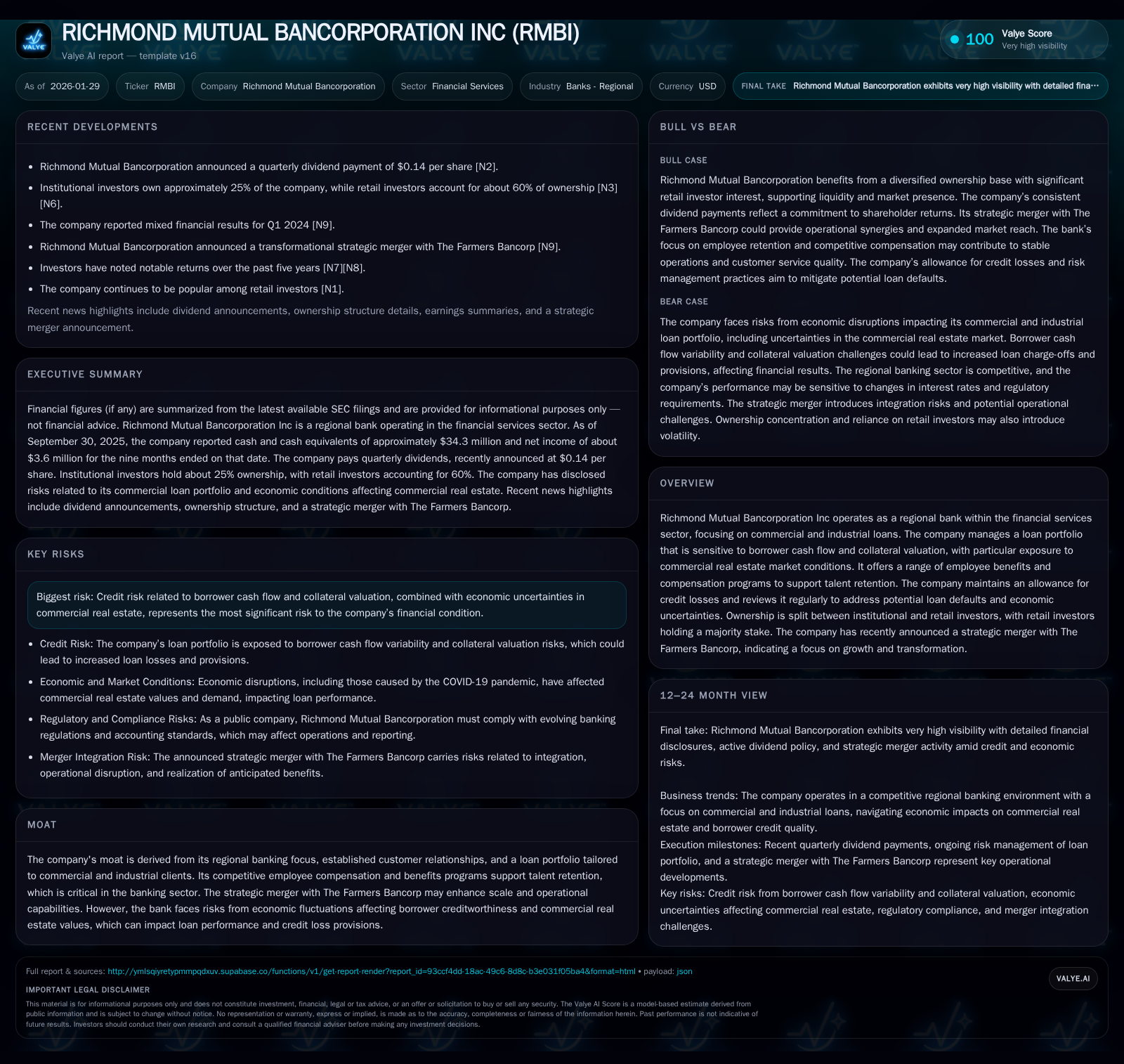
Richmond Mutual Bancorporation Inc. remains a niche regional bank centered on commercial and industrial lending, with a significant portion of its portfolio tied to the Columbus, Ohio market. The company recently announced a strategic merger with The Farmers Bancorp, signaling a growth and operational scale initiative. Its business model relies heavily on borrower cash flow analysis and collateral values, exposing it to credit risk and commercial real estate volatility. Talent retention and employee benefits are prioritized to sustain competitive advantage in a fragmented regional banking sector.
What Changed Recently
Richmond Mutual Bancorporation reported mixed financial results for Q1 2024 and fiscal year-end 2025, with steady dividend payments reaffirmed at $0.14 per share quarterly, reflecting a consistent shareholder return approach despite earnings variability [N1, N2, N8]. A pivotal development is the announcement of a strategic merger with The Farmers Bancorp, characterized as transformational, likely aiming to bolster scale, geographic footprint, and product capabilities within the regional banking landscape [N5]. This move aligns with trends in the banking sector where consolidation is often pursued to improve operational efficiencies and compete against larger banks and fintech entrants.
Business Model as a System
RMBI functions primarily as a regional commercial bank with a focus on commercial and industrial (C&I) lending, commercial real estate, and multi-family real estate loans. As of the end of 2024, commercial loans constituted nearly 70% of total loan and lease balances, with a notable geographic concentration in Columbus, Ohio, accounting for approximately 20% of total loans [S1]. The bank targets loan originations ranging from $250,000 to $8 million, covering working capital, term loans, equipment financing, real estate, and construction loans, primarily secured by borrower cash flow and collateral [S1, S6].
The business model leverages deposit gathering from retail and brokered sources, which are then deployed into higher-yielding commercial loans and selected investments, within regulatory constraints [S9]. Loan participations are also acquired to complement the portfolio. The bank maintains allowances for credit losses, recognizing the cyclical and unpredictable nature of borrower performance and collateral valuations, especially in the commercial real estate segment [S1, S26].
A distinctive element is RMBI’s emphasis on employee retention and development. The workforce is predominantly female (74%) with an average tenure exceeding a decade, supported by competitive compensation, bonus schemes, employee stock ownership plans, and comprehensive benefits. This human capital investment is critical for maintaining client relationships and underwriting quality in the relatively personalized regional banking model [S2].
Industry Map & Competitive Battlefield
RMBI operates within the regional banks industry, characterized by numerous players competing for commercial loans within defined geographic markets. Competitors include other community and regional banks, credit unions, and non-bank lenders such as equipment financing firms [S25]. The commercial lending market is sensitive to economic cycles, interest rate fluctuations, and sector-specific risks such as those impacting commercial real estate.
The recent strategic merger indicates an industry trend toward consolidation to achieve scale advantages, reduce operational redundancies, and enhance technology investment capacity. RMBI’s footprint, notably in Ohio and Indiana, places it in competitive markets with both entrenched regional banks and emerging non-traditional lenders.
Regulatory scrutiny is substantial, involving the Federal Reserve Board, FDIC, and state agencies. Compliance burdens and capital requirements create barriers but also pressure margins. Consumer protection laws and anti-money laundering regulations demand ongoing investment in controls [S22, S23].
Where the Economics Become Real
RMBI’s unit economics hinge on net interest margin derived from loan yields minus funding costs. The commercial loan portfolio, particularly C&I loans, is priced based on borrower risk profiles, cash flow stability, and collateral quality. Loans typically range in size from $250,000 to $8 million, balancing scale with risk concentration [S1].
Originations decreased by over 36% in 2024 compared to the prior year, likely reflecting tighter underwriting standards or subdued loan demand amid economic uncertainty [S15]. This contraction impacts revenue growth potential and operational leverage.
Credit risk is a key constraint. Because loans are largely secured by borrower cash flow and collateral (including commercial real estate), volatility in these inputs affects provisions for loan losses. The commercial real estate market faces headwinds from changing work patterns and potential valuation declines, which could pressure the loan portfolio [S26].
On the funding side, deposits form the primary source of liquidity. Retail depositors constitute the majority, complemented by brokered deposits. As of September 30, 2025, RMBI held approximately $34 million in cash and equivalents, providing a liquidity cushion against short-term disruptions [XBRL].
Operationally, RMBI invests in employee retention programs, which while increasing fixed costs, support client engagement and underwriting quality. The merger with The Farmers Bancorp may offer synergies to improve cost efficiency and scale revenues [N5].
Diligence Questions / Disconfirming Signals
How will the integration process with The Farmers Bancorp unfold, particularly regarding systems, culture, and credit risk management? M&A integration is often complex in banking and could temporarily distract management or increase costs.
What is the current stress testing on commercial real estate exposures, and how might prolonged vacancies or declining rents in office and multi-family sectors impact loan performance?
Given the decline in loan originations in 2024, is this a temporary cyclical effect or indicative of structural challenges in originating quality loans at scale?
How resilient is the deposit base, particularly retail deposits, amid broader banking sector volatility and changing consumer preferences?
What are the competitive differentiators RMBI can leverage post-merger to withstand pressures from larger regional banks and fintech disruptors?
Are credit loss allowances and provisioning policies sufficiently conservative to buffer against potential economic downturns?
How does the regulatory landscape, including potential changes in consumer protection and anti-money laundering rules, impact compliance costs and operational risk?
What are the key talent retention risks, given the bank’s reliance on long-tenured employees, and how might evolving labor market dynamics affect this?
This analysis synthesizes publicly available news and regulatory disclosures, providing an operational and strategic overview without making investment recommendations. The information is subject to change with emerging data and market conditions.
Disclaimer: This is research-only, informational analysis and not investment advice. It may include AI-generated interpretation and general industry context. Always verify important details using primary sources.

Comments