
Real Messenger Corp Advances Multi-Platform Brokerage Model with Technology Monetization Focus
Nasdaq compliance challenges underscore Real Messenger's transition toward acquisition-led brokerage growth and SaaS revenue.
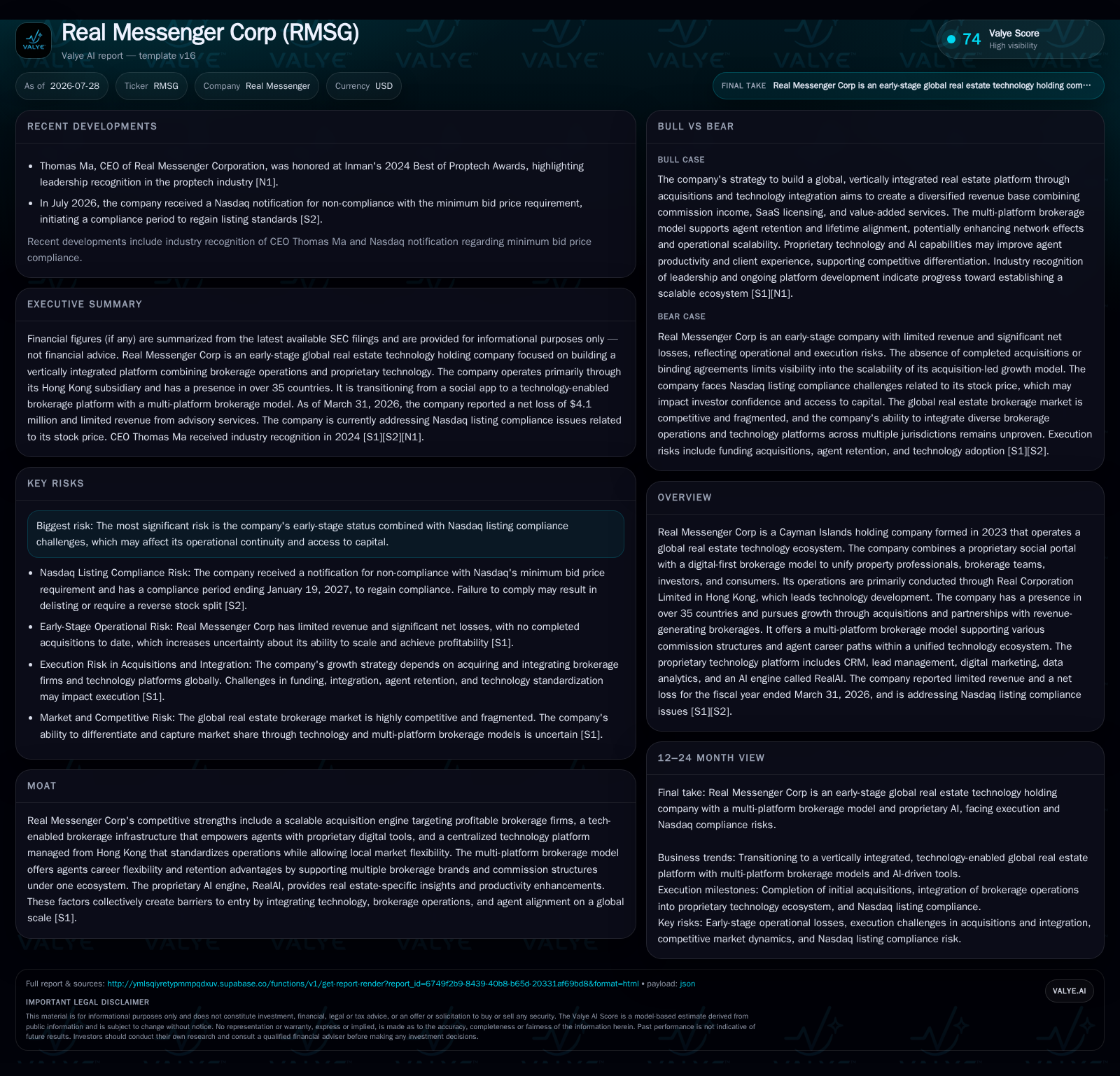
Real Messenger Corp is navigating a critical period marked by Nasdaq minimum bid price non-compliance, prompting a six-month window to regain market listing standards. Concurrently, the company is accelerating its strategic pivot from pre-revenue technology development to an acquisition-driven real estate brokerage platform. This approach integrates proprietary SaaS tools with brokerage operations across over 35 countries, aiming to balance commission-based income with recurring subscription fees. While the business model shows promise through agent retention and technology adoption metrics, execution risks and capital constraints remain significant near-term concerns.
Nasdaq Compliance Pressure Highlights Capital Constraints and Market Valuation Risks
On July 22, 2026, Real Messenger Corporation received formal notification from Nasdaq regarding non-compliance with the minimum bid price requirement after its Class A ordinary shares traded below $1 for 30 consecutive business days ending July 21, 2026 [S2]. This triggers a defined compliance period through January 19, 2027 during which the company must maintain a closing bid price above $1 for ten straight business days to avoid delisting. Options such as reverse stock splits exist but carry execution risk. This regulatory spotlight intensifies pressure on Real Messenger’s market capitalization and underscores uncertainties around liquidity and investor confidence—critical for funding its strategic pivot amid ongoing losses.
Strategic Pivot: Acquisition-Led Brokerage Platform Powered by Proprietary SaaS Ecosystem
Real Messenger operates primarily through its Hong Kong subsidiary Real Corporation Limited, building a global real estate technology ecosystem that integrates proprietary SaaS applications with digital-first brokerage operations spanning more than 35 countries [S6]. The company is transitioning from a pre-revenue development stage toward actively acquiring cash-flowing brokerages. By embedding all agents within acquired brokerages onto its proprietary platform—including CRM, listing management, communication tools, lead generation, transaction management, and analytics—it aims to drive high technology adoption rates enabling recurring software service fees alongside brokerage commission income [S1]. This hybrid model combines ownership control over brokerages with direct deployment of software tools—a scalable approach blending traditional brokerage dynamics with SaaS monetization.
Refined KPIs Focused on Brokerage Economics and Technology Adoption
Reflecting this shift, Real Messenger has revamped its key performance indicators away from consumer app engagement toward financially grounded metrics aligned with sustainable growth. These include real estate transaction commission revenue (reflecting brokerage production), agent count (via acquisitions or recruitment), commission revenue per agent (unit-level economics), agent retention rate (platform stickiness), technology adoption rate among agents (depth of software integration), future user-generated revenues from paid technology services, and anticipated inside sales within the ecosystem [S1][S18]. This KPI framework prioritizes how effectively technology adoption converts into predictable brokerage cash flows—a critical factor given industry evidence linking software usage intensity with agent retention and monetization.
"RealAI": Proprietary AI Integration as Differentiator Amid Industry Consolidation
Central to the platform’s competitive positioning is "RealAI," an AI engine embedded within CRM systems, lead management workflows, listing tools, and analytics modules [S15]. By combining dynamic vertical-specific data with static datasets, RealAI seeks to enhance agent productivity through actionable insights that streamline workflows and improve decision-making quality—addressing common productivity bottlenecks in traditional brokerages. This capability positions Real Messenger well amid industry consolidation driven by macroeconomic headwinds such as high interest rates dampening transaction volumes [S5]. The end-to-end integration of AI within active brokerage operations offers a potential moat dependent on sustained adoption and demonstrated value creation.
Multi-Brand Brokerage Platform Enables Flexible Commission Structures Supporting Agent Retention
Another core pillar is the multi-platform brokerage model supporting varied commission frameworks under one unified technological infrastructure [S15]. This flexibility contrasts with legacy brokerages’ rigid compensation models that often exacerbate agent churn during market downturns or regulatory shifts impacting compensation. Real Messenger’s design allows entrepreneurial agents to choose career paths aligned with brand preferences or commission schemes while leveraging consistent digital tools—potentially lowering churn rates critical for achieving operating leverage across multiple markets. Though unproven at scale, this approach aligns strategically with emerging bifurcation trends favoring either low-cost digital models or differentiated high-touch teams [S5].
Acquisition-Driven Expansion Anchored in Agent Integration Toward Recurring Revenue Mix Shift
Growth execution hinges on targeted acquisitions supplemented by partnerships designed to rapidly onboard entire brokerage teams onto the platform [S1][S15]. Acquisitions deliver immediate brokerage commission revenues plus aggregated recurring subscription fees as agents adopt proprietary software. While this integration poses operational risks including potential disruptions during transitions, it is essential for scaling combined SaaS-brokerage economics akin to public peers like Redfin or Compass. The March 2026 memorandum of understanding with a publicly traded U.S. brokerage reflects tangible progress toward commercial licensing beyond wholly owned entities [S5], enhancing visibility on monetization pathways.
Ecosystem Monetization: Inside Sales and Marketplace Revenue as Future Growth Levers
Beyond commissions and subscriptions, Real Messenger targets expanding ecosystem monetization via inside sales uplifts enabled by data analytics alongside premium marketing services, lead generation enhancements, media production offerings, advertising revenues, and AI feature add-ons accessible within its brokerage network [S1]. These higher-margin ancillary services could materially improve gross margins if scaled successfully. Cross-selling complementary services such as mortgage or title referrals fits naturally into this vertically integrated model—though these remain aspirational given current early-stage status.
Key Risks: Regulatory Pressures, Execution Complexity, Market Volatility
Near-term risks include managing Nasdaq compliance deadlines amid depressed share prices potentially constraining capital access—a critical concern given ongoing funding needs for acquisitions and technology investment [S2][S3]. Additional challenges encompass variable technology adoption rates across acquired brokerages risking delayed revenue realization; evolving legal/regulatory environments influencing commission structures; competitive pressures from established tech-enabled brokers; cybersecurity threats impacting trust; plus operational complexity inherent in managing geographically diverse markets requiring localized execution while maintaining standardized infrastructure advantages [S1]. Success depends on effectively navigating these multifaceted risks without derailing the strategic transition underway.
This analysis synthesizes publicly filed SEC disclosures without providing investment research views or forecasts. Readers should consult official filings for definitive information.
Disclaimer: This is research-only, informational analysis and not investment advice. It may include AI-generated interpretation and general industry context. Always verify important details using primary sources.

Comments