
Rank One Computing Advances with Zuccaro Acquisition and Maintains Strong Liquidity in Q2 2026
Rank One Computing Corp disclosed Q2 2026 results highlighting acquisition progress, integration risks, and a robust liquidity position.
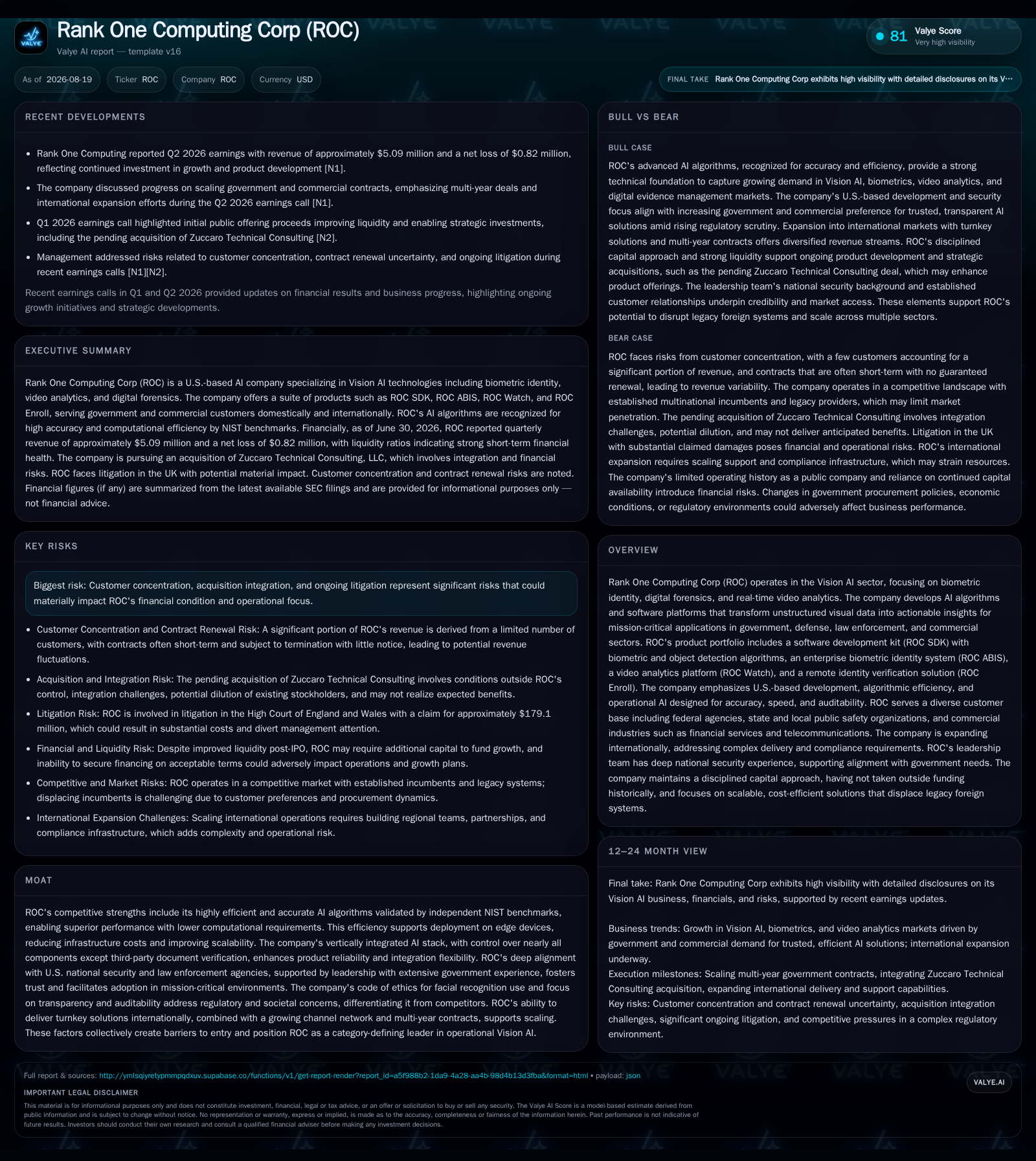
Rank One Computing Corp (ROC) reported its Q2 2026 operating and financial results, focusing on its pending acquisition of Zuccaro Technical Consulting, LLC (ZTC). The acquisition introduces integration challenges, dilution risks, and acquisition-related expenses that reduce operating results regardless of completion. Despite these risks, ROC maintains a strong balance sheet with $11.7 million in cash and a current ratio of 5.38 as of June 30, 2026, supporting ongoing operations amid litigation and customer concentration risks.
The company incurred significant acquisition-related legal, accounting, and advisory costs during the quarter, which are expensed as incurred and reduce operating results regardless of whether the acquisition closes [S2]. Despite these expenses, ROC’s balance sheet remains robust, with cash and equivalents totaling $11.7 million as of June 30, 2026, current assets of approximately $18.2 million, and current liabilities of $3.38 million, resulting in a strong current ratio of 5.38 [F1]. These include obtaining required regulatory approvals, third-party consents, execution of employment agreements with key ZTC personnel, and completion of a financial audit of ZTC’s 2024 and 2025 annual financial statements, which remains pending [S2]. The audit could reveal issues prompting renegotiation, delay, or termination of the acquisition.
The acquisition consideration comprises $500,000 in cash, $2.5 million in restricted common stock shares, and up to $7 million in revenue share payments over seven years [S2]. Additionally, ROC will issue $500,000 of restricted stock units to ZTC’s key personnel. The equity components and revenue share payments are forfeitable upon termination of employment, leading ROC to expect recognition of these amounts as compensation expense post-closing rather than as purchase consideration. This treatment will reduce reported operating results in future periods, potentially materially
ROC has limited prior experience in acquisitions and faces risks related to integrating ZTC’s operations, retaining key personnel and customers, and realizing anticipated benefits to its ROC Evidence product line. The company also expects to record goodwill and intangible assets subject to impairment testing, with potential impairment charges if acquired business performance or ROC’s market capitalization declines [S2]
Business Model and Market Position
ROC operates in the Vision AI sector, focusing on developing and licensing AI algorithms and software platforms for biometric identity, digital forensics, and video analytics. Its solutions target government agencies, law enforcement, defense, and commercial enterprises requiring U.S.-based sovereign technology. ROC’s biometric algorithms are recognized for high accuracy and computational efficiency, validated by National Institute of Standards and Technology (NIST) benchmarks. The company’s Vision AI platforms aim to replace foreign-built legacy systems with more efficient, cost-effective, and rapidly deployable American-built alternatives [S1].
Revenue is primarily generated through software licensing, multi-year contracts, and integration with customer platforms. The acquisition of ZTC introduces revenue share arrangements that could affect future revenue recognition and margins. ROC’s algorithmic efficiency supports margin stability by reducing infrastructure costs, but acquisition-related expenses and integration costs may pressure margins temporarily.
Risks and Industry Context
ROC continues to face ongoing litigation risks, including a claim filed in March 2026 in the High Court of England and Wales [S2,S6]. This concentration heightens the risk of quarterly fluctuations in operating results and challenges in sustaining consistent growth and cash flow.
Industry-wide, Vision AI demand is structurally driven by increasing government and commercial investments in biometric identity and video analytics. However, cyclical factors such as contract renewals, regulatory changes, and litigation outcomes can impact ROC’s performance. ROC differentiates itself from peers by offering U.S.-developed sovereign AI solutions with superior accuracy and efficiency, though its limited acquisition experience is a relative constraint compared to competitors.
Conclusion
Rank One Computing’s Q2 2026 update underscores a pivotal period marked by the pending acquisition of Zuccaro Technical Consulting, which offers strategic expansion but introduces significant integration, dilution, and financial risks. The company’s strong liquidity position, evidenced by cash and equivalents of $11.7 million and a current ratio of 5.38 as of June 30, 2026 [F1], provides a solid foundation to support operations and acquisition-related expenditures. Nonetheless, ongoing litigation and high customer concentration continue to pose risks to revenue stability. Monitoring the completion and integration of the ZTC acquisition, alongside customer contract renewals and litigation developments, will be critical for assessing ROC’s near-term operating trajectory.
This article is based on public filings and does not constitute investment advice.
Disclaimer: This is research-only, informational analysis and not investment advice. It may include AI-generated interpretation and general industry context. Always verify important details using primary sources.

Comments