
Rollins’ Recurring Revenue and Regulatory Challenges Shape Its Competitive Pest Management Position
Rollins reports steady Q2 earnings supported by recurring contracts but faces liquidity constraints and rising regulatory costs that pressure margins.
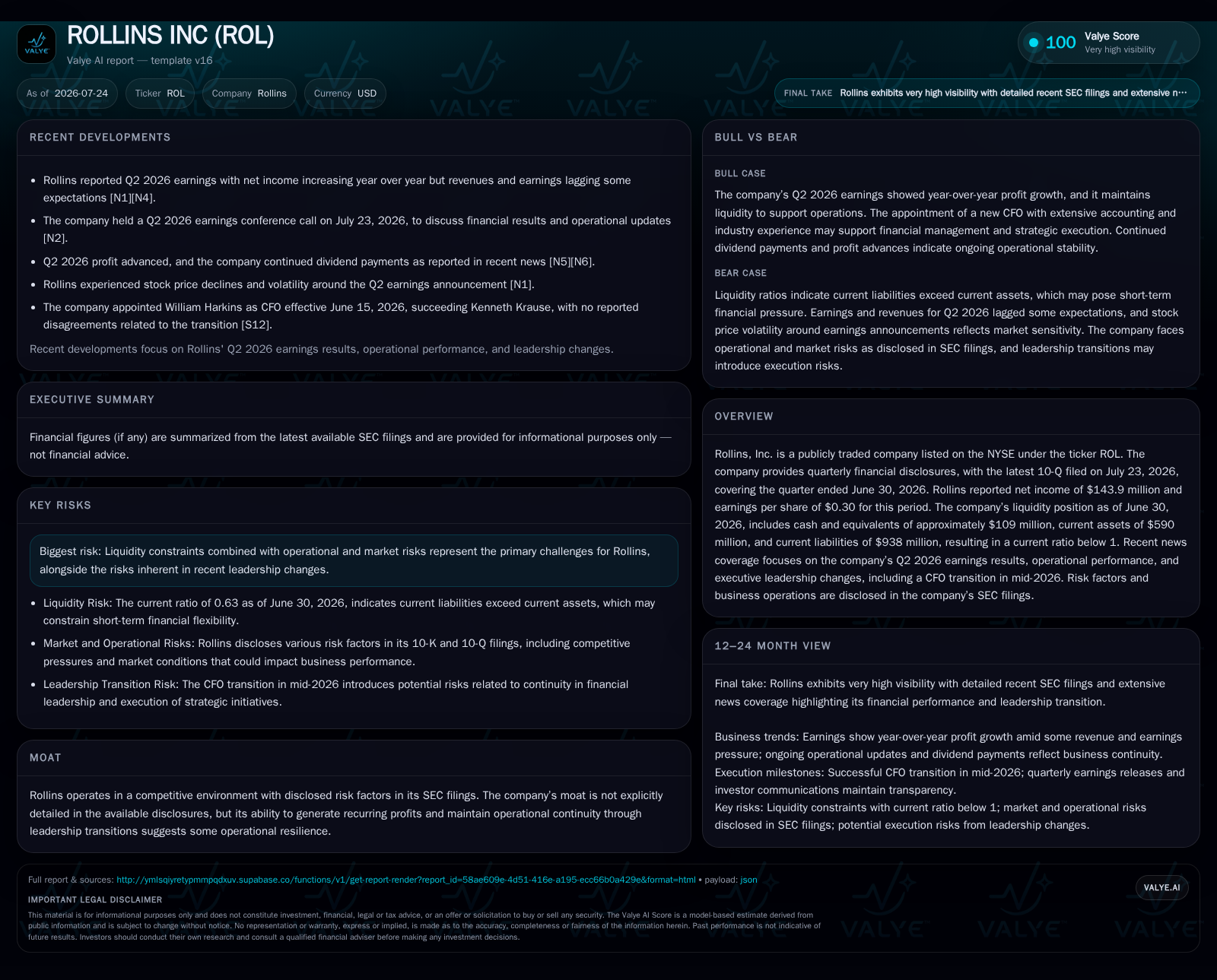
In Q2 2026, Rollins Inc. posted net income of $143.9 million on the back of sustained demand for its residential and commercial pest control services, underscoring the resilience of its recurring contract model. However, the company’s liquidity profile remains tight with a current ratio of 0.63 and total debt near $500 million, reflecting a potential constraint on near-term strategic flexibility. Regulatory compliance related to chemical treatments continues to pressure operating costs amid industry-wide environmental mandates, challenging Rollins’ pricing power. The recent CFO transition introduces an additional management execution risk during this delicate balance between growth and financial discipline.
Q2 Results Unpacked: Revenue Growth Meets Liquidity Constraints
The company’s liquidity profile is particularly notable. As of June 30, 2026, Rollins held approximately $109 million in cash and cash equivalents against current liabilities of about $938 million, resulting in a current ratio of roughly 0.63 [F1]. Total debt stood near $500 million, with net debt around $391 million after accounting for cash balances [F1]. This financial snapshot underscores the balance Rollins must maintain between operational growth and managing liquidity constraints in a service-oriented business.
Recurring Contracts Drive Revenue Stability Despite Competitive Industry Dynamics
Pest control services such as those offered by Rollins depend heavily on recurring service contracts with both residential homeowners and commercial property managers [S1]. These contracts typically encompass routine inspections, exterminations targeting insects or rodents, termite treatments, fumigation services, and preventive measures using regulated chemical treatments.
Rollins leverages this contract-based revenue model to generate predictable top-line inflows that are less sensitive to short-term economic cycles than many other industries in the services sector. High contract renewal rates serve as the linchpin for sustainable margins by reducing new customer acquisition costs and enabling efficient resource allocation across field operations.
However, the pest control market is fragmented and competitive. National players like Terminix Global Holdings provide scale advantages with broad geographic coverage yet face similar challenges in customer retention. Rollins’ scale lies closer to mid-sized national reach with strong penetration in certain service territories complemented by regional/local operators who compete intensely on price and localized service quality.
The stability derived from recurring contracts can be offset if customer churn increases or renewal pricing power diminishes amidst competition or economic softness [S1][S2]. Thus, maintaining high renewal rates remains central to Rollins’ financial health
Operational Efficiency Measured: Technician Utilization and Customer Retention Trends
Industrial knowledge in pest control points to service technician utilization as an essential operational KPI. High utilization improves operating leverage because technicians are the primary cost drivers delivering direct extermination and inspection services.
Similarly, contract renewal rates remain core to assessing durable customer loyalty. Sustained renewals suggest effective value delivery via integrated pest management techniques combining chemical treatments with environmentally conscious approaches favored increasingly by customers complying with regulatory mandates.
Peers have demonstrated that boosting technician productivity alongside strong customer retention correlates tightly with above-industry-average EBITDA margins—an operational aspiration Rollins appears aligned with but must continue monitoring prudently.
Regulatory Factors Elevate Chemical Treatment Costs and Risk Exposure
Rollins explicitly flags in its risk disclosures that environmental regulations significantly impact the pest control industry’s cost structure [S17][S18]. Chemicals used for extermination require compliance with stringent safety standards involving storage, application protocols, worker protection measures, disposal practices, and local environmental mandates.
These mandates often increase overhead through additional training requirements, protective equipment investments, documentation processes, and sometimes restrict usage of formerly common pesticides altogether.
Consequently, costs for qualified chemical treatments have risen materially in recent years—not necessarily fully offset by pricing enhancements due to competitive market dynamics—thus compressing gross margins temporarily or permanently depending on market elasticity.
Monitoring regulatory shifts represents an ongoing imperative since emerging rules can require technological innovation or alternative integrated pest management solutions that may entail upfront investment before cost pass-through becomes feasible.
Leadership Transition Impact: Navigating CFO Change Amid Market Pressures
Management continuity faced an inflection point mid-2026 when longtime CFO Kenneth Krause resigned effective June 15 with William W. Harkins stepping into the role from his prior Chief Accounting Officer capacity [S16]. This transition occurred without indications of disagreement or operational disruption per company disclosures.
Leadership changes at financial steward roles during liquidity-constrained periods can introduce execution uncertainty over budgeting discipline, capital allocation decisions, and investor communications cadence. However, Mr. Harkins’ deep corporate accounting experience from branded consumer goods firms suggests he brings analytical rigor potentially beneficial in navigating fiscal challenges ahead.
The board’s proactive announcement and structured one-time equity incentives tied to retention intend to underpin strategic continuity even as broader market complexities unfold [S14]. Stakeholders will watch closely how his leadership influences upcoming quarterly guidance revisions or capital structure maneuvers.
Growth Catalysts: Geographic Expansion and Novel Pest Management Techniques
Rollins continues focusing on expanding its geographic footprint through acquisitions targeted at underserved regions or complementary service areas while augmenting its portfolio with innovative integrated pest management (IPM) solutions emphasizing reduced environmental impact [S1][S2].
IPM approaches combine mechanical controls with selective chemical use leveraging data analytics about infestation patterns—positioning offerings more favorably amid regulatory tightening and increasing client eco-consciousness.
Furthermore, commercial real estate development trends fuel demand from new construction requiring pest control pre-treatments alongside ongoing maintenance contracts—a channel likely enhancing average revenue per customer metrics where Rollins is active.
Organic growth via new customer acquisition rates partially offsets attrition risks while acquisitions accelerate scale advantages vital against larger peers offering bundled facility services including sanitation and cleaning segments.
Emerging Risks: Environmental Compliance, Seasonality, and Competitive Intensity
Key risks rolling through Rollins’ business model include amplified environmental compliance costs affecting pesticide procurement expenses plus administrative overhead related to permitting or reporting requirements [S17][S18]
Seasonality inherently affects pest control demand—warmer months drive higher infestation treatment volumes creating quarterly revenue volatility patterns requiring fine-tuned workforce scheduling to optimize technician utilization without incurring excess labor costs during trough periods.
Moreover, competitive pressures from national chains advantaged by broad multi-service portfolios coexist alongside aggressive regional players who may undercut prices locally creating challenges sustaining pricing discipline especially in residential segments.
Customer attrition potential remains ever-present factoring economic downturn impacts reducing discretionary spending on non-essential home services such as pesticide inspections or rodent control unless bundled attractively within package contracts.
Strategic integration risks from recent or future acquisitions also necessitate diligent oversight given variable localized market dynamics impacting consistent execution quality across diverse territories.
Forward Indicators: Contract Renewal Patterns and Upcoming Guidance Signals
Investors focusing beyond raw Q2 results should prioritize incoming data on contract renewal rates disclosed in subsequent quarters since sustenance or erosion there indicates health of core recurring revenue streams fundamental for valuation analyses [N2][N3]
Similarly important are any updated forward-looking statements presented during upcoming earnings calls clarifying management’s outlook on margin recovery potential amid regulatory cost pressures plus any shifts signaling altered capital expenditure strategies aimed at supporting geographic expansion or technology adoption could materially influence future profitability trajectories.
Careful attention to commentary surrounding seasonality adjustments will further delineate whether near-term earnings misses stem from transient timing issues versus structural demand shifts requiring tactical response recalibrations.
Financial Profile Discussion: Liquidity Squeeze versus Operational Cash Flow Generation
As of June 30, 2026, Rollins held approximately $109 million in cash alongside roughly $500 million in total debt, resulting in net debt near $391 million after adjusting for cash balances [F1]. Current assets of about $590 million compared to current liabilities near $938 million yield a current ratio of approximately 0.63 [F1].
This liquidity position highlights limited near-term cushion for unexpected working capital needs or accelerated capital expenditures without accessing capital markets or refinancing arrangements [S2]. However, it must be balanced against consistent operational cash flow generation supported by recurring billing models embedded in multi-year residential and commercial contracts
The recent CFO transition may also signal renewed focus on deleveraging and treasury management to enhance financial flexibility amid ongoing sector headwinds.
Disclaimer: This is research-only, informational analysis and not investment advice. It may include AI-generated interpretation and general industry context. Always verify important details using primary sources.

Comments