Royalty Pharma’s Strategic Lead in Biopharma Royalties: Innovation, Income Volatility, and Portfolio Depth
Royalty Pharma has cemented its role as the preeminent acquirer and manager of biopharmaceutical royalties, intricately blending finance with drug innovation.
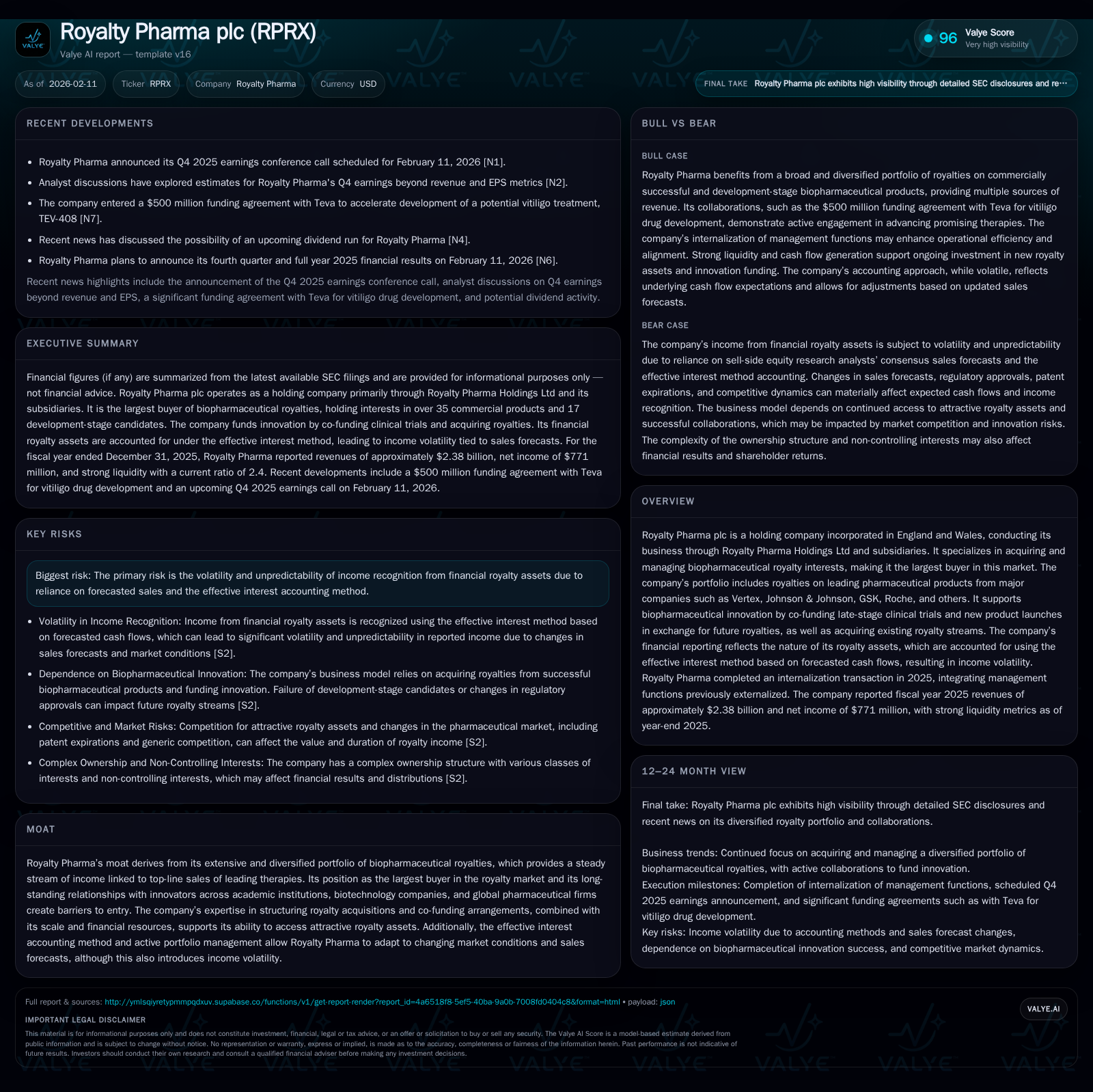
Since its 1996 inception, Royalty Pharma plc has pioneered a unique business model focused on acquiring and managing royalties from leading pharmaceutical products. Its extensive portfolio spans blockbuster drugs from industry titans like Vertex and Johnson & Johnson, supported by innovative co-funding partnerships that accelerate late-stage development. The company’s complex earnings profile, driven by effective interest accounting tied to sales forecasts, introduces notable revenue volatility despite robust underlying cash flows. A landmark internalization in 2025 streamlined operations and reinforced capital structure, positioning Royalty Pharma for sustained growth amid shifting market dynamics.
Forging A Unique Business Model: Royalty Pharma’s Market Position
Royalty Pharma plc stands apart in the financial landscape as the largest dedicated acquirer of biopharmaceutical royalties. Originating in 1996 as a pioneer investor bridging capital markets with medical innovation, it functions primarily as a holding company incorporated in England and Wales that operates through Royalty Pharma Holdings Ltd and other subsidiaries [S1][S2]. This structure provides flexibility for complex acquisition transactions and ongoing management of royalty streams.
Unlike traditional pharmaceutical companies focused on drug discovery or manufacturing, Royalty Pharma occupies a niche intersecting finance and life sciences. By purchasing rights to future royalties on approved drugs or developmental candidates from inventors ranging from academic institutions to global pharma giants, it extracts value from intellectual property while enabling capital recycling into fresh innovation channels. Its broad industry relationships afford access and negotiation leverage rarely matched by typical investors.
The raison d’être behind this acquisition-driven approach lies in capturing income linked directly to top-line sales performance rather than profit margins or research outcomes. This creates compelling long-term cash flow potential albeit with unique risks tied to forecasting drug sales dynamics.
An Expansive & Diversified Portfolio: Catalyzing Innovation Through Royalties
At the heart of Royalty Pharma’s competitive advantage is the sheer breadth and diversity of its royalty holdings. The company’s portfolio encompasses royalty interests associated with over 35 commercial products alongside another 17 programs at various development stages [S2]. These assets span blockbuster therapies such as Vertex's Trikafta and Alyftrek; Johnson & Johnson’s Tremfya; GSK's Trelegy; Roche’s Evrysdi; Biogen's Tysabri and Spinraza; AbbVie/Johnson & Johnson's Imbruvica; Astellas/Pfizer's Xtandi; Pfizer’s Nurtec ODT; and Gilead’s Trodelvy among others [S2].
This expansive mix reflects an intentional strategy to avoid concentration risk while capturing diverse segments within the evolving biopharmaceutical landscape. Furthermore, Royalty Pharma complements its acquisitions by actively investing via co-funding initiatives that propel late-stage clinical studies or product launches in exchange for future royalties—a symbiotic approach combining capital infusion with de-risking developmental assets [S2].
Recent examples vividly illustrate this model: The collaboration with Teva Pharmaceuticals specifically aims at advancing a potential vitiligo treatment through shared funding commitments—with Royalty Pharma’s role catalyzing acceleration of this dermatological innovation [N9][N14]. Such partnerships highlight not only pipeline expansion but also downstream opportunities for royalty monetization.
Financials in Focus: Understanding Revenue Volatility Amid Predictive Accounting
One of the more intricate facets of Royalty Pharma is its revenue recognition methodology anchored in the effective interest method applied to forecasted cash flows from royalty assets [S1][F1]. Rather than simple cash receipts marking revenue events, income statements reflect amortized valuation adjustments based on periodically revised sales projections.
This forward-looking accounting rigorously aligns reported revenues with expected economic benefits embedded within royalties but also seeds inherent volatility. For instance, upward or downward revisions in anticipated product sales directly influence income recognized — creating pronounced quarter-to-quarter swings even if underlying cash collection trends remain stable.
Financial results for the fiscal year ending 2025 underscore this dynamic: Annual revenue reached approximately $2.38 billion while net income totaled near $771 million [F1]. Nonetheless, management commentary during the Q4 earnings call noted that reported bottom-line advances involved significant non-cash adjustments reflecting updated assumptions around product performance forecasts [N10]. Such disclosures emphasize that short-term earnings volatility should be contextualized within long-term asset value preservation.
Additionally, Royalty Pharma maintains a strong liquidity position with over $600 million in cash equivalents alongside a current ratio of about 2.4 — supporting operational flexibility amid potential income fluctuations [F1]. This financial resilience enables sustained investment capacity for acquiring new royalty interests or bolstering existing collaborations.
2025 Milestones: Internalization & Its Strategic Implications
A transformative event shaping Royalty Pharma’s corporate trajectory was the completion of an internalization transaction in 2025 [S1]. Prior to this milestone, key royalty assets were held indirectly through various partnerships and collective vehicle structures which entailed complexity in governance and economic arrangements.
Post-internalization, ownership consolidated under Royalty Pharma plc alongside RP Holdings Ltd with former external investors exchanging limited partnership interests for Class E equity stakes within RP Holdings [S1][S2]. This shift simplified shareholder architecture while enhancing transparency regarding operational control—benefits keenly noted by market watchers following announcement disclosures.
From an operational standpoint, integration efforts accompanying internalization targeted harmonizing asset management practices across subsidiaries to improve efficiencies and strategic alignment. Economically, it also reinforced capital allocation discipline given clearer linkage between earnings streams accrued at subsidiary levels feeding directly into publicly reported results.
This corporate realignment provides a firmer foundation for scaling acquisition activities or expanding partner-funded projects while underscoring confidence in longitudinal royalty income prospects amidst evolving external factors.
Partnerships Powering Growth: Collaborations with Teva and Industry Giants
Royalty Pharma’s continued growth narrative is heavily intertwined with collaborative ventures that extend beyond passive ownership into active partnership roles [S2][N9][N14]. The strategic alliance with Teva embodies this evolution: by co-funding vitiligo drug development efforts alongside Teva’s expertise, Royalty Pharma shares both risk exposure and prospective rewards tied to successful commercialization [N9][N14].
Such collaborations serve multiple purposes—accelerating time-to-market by easing funding constraints for innovators; fostering closer alignment on clinical milestones informing royalty projections; and diversifying pipeline risk through staged investments rather than lump-sum acquisitions.
Moreover, ongoing relationships with established industry leaders like Johnson & Johnson, GSK, Roche, Biogen, AbbVie, Pfizer, and others create reinforcing networks enabling access to high-caliber royalty streams while supporting emerging scientific advances indirectly through strategic capital deployment [S2].
By embedding itself within both mature blockbuster franchises and nascent therapeutic areas via these partnerships, Royalty Pharma enhances its ability to capture varied growth vectors across the highly competitive biopharma ecosystem.
Risk Landscape: Navigating Income Uncertainty and Market Dynamics
Despite an enviable portfolio breadth and innovative business model, Royalty Pharma encounters specific structural risks chiefly emanating from income recognition idiosyncrasies and market variability [S1][S2].
Foremost among these challenges is the dependency on forecasted product sales underpinning effective interest accounting. If actual market uptake diverges sharply from estimates—due to competition intensification, regulatory setbacks, patent expirations or unforeseen disruptions—recognized revenue can veer considerably away from cash receipts resulting in volatile reported earnings [S1]. This decoupling complicates straightforward performance assessment for stakeholders.
Beyond forecasting risk lies broader industry headwinds: evolving payer dynamics influencing pharmaceutical pricing; shifts in healthcare policy impacting drug utilization; competition spawning biosimilars or next-gen alternatives—all factors potentially exerting pressure on royal streams derived from older compounds.
Additionally, concentration remains a latent concern although partially mitigated by diversification strategies. Reliance on a subset of blockbuster products means adverse developments affecting any major asset could have disproportionate financial repercussions without timely offsetting acquisitions or partnership deals.
Understanding these risks requires parsing nuanced financial statements closely rather than relying solely on headline metrics—a theme echoed repeatedly during recent analyst discussions around Q4 2025 results [N3][N10].
Investor Sentiment & Market Reaction: Analyzing Recent Earnings and Analyst Perspectives
Investor reaction following release of Q4 2025 earnings illustrates growing appreciation of Royalty Pharma's complex financial narrative balanced against its strategic strengths. Analysts highlighted solid revenue growth reaching nearly $2.38 billion annually coupled with net income improvements around $770 million as positive validation points but cautioned that headline gains mask layered accounting impacts stemming from forecast adjustments [N1][N3][N10].
Market commentary increasingly frames appraisal criteria not merely around top-line metrics but deeper evaluation of earnings quality — dissecting items like non-cash amortizations intrinsic to royalty valuations versus actual cash generation trends [N3][N5]. Conversations about potential dividend enhancements have surfaced as well given robust cash flow profiles providing room for returns alongside reinvestment priorities [N11].
These dialogues reflect maturation among investors embracing the company's hybrid biotech/financial asset nature: bullish about future growth potential yet prudent given earnings variability grounded in analytic assumptions underpinning asset valuations.
The Road Ahead: Prospects for Growth and Value Creation in Biopharma Royalty Investing
Looking forward into 2026 and beyond, Royalty Pharma occupies a distinctly advantaged position poised to capitalize on multiple fronts. Its unrivaled scale as largest purchaser equips it uniquely to source premium royalty assets while active portfolio management allows recalibration responsive to market realities [S1][F1].
The company's proven ability to forge meaningful partnerships—as exemplified recently by Teva collaborations—signals capacity not just for reactive acquisition but proactive co-investment fostering innovation synergistically aligned with emerging therapeutic opportunities [N14].
Financially robust with ample liquidity plus clearer governance post-internalization underpins confident pursuit of strategic initiatives aimed at expanding royalty base or deepening involvement across promising development candidates across more indications.
However carefully nuanced understanding remains essential—as does attentive monitoring of evolving pandemic aftereffects on drug markets plus regulatory landscapes reshaping pharmaceutical economics globally.
In sum, Royalty Pharma blends financial ingenuity with life sciences domain expertise producing a resilient platform marrying income generation with exposure to cutting-edge medical advancement ultimately driving value creation tailored closely to sector-specific imperatives.
Disclaimer: This analysis is intended solely for informational purposes without providing investment advice or recommendations. All data reflect publicly available information as of early 2026. Risks inherent to investment relate closely to underlying assumptions detailed herein which may evolve over time. Readers should perform their own due diligence before making any investment decisions.
Disclaimer: This is research-only, informational analysis and not investment advice. It may include AI-generated interpretation and general industry context. Always verify important details using primary sources.

Comments