
Red Robin Reports Operational Recovery and Strategic Challenges with Elevated Debt Load
Red Robin's 2025 results show early progress in its turnaround plan but highlight ongoing liquidity constraints and competitive pressures in casual dining.
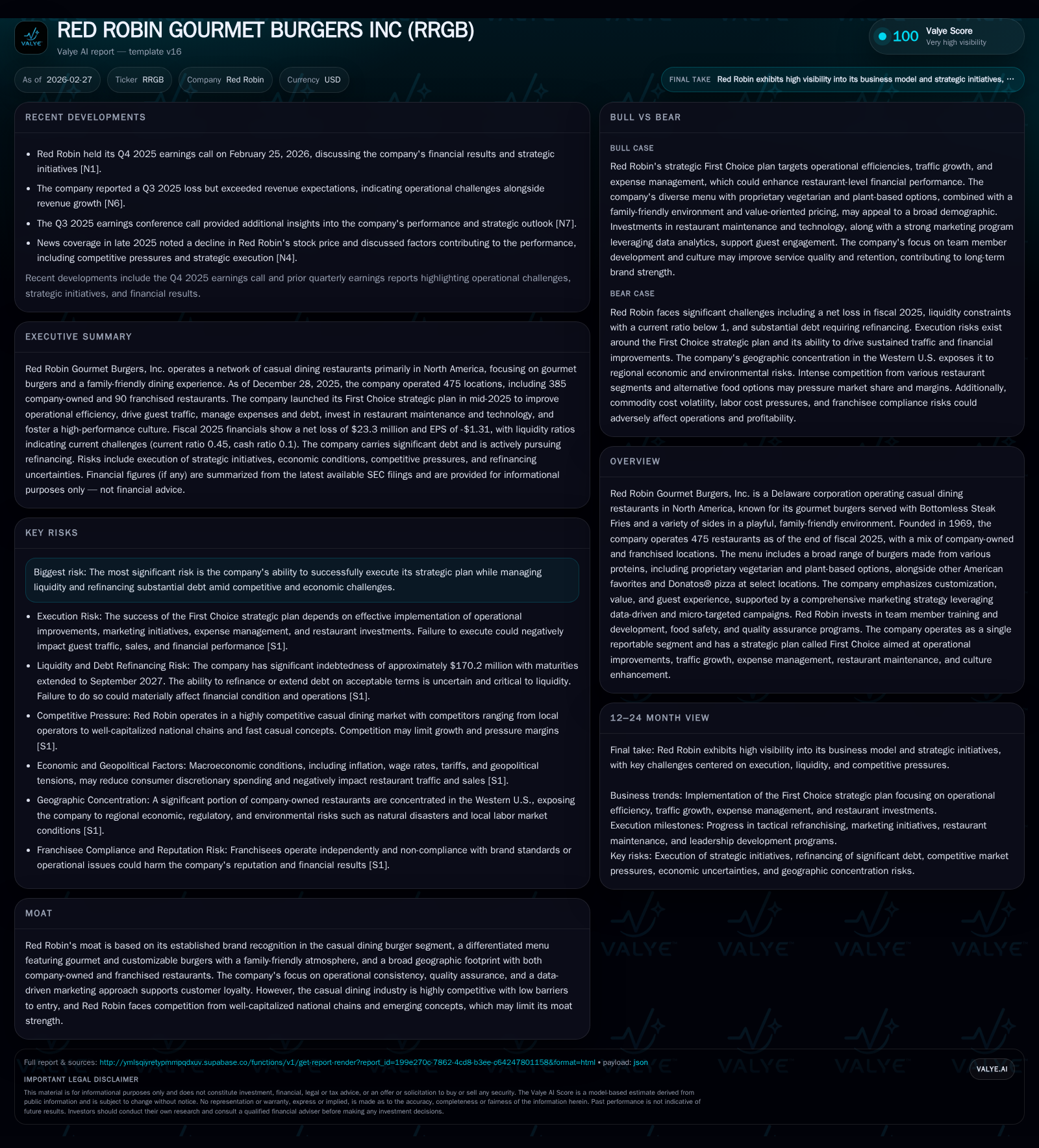
Red Robin Gourmet Burgers, Inc. operates a national portfolio of casual dining restaurants specializing in gourmet, customizable burgers served in family-friendly settings. Fiscal 2025 saw a modest return to operating income profitability and improved cash flow from operations after recent years of losses, reflecting initial traction from its First Choice strategic plan launched mid-2025. However, the company reported a net loss of $23.3 million in 2025 and faces considerable refinancing risk on approximately $170 million of maturing debt due by late 2027. Tactical refranchising and operational investments aim to free up capital and enhance guest experience amid intense competition and rising labor costs concentrated in Western U.S. markets. Continued execution on marketing initiatives, cost controls, and debt management will be critical to sustaining growth and restoring shareholder value.
Company Overview and Historical Performance
Red Robin Gourmet Burgers, Inc., founded in 1969 with the first restaurant opened in Seattle, has grown into a sizable casual dining chain with 475 locations across North America as of fiscal year-end 2025. The portfolio consists primarily of company-operated restaurants (385), supplemented by franchised units (90), spanning 39 states plus one Canadian province. The brand is well-known for its gourmet burger offerings served with "Bottomless Steak Fries®" amidst a family-friendly environment which is core to its identifiable customer experience [S1].
From a financial standpoint, revenue has stabilized around the low $300 million range after peaking near $342 million in FY2017 (e.g., $302.9 million reported for FY2019) [F1]. Operating income has experienced volatility: after posting losses exceeding $56 million in FY2022 and rebounding to positive territory in FY2023 ($4.54 million), Red Robin returned to an operating loss in FY2024 (-$53.1 million) before achieving modest profitability ($2.79 million) in FY2025 [F1].
Net income trends mirror operating results but remain negative: losses narrowed from over $77 million in both FY2022 and FY2024 to approximately $23.3 million for FY2025 despite operational improvements [F1].
Operating cash flow recovered strongly from negative territory (-$1.15 million) in FY2023 to positive $37 million by year-end 2025, supporting working capital needs amid significant capital expenditures aimed at restaurant upkeep and technology upgrades [F1].
Historical performance (annual)
| FY | Net ($mm) | CFO ($mm) | OpInc ($mm) | Net YoY |
|---|---|---|---|---|
| 2025 | -23 | 37 | 3 | +70.0% |
| 2024 | -78 | 7 | -53 | -265.3% |
| 2023 | -21 | -1 | 5 | +72.7% |
| 2022 | -78 | 36 | -56 |
Source: SEC companyfacts cache [F1].
Capital returns and efficiency (annual)
| FY | Buybacks ($mm) | ROE% |
|---|---|---|
| 2025 | 0 | 21.9 |
| 2024 | 0 | 92.0 |
| 2023 | 10 | 103.8 |
| 2022 | 0 | -1447.4 |
Source: SEC companyfacts cache [F1].
Note: 'N/A' denotes data not explicitly disclosed or available.
Strategic Initiatives and Growth Prospects
In July 2025, Red Robin appointed David Pace as CEO and launched the "First Choice" strategic plan targeting long-term value creation through four pillars: Hold Serve (operational consistency), Drive Traffic (marketing innovation leveraging data-driven micro-targeting), Find Money (expense management, tactical refranchising, debt reduction), and Fix Restaurants (addressing deferred maintenance) [S1][S21].
These initiatives address challenges such as competitive pressures from fast-casual chains and consumer demand shifts while aiming to enhance guest experience through reinvested capital and refined marketing strategies [S25][N1]. The company also incorporates licensed Donatos® pizza offerings at select locations, adding product diversification under controlled brand management [S15][S23].
Growth depends on effective execution amid sector competition characterized by pricing dynamics, menu innovation, and geographic expansion by peers [S29]. Red Robin’s established brand focused on gourmet family burgers with customizable options serves as differentiation if supported by successful marketing campaigns and loyalty program enhancements [S27][S21].
Financial Outlook and Key Milestones
While explicit guidance is limited during this transformation phase, critical milestones include:
- Sustained positive operating income beyond FY2025 would validate turnaround efforts.
- Progress refinancing or extending approximately $170 million debt maturing September 2027 is vital given tight liquidity indicated by a current ratio near 0.45 [F1][S4][S10].
- Execution of tactical refranchising transactions will shift revenue mix toward franchise royalties while alleviating capital expenditure burdens on company-operated stores [S14][S19].
- Marketing effectiveness metrics such as guest frequency increases or average check growth via loyalty analytics may forecast sustained top-line improvement [S21][N1].
Investors should monitor quarterly trends relative to expense control alongside refinancing updates communicated through investor relations channels.
Capital Allocation & Liquidity Considerations
Balance sheet constraints are evident with current liabilities ($199 million) significantly exceeding current assets ($89 million), resulting in a current ratio of approximately 0.45 indicating short-term funding pressures; cash and equivalents stood at about $19.9 million as of December 28, 2025 [F1].
Total debt approximates $170 million due by September 2027 following recent credit agreement amendments extending maturity dates by six months; refinancing success hinges on sustained operational improvements enabling covenant compliance under restrictive credit terms [S4][S10][F1].
Free cash flow remains negative when accounting for capital expenditures despite improved operating cash flow—estimated around -$22.95 million—reflecting ongoing reinvestment needs limiting discretionary capacity for aggressive debt reduction or shareholder returns currently [F1][S19][S18].
No share repurchases occurred during FY2025 following prior activity reductions highlighting cautious capital deployment favoring liquidity preservation over distributions under existing leverage conditions [F1][S5]. Dividends are not emphasized given financial priorities.
Competitive Landscape & Risks
The competitive environment includes fast-casual entrants aggressively targeting the gourmet burger niche alongside established full-service chains competing via pricing flexibility, menu innovation, and scale advantages; brand loyalty is challenged amid evolving consumer preferences requiring continuous innovation [S25][S29].
Geographic concentration—with roughly half of revenues generated from Western U.S. stores where labor regulations impose high minimum wages—exposes Red Robin to regional cost pressures complicating margin management amid tight labor markets nationally [S20][S21]. Supply chain inflation further pressures margins requiring vigilant sourcing strategies.
Legal risks include employment litigation related to wage-hour compliance and employee classification disputes that could divert resources though mitigated by active legal oversight documented by the Company [S12][S13]. Data privacy laws impose compliance costs limiting marketing scope while cybersecurity threats require ongoing investment to protect guest data and maintain operational continuity [S27][S28].
Refinancing remains critical given credit facility covenants that if breached could trigger default accelerating debt repayment demands impacting business continuity absent renegotiation or asset sales under duress scenarios.
Conclusion
Red Robin Gourmet Burgers shows signs of stabilizing operations with modest operating profitability restored alongside improved cash generation reflecting initial benefits from its First Choice strategic plan introduced mid-2025 [N1][S1][F1]. Substantial indebtedness maturing within two years presents refinancing risks that require close monitoring alongside execution of tactical refranchising initiatives aimed at balance sheet optimization [S4][S14]. Future success will depend on accelerating top-line growth through innovative marketing balanced against cost inflation headwinds; managing geographic concentration risks; nurturing workforce talent amid rising labor costs; protecting intellectual property; maintaining regulatory compliance; and securing financial flexibility through successful refinancing efforts.
Stakeholders should focus on quarterly financial performance sustainability alongside management updates regarding refinancing progress as key indicators shaping Red Robin's path toward renewed competitiveness within the casual dining segment.
This analysis is based on publicly available information as of February 27, 2026, including SEC filings and transcripts referenced herein.
Disclaimer: This is research-only, informational analysis and not investment advice. It may include AI-generated interpretation and general industry context. Always verify important details using primary sources.

Comments