RTX CORP’s Strategic Synergy in Aerospace Innovation and Defense Contracting Amid Rising Risks
RTX’s $268 billion backlog and diversified segments underpin a complex interplay of stability and risk fueled by geopolitical uncertainties and economic pressures.
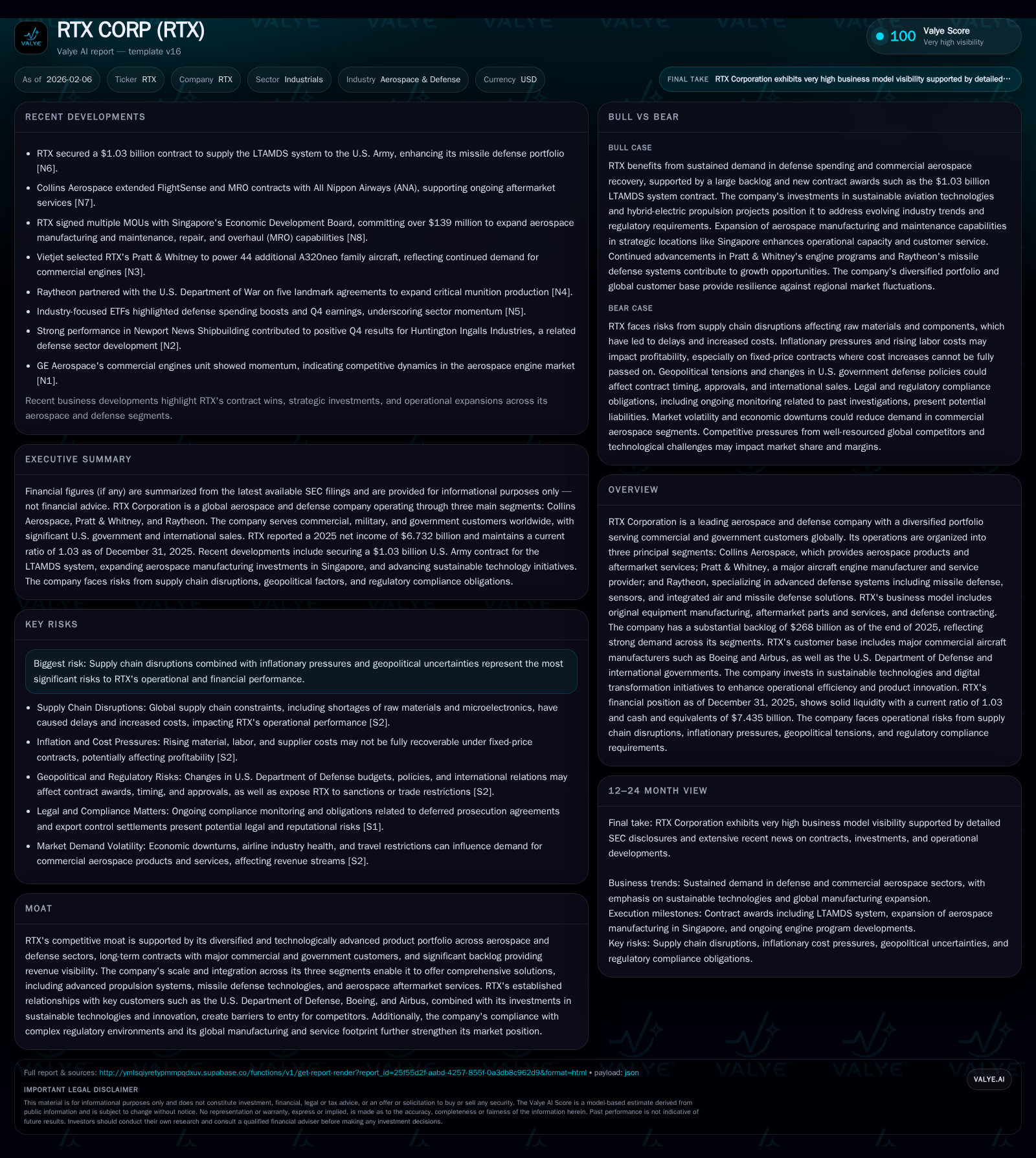
RTX Corporation leverages its three-pronged business model—Collins Aerospace, Pratt & Whitney, and Raytheon—to sustain robust revenue streams from both commercial aerospace and defense sectors. Its massive backlog provides substantial revenue visibility but also underscores challenges inherent in contract execution, supply chain constraints, and inflation. Political volatility around U.S. government defense budgets introduces uncertainty that permeates RTX’s operational outlook. The company’s financial fundamentals remain solid, buttressed by cash liquidity and consistent profitability, while ongoing investments in innovation and sustainability seek to deepen its formidable moat.
Anchoring Aerospace: The Backbone of Collins and Pratt & Whitney
At the heart of RTX’s balanced business model lie Collins Aerospace and Pratt & Whitney—two segments that fortify the company’s commercial aerospace foundation through both original equipment manufacturing (OEM) and aftermarket services. Collins Aerospace delivers an extensive suite of technologically advanced aerospace products ranging from flight control systems to cabin interiors. Its client roster prominently includes Boeing and Airbus, which historically account for roughly one-third of its sales combined before incentives [S1]. This stable relationship ensures steady order flow underpinning RTX’s revenue base.
Pratt & Whitney operates as a global leader in aircraft engine manufacturing, with a portfolio that includes high-performance engines tailored for both military applications and commercial airliners. It also offers comprehensive aftermarket maintenance support, enhancing lifecycle value for aircraft operators. Together, these aerospace arms provide RTX a stable revenue floor insulated somewhat from the cyclical nature of defense procurement.
The dual-pronged commercial approach translates into sustained demand for new aircraft production alongside lucrative recurring aftermarket service contracts. Such diversification across OEM output and service solutions contributes to resilience amid global shifts in airline traffic patterns or supply fluctuations [F1], [S1].
Raytheon Reimagined: Defense Innovation at the Forefront
Complementing RTX's aerospace backbone is Raytheon Technologies’ evolving role as a linchpin of advanced defense systems innovation. Raytheon specializes in missile defense platforms, radar sensors, integrated air command solutions, and cyber-enabled military technologies—all critical components within U.S. Department of Defense contracts and allied international programs [S1]. These portfolio offerings position RTX at the nexus of next-generation warfare capabilities.
The magnitude of Raytheon's contribution surfaces notably in the company’s vast backlog, where defense-related orders represent a significant portion reflecting strong government demand [F1]. Its expertise in complex systems integration and cutting-edge R&D enables RTX to maintain competitive advantage vis-à-vis peers operating within the aerospace-defense ecosystem.
Given global geopolitical tensions driving increased defense spending commitments internationally, Raytheon’s innovation pipeline acts as a strategic growth catalyst while cementing RTX’s domain leadership.
Executing Against a $268 Billion Backlog: Visibility with Challenge
RTX’s reported backlog of $268 billion entering 2026 is both a testament to its broad customer appeal and an operational crucible testing execution discipline [F1], [N10], [N11]. This unparalleled volume signals strong forward revenue visibility stemming from multi-year contracts across its three principal segments.
However, such size also introduces heightened complexity: managing delivery schedules over extended time horizons; optimizing capital tied up in work-in-progress; navigating resource constraints; and mitigating risks linked to cost overruns or contractual delays (especially given inflationary pressures) [S1], [N11]. While management successfully exceeded Q4 earnings guidance per recent releases [N10], sustaining this performance demands rigorous program management amid evolving supply chain dynamics.
Moreover, integrating diverse business units under common operational strategy amplifies coordination challenges as each segment undergoes distinct market cycles or technology transitions.
Navigating the Political Labyrinth: Government Spending Risks Unpacked
A critical factor shaping RTX's future unfolds within the contours of U.S. government defense budget processes—a notoriously volatile arena fraught with legislative delays, shifting strategic priorities, and political negotiations [S1]. Because a substantial portion of revenues derives from prime contracts with the Department of Defense (DoD) or subcontracting arrangements subject to appropriations timing, any disruption in congressional funding cycles can materially affect order flow.
These risks manifest chiefly through potential government shutdowns delaying contract awards or payments; stop-work directives curtailed by changing policy environments; or partial program funding truncating long-term projects. While termination clauses typically provide cost recovery protections for contractors like RTX, abrupt program changes erode predictability and can adversely impact profitability metrics [S1].
This structural dependence on federal budgeting injects an element of uncertainty despite strong underlying demand drivers linked to national security imperatives.
Supply Chain and Inflation: The Invisible Headwinds
Beyond political uncertainties lies the domain of operational pressure points—specifically inflationary cost increases combined with supply chain interruptions—that have dogged industrial manufacturers globally [valye_report_excerpt], [S1]. For RTX, procurement of specialized materials, electronic components, and skilled labor are essential inputs vulnerable to price volatility or logistical bottlenecks.
Management disclosures acknowledge these factors as ongoing margin constraints requiring strategic supplier engagement and efficiency improvements to absorb cost shocks without passing all burdens downstream [S1], [N11].
Global trade complexities further add layers of unpredictability impacting timely fulfillment schedules across both aerospace production lines and defense system deliveries.
Financial Fortitude: Balance Sheet Strength and Operational Metrics
RTX's latest reported financial data depicts resilient fundamentals rooted in disciplined capital management and profitable operations [F1], [N10], [N11]. The net income tally of approximately $6.7 billion for 2025 indicates sustained earnings power despite macro headwinds.
Liquidity indicators reveal cash reserves near $7.4 billion paired with current assets totaling about $60 billion against current liabilities close to $58.8 billion—generating a current ratio slightly above one at 1.03 [F1]. This suggests ample short-term coverage though reflects a delicate balance requiring careful working capital stewardship.
Operationally, margins remain under pressure relative to peak historical levels; nevertheless, effective cost controls coupled with scaling benefits from backlog execution support robust free cash flow generation essential for funding R&D initiatives or selective capital expenditures.
Defense Sector Comparisons: How RTX Matches Up Amid Peers
Against industry peers such as Lockheed Martin or Northrop Grumman noted during Q4 earnings cycles [N3], RTX distinguishes itself through backlog expansion whereas some peers faced mixed momentum characterized by earnings misses or slowing order growth [N4], [N8].
Market commentators have highlighted RTX's ability to capitalize on prevailing geopolitical themes favoring missile defense modernization while maintaining strong commercial aerospace presence—a duality not universally shared among competitors largely concentrated solely within defense sectors [N2], [N3].
This comparative positioning frames RTX uniquely in portfolio constructs emphasizing resilience via diversified exposure.
Sustainability and Innovation: The Emerging Moat Components
While technological prowess has traditionally defined competitive moats within aerospace-defense giants like RTX, contemporary strategic narratives increasingly emphasize environmental sustainability and digital modernization as expanding fortress walls around market share [valye_report_excerpt], [S1].
RTX's ramp-up in sustainable aviation technologies—including propulsion enhancements reducing carbon footprints—and investments in connected aviation data services illustrate this broadening moat architecture.
These efforts not only align with regulatory trends globally but also attract customer commitments seeking greener solutions amid tightening emissions frameworks—a valuable differentiator extending beyond conventional product features.
Innovation remains tightly interwoven with defense space advancements particularly relevant to next-gen weapons platforms integrating AI-enabled sensors or networked battlefield communications enhancing operational superiority.
The Stock Market’s Take: Q4 Earnings Insights and Investor Sentiment
Following announcement of Q4 results beating revenue and earnings estimates [N10], investor response reflected cautious optimism tempered by broader macroeconomic concerns including interest rate environments and geopolitical risk scenarios discussed extensively across analyst calls and media summaries [N6], [N7].
Trading volumes showed moderate uplift aligning with positive fundamentals but tempered by recognition that upstream budget uncertainty or supply challenges could forestall upside surprises short term.
Podcasts capturing real-time market commentary relayed that while confidence remains elevated around backlog quality and technology pipelines, investors are closely watching congressional defense appropriations timelines alongside global conflict hotspots influencing spending trajectories [N9], [N13].
Indeed post-earnings narratives conveyed a nuanced equilibrium balancing operational success against external fragility—the very paradox defining RTX’s near-term outlook.
Disclaimer: This analysis is based on publicly available information as of early 2026 including company filings (SEC), recent news coverage, industry context synthesis and does not constitute investment advice or recommendations. Readers should perform their own due diligence before making decisions involving securities described herein.
Disclaimer: This is research-only, informational analysis and not investment advice. It may include AI-generated interpretation and general industry context. Always verify important details using primary sources.

Comments