
Rhythm Pharmaceuticals’ Growth Hinges on IMCIVREE Expansion and Pipeline Progress
The company’s focus on rare MC4R pathway diseases underpins its commercial and clinical development trajectory through 2026.
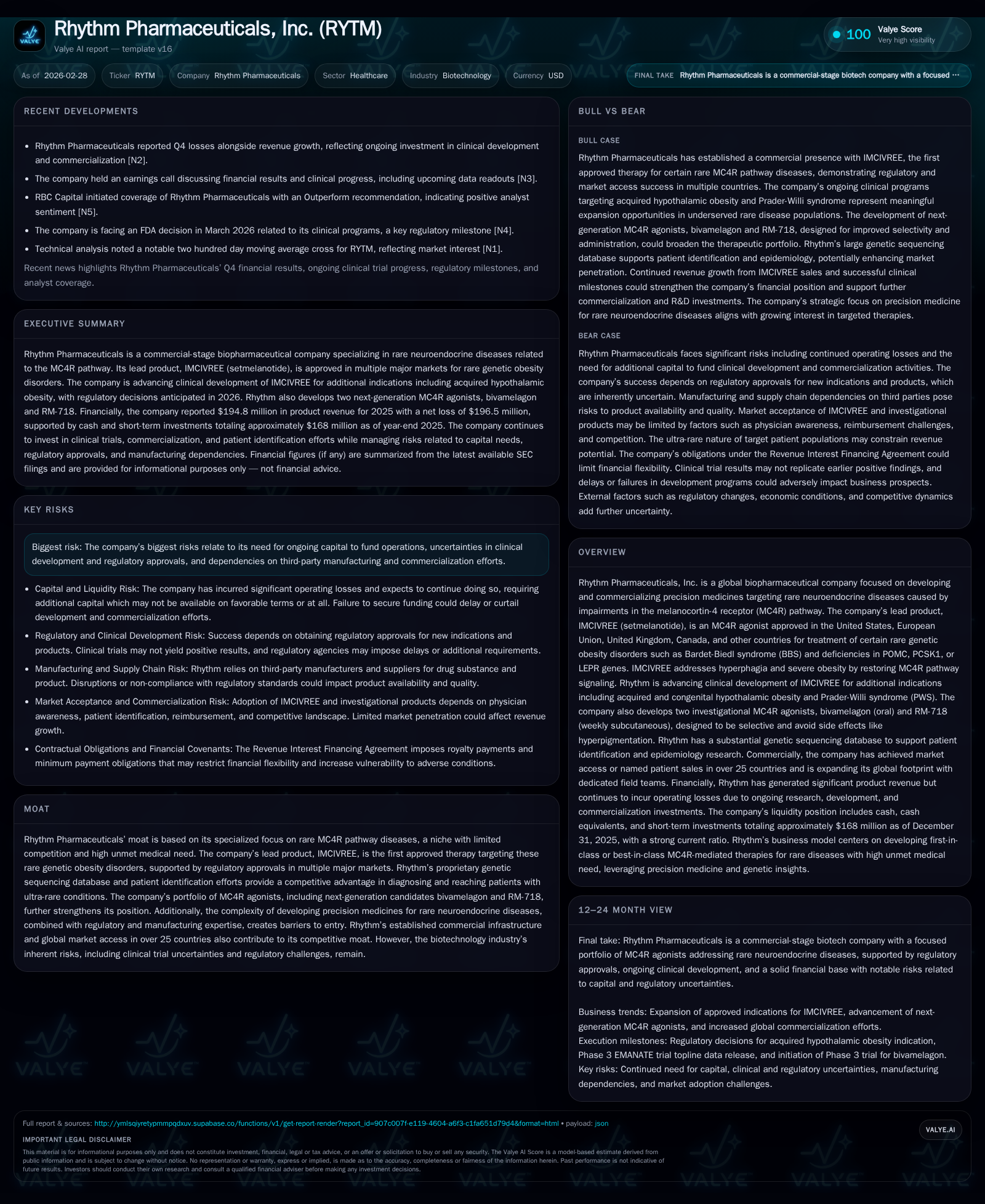
Rhythm Pharmaceuticals, a commercial-stage biopharmaceutical specialist in rare neuroendocrine obesity disorders, continues expanding its lead product IMCIVREE into new indications such as acquired hypothalamic obesity. Despite persistent operating losses and negative cash flow reflecting early commercialization and R&D investments, the company leverages regulatory milestones and pipeline assets bivamelagon and RM-718 to broaden patient reach. With IMCIVREE approved across major markets and ongoing pivotal trials, Rhythm stands at a critical juncture to demonstrate sustainable revenue growth against significant regulatory, commercialization, and capital risks.
Company Overview
Rhythm Pharmaceuticals focuses on developing precision medicines for rare neuroendocrine diseases caused by impairments in the melanocortin-4 receptor (MC4R) pathway. Their lead product, IMCIVREE (setmelanotide), is approved to treat hyperphagia and severe obesity due to rare genetic conditions such as Bardet-Biedl syndrome (BBS), POMC, PCSK1, or LEPR deficiencies.[S1][S2]
IMCIVREE is marketed across the United States, European Union, United Kingdom, Canada, and other regions,[S1] representing the first therapy globally targeting these rare MC4R pathway diseases. The drug addresses pathological hunger by restoring MC4R signaling which regulates appetite and energy expenditure.
The company’s pipeline includes two investigational MC4R agonists: bivamelagon (oral small molecule) and RM-718 (weekly subcutaneous injection), designed to selectively target MC4R while sparing MC1R to avoid hyperpigmentation side effects.[S1] These candidates aim to expand treatment options into acquired hypothalamic obesity and Prader-Willi syndrome (PWS), conditions with significant unmet medical needs.[S1]
Historical Financial Performance
Rhythm transitioned from research to commercialization with IMCIVREE’s U.S. launch in Q1 2021.[S1] While cumulative product sales have reached approximately $422.5 million as of early 2026,[S1] the company continues to operate at a loss due to ongoing investment in R&D, commercial infrastructure development, manufacturing scale-up, and clinical program expansion.
Financial results for fiscal year 2025 show an operating loss of approximately $192 million improving from a $265 million loss in 2024. Net loss narrowed to $196.5 million from $260.6 million the prior year—a roughly 24.6% year-over-year improvement.[F1] Operating cash flow remained negative at $115.7 million but was relatively stable compared to prior periods,[F1] reflecting continued cash burn associated with pipeline advancement.
Capital expenditures were minimal at just under $1 million in 2025,[F1] indicating that most costs relate to non-capitalized activities such as clinical trials and sales force expansion.
Liquidity appears sufficient for near-term operations with $54.3 million in cash alongside current assets of nearly $467 million versus current liabilities of approximately $106 million—yielding a strong current ratio of about 4.41.[F1]
Historical performance (annual)
| FY | Net ($mm) | CFO ($mm) | OpInc ($mm) | Capex ($) | Net YoY |
|---|---|---|---|---|---|
| 2025 | -197 | -116 | -192 | 953000 | +24.6% |
| 2024 | -261 | -114 | -266 | 47000 | -41.1% |
| 2023 | -185 | -136 | -184 | 47000 | -2.0% |
| 2022 | -181 | -173 | -179 | 281000 |
Source: SEC companyfacts cache [F1].
Capital returns and efficiency (annual)
| FY | FCF ($mm) | ROE% |
|---|---|---|
| 2025 | -117 | -141.3 |
| 2024 | -114 | -1199.3 |
| 2023 | -136 | -108.8 |
| 2022 | -174 | -68.5 |
Source: SEC companyfacts cache [F1].
Note: Negative net income reflects continued reinvestment into clinical development and commercialization efforts.
Future Growth Prospects
A key growth driver is expanding IMCIVREE’s label beyond genetically confirmed BBS or POMC/PCSK1/LEPR deficiencies into acquired hypothalamic obesity (HO). This rare condition affects an estimated 10,000 patients in the U.S., with similar prevalence in Europe and Japan.[S1] A Phase 3 trial involving roughly 120 patients demonstrated statistically significant BMI reductions (19.8% placebo-adjusted), supporting ongoing FDA review with a PDUFA date set for March 20, 2026.[S1]
Topline data from a Japanese cohort are expected imminently (March 2026), potentially enabling regulatory submissions there later this year.[S1]
Additionally, Rhythm is exploring MC4R agonists’ utility in Prader-Willi syndrome (PWS), a rare genetic disorder marked by severe hyperphagia affecting ~20,000 patients in the U.S.[S1] Positive preliminary Phase 2 data have prompted further development plans for both setmelanotide and RM-718 targeting this indication.[S1]
Recruitment also continues for congenital hypothalamic obesity substudies within the global EMANATE Phase 3 trial framework as part of efforts to broaden patient populations benefiting from MC4R modulation.[S1]
Risks Capping Growth Potential
Several factors could limit Rhythm’s growth:
- Capital intensity: Continued operating losses necessitate external financing or equity raises absent clear profitability timelines.[S1][F1]
- Regulatory risk: Future filings for acquired hypothalamic obesity and PWS face inherent uncertainties including review outcomes or unmet endpoints.[S1][N6]
- Commercial execution: Early-stage global commercial infrastructure requires scaling; reliance on third-party manufacturers introduces supply chain risks.[S1]
- Compliance demands: Complex healthcare regulations expose Rhythm to potential penalties related to fraud/abuse laws, privacy rules (HIPAA), pricing transparency mandates across jurisdictions, any breaches could impact reputation and finances.
- Pricing pressure: Healthcare systems increasingly scrutinize drug prices,[S9][S10][S20] which may constrain reimbursement despite clinical benefits.
Returns & Capital Allocation
Rhythm has not generated positive returns on equity given its early commercialization phase; approximate ROE stood at about -141% as of end-2025 reflecting accumulated deficits approaching $1.4 billion.[F1][S1]
Free cash flow was negative approximately $116.6 million (operating cash flow less capex), underscoring funding focused on pipeline development rather than shareholder distributions.[F1]
No dividends or share buyback programs have been announced or indicated consistent with capital conservation typical for early-stage biopharmaceutical companies.[N3][S3]
Outlook & Key Milestones
Upcoming catalysts include the FDA decision on acquired hypothalamic obesity scheduled for March 20, 2026,[N6][S1] alongside Japanese cohort data readout potentially enabling further international expansion.
Clinical trial progress in PWS will be critical for unlocking new patient segments requiring substantial investment.
Market adoption post-launch will depend on salesforce expansion effectiveness; reimbursement negotiations amid pricing scrutiny remain key variables influencing revenue trajectory.
Advancement of bivamelagon through clinical phases will also signal Rhythm’s ability to diversify beyond its first approved therapy.
Summary
Rhythm Pharmaceuticals operates within a specialized niche addressing ultra-rare neuroendocrine obesity disorders through precision medicine approaches centered on MC4R pathway modulation.
While possessing first-to-market advantages with IMCIVREE approved across major markets, the company faces typical biotech inflection point challenges involving sustained R&D investment without profitability yet realized,[F1] complex regulatory environments, commercial scaling hurdles, and evolving pricing pressures.
Investors should monitor regulatory feedback on label expansions and clinical milestones closely as these will shape Rhythm’s ability to broaden patient reach and achieve sustainable growth within these underserved populations.
This analysis is based solely on publicly available disclosures as of February 28, 2026, without any forward-looking projections beyond documented information.
Disclaimer: This is research-only, informational analysis and not investment advice. It may include AI-generated interpretation and general industry context. Always verify important details using primary sources.

Comments