
Safeguard Acquisition Corp. IPO Raises $230M with SPAC Model Dependent on Successful Business Combination
Safeguard Acquisition Corp., a Cayman Islands incorporated blank check company, launched its IPO in late 2025 with $230 million proceeds held in trust awaiting a business combination.
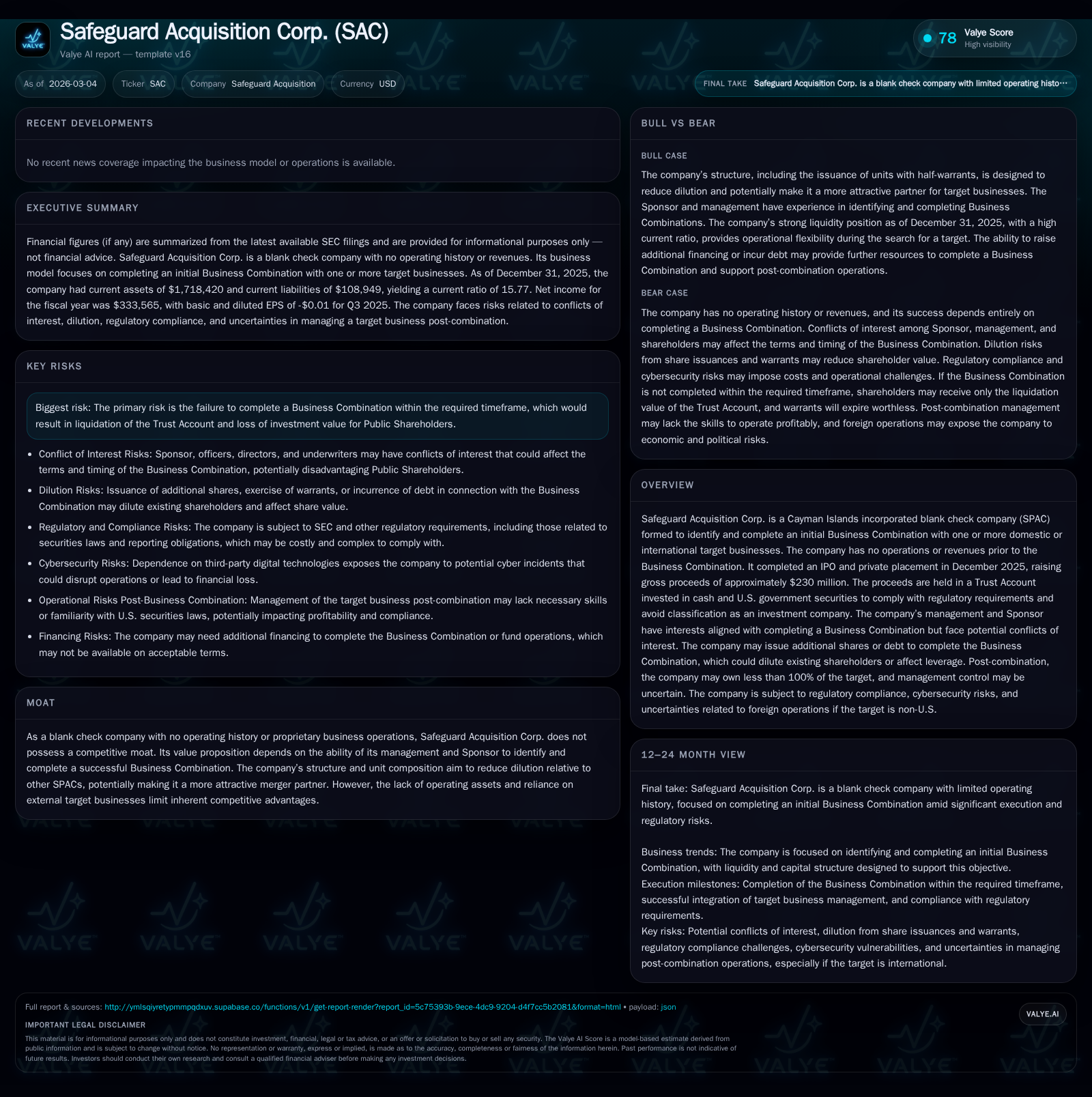
Safeguard Acquisition Corp. (SAC) operates as a special purpose acquisition company (SPAC) with no operating history or revenues, raising approximately $230 million in gross proceeds through its December 2025 IPO and private placement. Its future growth relies entirely on identifying and completing a successful business combination within the 24-month timeframe mandated by its governing documents. The SPAC’s capital is securely held in a Trust Account invested in cash and U.S. government securities, limiting investment risk but also operational flexibility. The company faces notable risks including the potential failure to complete a business combination, management conflicts of interest, evolving regulatory requirements, and shareholder dilution through possible additional share or debt issuances during post-combination financing.
Overview and Historical Performance
Safeguard Acquisition Corp. (ticker: SAC) is a Cayman Islands exempted company formed specifically as a blank check vehicle for completing an initial Business Combination with one or more operating businesses domestically or internationally [S1]. The company has no operations or generated revenue before any merger/acquisition transaction. It completed its IPO alongside a concurrent private placement offering in December 2025, aggregating gross proceeds near $230 million [S1][F1]. This capital pool forms the principal base for identifying potential target acquisitions.
The capital raised is held in a Trust Account primarily invested in cash and U.S. government securities as per SEC regulatory mandates designed to limit risk until deployment into an identified target business [S1]. This ensures that while operational activity is absent currently, shareholders’ capital is shielded from market volatility inherent to more diversified or less liquid SPAC structures.
Financial metrics through fiscal year-end 2025 reflect this nascent stage: operating income was negative approximately $193k attributable primarily to administrative expenses; net income recorded a modest positive of about $334k mostly reflecting interest income from trust investments [F1]. Current assets stood at approximately $1.72 billion versus current liabilities near $109k resulting in an ample current ratio exceeding 15x — consistent with large liquid reserve capitalization pending business combination deployment [F1].
Historical performance (annual)
| FY |
|---|
| 2025 |
Source: SEC companyfacts cache [F1].
Note: Revenue is not applicable given pre-operating status [F1].
Growth Drivers and Prospects
As a SPAC entity, Safeguard’s growth prospects hinge exclusively on successful completion of its first Business Combination within the prescribed timeframe (generally up to two years from IPO close) [S1][S6]. This transaction would bring an operating business under Safeguard’s umbrella, unlocking revenue generation opportunities and altering financial profile dramatically.
The company’s ability to grow post-combination depends on multiple factors: identification of attractive target(s), terms negotiated that preserve shareholder value, effective integration and execution by combined management teams, and compliance with evolving regulatory landscapes especially relevant when cross-border deals are contemplated [S4][S21][S27]. Equity ownership may be diluted through issuance of new shares for financing purposes, further complicating returns for initial investors [S28].
Potential constraints include failure to find suitable targets compliant with listing framework; unforeseen operational difficulties after merger such as cultural clashes or regulatory noncompliance especially when acquiring foreign entities; and macroeconomic conditions that may dampen valuation appetites or demand profiles within chosen industries [S4][S9].
Forecasts and Milestones
Safeguard has not provided explicit forward financial guidance beyond the public commitment to complete an initial Business Combination within its legally binding deadline. Investors should monitor progress toward announced merger targets if any are revealed post-IPO via SEC filings or public disclosures. Key milestones will include:
- Identification and announcement of target(s);
- Shareholder vote if triggered by transaction structure;
- Redemption rights exercise timeframe availability;
- Completion or abandonment timing relative to the expiration of the mandated window.
Failure to consummate the Business Combination will result in liquidation of the Trust Account with funds returned pro-rata based on liquidation rules embedded in governing documents [S1][S26].
Capital Allocation and Returns
Until completion of a business combination, Safeguard does not pay dividends nor engage in share repurchases due to absence of operating revenues and focus on preserving capital for future dealmaking [F1][S28]. Founder shares carry minimal upfront cost but become worthless if no deal is completed.
Return metrics show a marginally negative return on equity (~-4.4%) reflecting costs expensed against equity despite lack of operational earnings yet [F1]. Cash flows prior to acquisition remain conservative given substantial funds held under trust rather than deployed assets generating operating cash.
Post-merger returns will depend heavily on acquired company performance along with Safeguard’s ability to manage new debt if issued during combination — factors currently unknown [S6][S28]. Sponsor alignment and conflict risks exist given Sponsor owns roughly 25% of ordinary shares and holds influence potentially skewing merger outcomes against public minority holders [S1][S28].
Risks and Considerations
Key risks impacting Safeguard's investment case include:
- Non-completion Risk: Failure to close an initial Business Combination before expiry leads to dissolution with only recourse being return of funds from Trust Account — possibly less than original investment after fees [S1][S26].
- Management Conflicts: Sponsor’s large equity stake combined with discretion over shareholder votes introduces governance dynamics potentially adverse to minority shareholders [S1][S28].
- Regulatory Environment: Obtaining approvals especially amid cross-border deals can delay or scuttle transactions; compliance burdens increase costs post-merger including Securities Exchange Act requirements [S9][S11][S16].
- Market Reception: Reputational risks stem from managerial disputes and litigation involving individuals associated with management though none currently pending against SAC itself; rising directors/officers liability insurance costs can constrain competitiveness post-merger [S4][S14][S18].
- Geographic Concentration & Currency Risks: Acquiring overseas businesses exposes operations and revenue to country-specific economic/political risks plus foreign exchange volatility restricting integration success [S21][S27].
- Cybersecurity Vulnerabilities: Dependence on third-party digital infrastructure without own significant cybersecurity investments may expose sensitive data though limited current operations mitigate impact [S15][S17].
Conclusion
Safeguard Acquisition Corp embodies the typical SPAC structure entered late-2025 with solidly capitalized trust reserves but lacking commercial operations thus far. Its trajectory depends solely on executing an initial Business Combination within regulatory timelines alongside navigating multifaceted legal, financial, governance, and operational risks intrinsic to such vehicles. Stakeholders should focus on emergent disclosures regarding target identification progress, market conditions impacting merger valuations, regulatory updates especially around cross-border sensitivities, and governance policies addressing Sponsor influence safeguards.
Disclaimer: This report serves informational purposes only based on available SEC filings and does not constitute investment advice or recommendations.
Disclaimer: This is research-only, informational analysis and not investment advice. It may include AI-generated interpretation and general industry context. Always verify important details using primary sources.

Comments