
Sinclair, Inc.: Balancing Innovation and High Leverage in Broadcast Media
Sinclair's mix of cutting-edge broadcast technology investments and a heavy debt profile shapes its operational and financial dynamics.
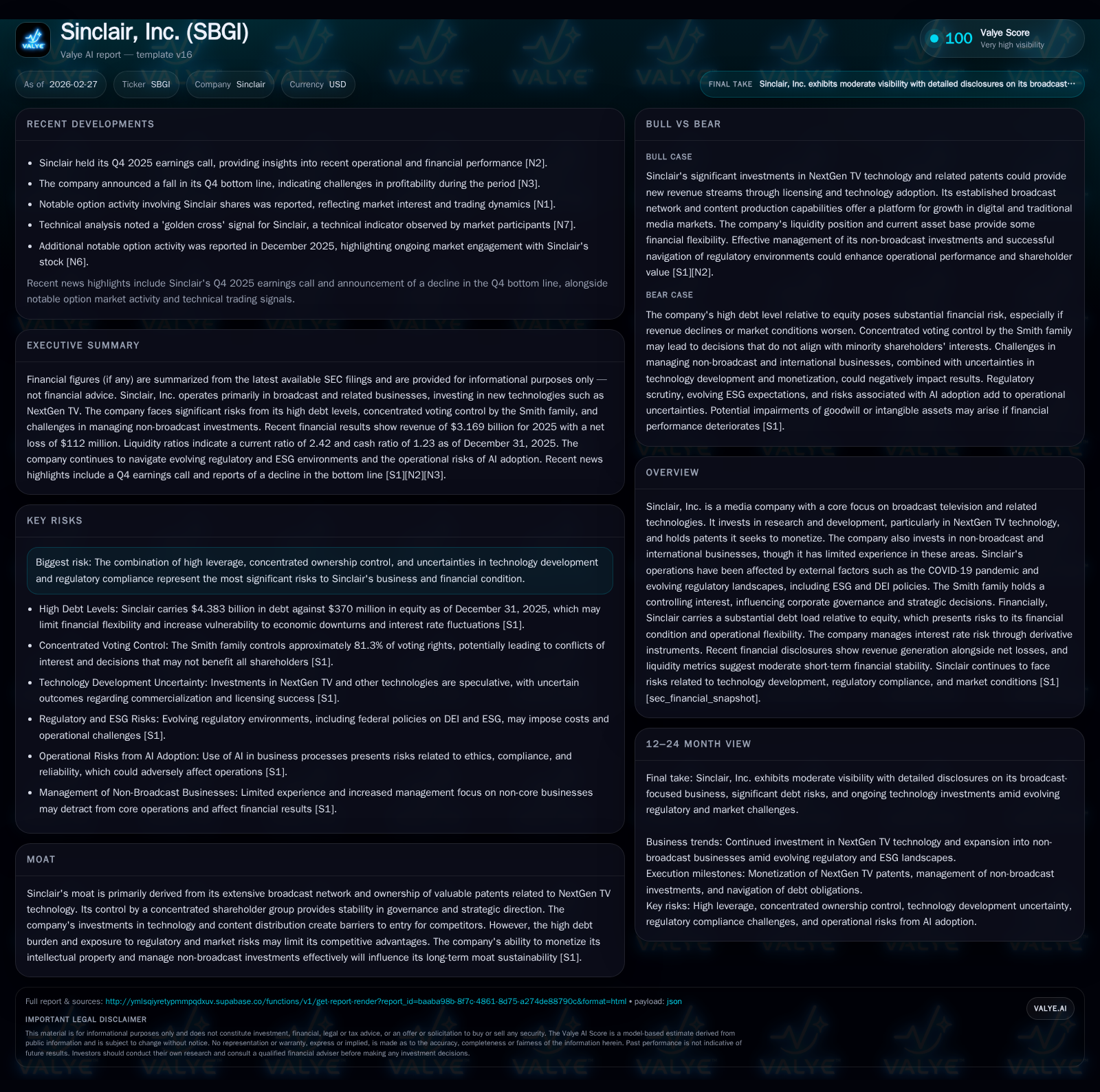
Sinclair, Inc. operates at the intersection of legacy broadcast media and emerging NextGen TV technology, supported by an extensive patent portfolio. While revenue showed contraction in 2025 following growth in earlier years, operating cash flow nearly doubled, underscoring operational resilience amid market and pandemic-related pressures. The company’s substantial debt load—over $4.3 billion—poses significant risks to financial flexibility and requires careful management of refinancing and interest rate exposure. Concentrated control by the Smith family adds governance stability but also potential strategic concentration risk. Key watchpoints include the success of patent monetization efforts, regulatory compliance costs, non-broadcast investment outcomes, and debt covenant adherence.
Historical Revenue and Profit Trends Reveal Volatility
Sinclair has experienced pronounced swings in its top-line and profit figures over recent fiscal years that underscore both operational challenges and marketplace pressures. Revenue expanded from approximately $3.13 billion in 2023 to a peak above $3.54 billion in 2024 before contracting sharply by 10.7% to about $3.17 billion in 2025 [F1]. This reversal coincided with a dramatic decrease in operating income: swinging from a negative $331 million loss in 2023 to a robust positive $551 million in 2024 then plunging again by nearly 69% to just $173 million in 2025 [F1]. Net income followed this volatile track with losses recorded in two out of the three years examined: roughly -$291 million in 2023, a sharp positive turnaround to $310 million in 2024, then back down to a -$112 million loss in fiscal 2025 [F1].
Notably, operating cash flow bucked the profitability trends by increasing year-over-year by almost 93% from $98 million up to $189 million between 2024-25, reflecting effective working capital management or non-cash charge impacts despite earnings swings. Capital expenditures trended modestly lower over this time frame, dropping from $92 million to $74 million indicating possibly restrained reinvestment amid financial prudence [F1]. Equity showed a recovery from a low base of approximately $285 million at end-2023 up to around $443 million by end-2025, still modest relative to total debt levels.
Historical performance (annual)
| FY | Rev ($bn) | Net ($mm) | CFO ($mm) | OpInc ($mm) | Rev YoY | Net YoY |
|---|---|---|---|---|---|---|
| 2025 | 3.2 | -112 | 189 | 173 | -10.7% | -136.1% |
| 2024 | 3.5 | 310 | 98 | 551 | +13.2% | +206.5% |
| 2023 | 3.1 | -291 | 235 | -331 |
Source: SEC companyfacts cache [F1].
Capital returns and efficiency (annual)
| FY | Div ($mm) | Buybacks ($mm) | FCF ($mm) |
|---|---|---|---|
| 2025 | 69 | 0 | 115 |
| 2024 | 66 | 0 | 14 |
| 2023 | 65 | 153 | 143 |
Source: SEC companyfacts cache [F1].
Note: YoY percentages calculated based on reported figures for each preceding fiscal year.
These metrics collectively showcase a company wrestling with cyclical advertising revenue dynamics influenced by broader economic factors—including lingering COVID-19 pandemic effects—and challenges tied to evolving content distribution models.
NextGen TV and Patent Monetization: Key Drivers Under Development
Sinclair positions itself uniquely with considerable ongoing investments centered on NextGen TV technology development—a federally-standardized broadcasting evolution designed for improved picture quality, interactive features, and targeted advertising capabilities [S1][S6]. The firm holds multiple related patents developed either internally or via joint ventures. These intellectual properties present an emerging moat element if successfully monetized through licensing arrangements or inclusion within patent pools targeting equipment manufacturers.
However, the pathway from R&D spending to commercial returns remains speculative. The company acknowledges uncertainty surrounding acceptability of licensing terms or actual receipt of royalty payments from third parties [S1]. Ownership of relevant patents supports potential barriers against competitors replicating similar technological capabilities but depends heavily on Sinclair’s success at navigating complex licensing negotiations and legal frameworks.
Additionally, Sinclair invests beyond broadcasting core operations into other technologies and international opportunities where organizational experience is limited—heightening execution risk [S6]. This diversification strategy could facilitate future growth expansion should these ventures mature effectively yet warrants cautious monitoring given historical volatility.
Emerging Regulatory and Market Constraints Impact Strategy
The regulatory environment surrounding Sinclair has become more complex particularly due to shifting ESG (environmental, social governance) considerations and changes concerning diversity, equity & inclusion (DEI) initiatives at federal levels [S8][S11]. For example, an executive order issued early in 2025 curbed federal agency support for DEI programs potentially extending scrutiny into private sector initiatives including broadcasting companies like Sinclair.
Regulatory compliance measures contribute additional operational expenses while evolving stakeholder expectations increase reputational risks linked with social responsibility policies [S11]. Furthermore, the pandemic disrupted advertising sales cycles due to economic uncertainties among advertisers and delayed content production schedules which directly affected programming availability—both material revenue drivers for Sinclair’s local stations ecosystem [S1][N1].
Market conditions remain influenced by geopolitical tensions that could affect capital costs and supply chains relevant for technological upgrades or station operations [S19]. Such external constraints underline the need for strategic agility despite leverage-induced inflexibility.
Looking Ahead: Growth Prospects and Watchpoints
Explicit forward guidance is sparse; however, indications point toward critical milestones including realization of returns on NextGen TV patent portfolios via licensing agreements or pooled patent structures [N1][S6]. Broader success also hinges on managing non-core business expansion effectively despite limited internal expertise—outcomes that can materially affect long-term competitiveness.
Debt servicing ability will be pivotal given refinancing timing pressures amid fluctuating market rates; any challenges here could force asset sales or restructuring that impact growth investments negatively [S1][N1]. Additionally, monitoring advertising revenue cyclicality post-pandemic recovery remains vital.
Analysts should closely track quarterly earnings commentary for updates on intellectual property monetization progress alongside cash flow sustainability metrics that underpin ability to maintain dividends or reinitiate share repurchases after recent suspension [N1][F1].
Capital Allocation: Navigating Debt, Dividends, and Cash Flows
Sinclair carries a notably high leverage ratio with total debt recorded at approximately $4.38 billion versus shareholder equity near $443 million at fiscal year-end—a leverage multiple indicative of significant credit risk exposure [F1][S1]. This translates into an approximate negative return on equity (-25%) when considering net income losses weighted over equity balances for the latest period.
The company employs derivative instruments like interest rate swaps to manage variable rate debt exposure linked primarily to its New Credit Agreement representing about $1.43 billion principal outstanding as of end-2025 [S13][S14]. These hedges help mitigate volatility but introduce potential P&L fluctuations tied to interest rate movements.
Dividend payments totaling roughly $69 million persisted through financially adverse periods highlighting management’s prioritization of shareholder returns even amidst cash flow pressures; conversely no share repurchases have been conducted since ceasing ~$153 million buyback activity in FY2023 [F1]. Cash flow from operations reached $189 million generating approximately $115 million free cash flow after deducting capex—providing moderate funding cushion though constrained relative to debt service needs.
Covenant restrictions embedded within credit agreements limit flexibility around asset disposals, dividend increases or new indebtedness which underscores importance of maintaining sufficient liquidity buffers to avoid default scenarios or forced deleveraging actions potentially detrimental to long-term strategy execution [S4][S7][S10].
Governance Dynamics: Influence of Concentrated Ownership
Sinclair benefits from governance stability through the Smith family’s concentrated voting control representing roughly 81% of voting power facilitated predominantly via Class B common shares structured at ten votes per share versus one vote per Class A share [S14][S15]. Four Board members are Smith family affiliates ensuring dominant influence over strategic direction including decisions on acquisitions/divestitures during refinancing negotiations.
Concentration engenders both benefits—such as continuity during turbulent industry shifts—and risks related to potential minority shareholder disenfranchisement or strategic decisions prioritizing controlling interests over broader stakeholder value maximization.
Ongoing governance considerations include counsels around possible changes should significant divestitures reduce Smith ownership below majority thresholds potentially altering board composition or control mechanics going forward.
This analysis presents an integrative view grounded solely on reported data within SEC filings ([F1],[S#]) and public disclosures ([N#]) without extrapolation beyond verified facts. It is intended strictly for informational purposes focused on operational patterns, innovation strategies, financial constraints, risk factors, governance characteristics of Sinclair, Inc., offering a comprehensive framework for further evaluation without investment recommendations.
Disclaimer: This is research-only, informational analysis and not investment advice. It may include AI-generated interpretation and general industry context. Always verify important details using primary sources.

Comments