
Southside Bancshares' Earnings Retreat Amid Interest Rate Shifts and Strategic Capital Moves
Southside Bancshares faces profit headwinds from Federal Reserve rate cuts while managing liquidity and capital allocation in competitive Texas banking markets.
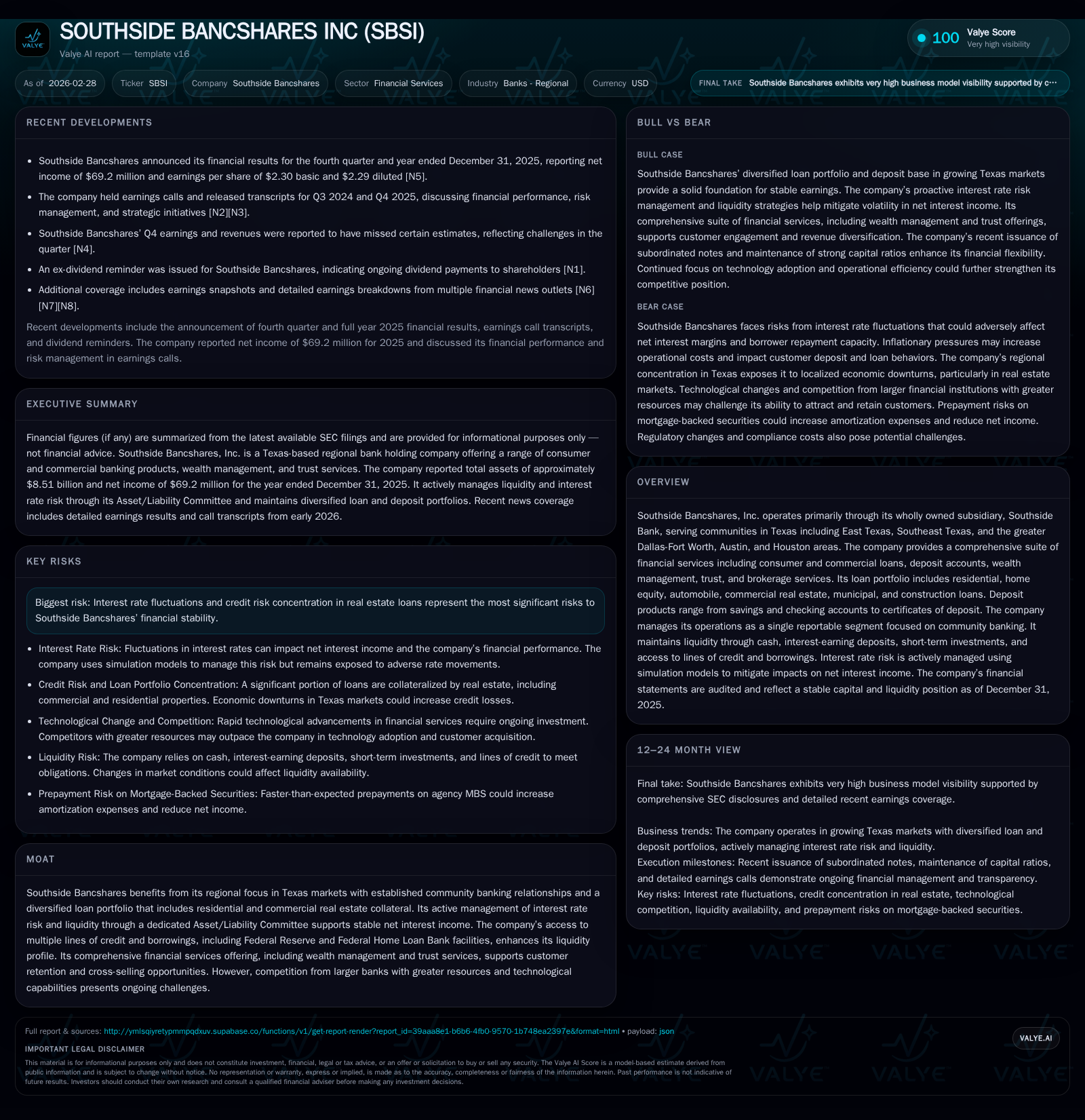
Southside Bancshares, a regional Texas community bank, reported a net income decline of nearly 22% in 2025 due largely to compressed net interest margins driven by a sequence of Federal Reserve rate cuts during 2024-2025. Despite this earnings softness, the Bank's liquidity position remains robust, supported by diversified funding sources including borrowings from the Federal Reserve discount window and Federal Home Loan Bank advances. Capital allocation reflected a heightened emphasis on share repurchases alongside steady dividends, underscoring management's commitment to shareholder returns amid slower profit growth. Moving forward, the bank's concentrated real estate loan portfolio and sensitivity to interest rate fluctuations represent key risk factors to monitor.
2025 Earnings Recap: Assessing Profit Decline Despite Stability
Southside Bancshares experienced a notable drop in profitability for full-year 2025 with net income falling approximately 21.8% to $69.2 million compared to $88.5 million in 2024 [F1]. Operating cash flow also receded by nearly 7.9% year-over-year to $93.8 million [F1]. Conversely, capital expenditures surged by over 82%, hitting $20.3 million as the bank appears to ramp investments possibly aimed at technology or branch infrastructure [F1]. Equity grew steadily by about 4.4% reaching $847.6 million by year-end [F1]. The earnings softness juxtaposed against stable equity signals constrained profitability margins rather than operational deterioration. The company’s Q4 earnings commentary highlighted challenges posed by narrowing net interest margins due to macroeconomic shifts [N4].
Historical performance (annual)
| FY | Net ($mm) | CFO ($mm) | Capex ($mm) | Net YoY |
|---|---|---|---|---|
| 2025 | 69 | 94 | 20 | -21.8% |
| 2024 | 88 | 102 | 11 | +2.1% |
| 2023 | 87 | 80 | 7 | -17.5% |
| 2022 | 105 | 227 | 9 |
Source: SEC companyfacts cache [F1].
Capital returns and efficiency (annual)
| FY | Div ($mm) | Buybacks ($mm) | FCF ($mm) |
|---|---|---|---|
| 2025 | 43 | 23 | 73 |
| 2024 | 44 | 2 | 91 |
| 2023 | 44 | 45 | 73 |
| 2022 | 45 | 34 | 217 |
Source: SEC companyfacts cache [F1].
Note: The recent increase in capital expenditures likely reflects investments in technology or physical infrastructure.
Interest Rate Environment Impact: Yield Curve and Margin Pressures
A critical factor contributing to SBSI's earnings decline stems from a succession of Federal Reserve interest rate reductions during mid-2024 through the end of 2025 [S1]. The federal funds target rate descended from elevated levels between 5.25%-5.50% down to roughly 3.50%-3.75%, involving six total cuts [S1]. Southside’s management cautioned that these compressions constrain net interest income as the yield curve flattened and the spread between loan yields and deposit costs tightened [N1][S1]. Given Southside's asset-heavy structure reliant on interest-earning loans financed through deposits and borrowings with fixed or variable costs set by market rates, such rate shifts create margin pressure.
The company actively manages this interest rate risk through its Asset/Liability Committee (ALCO), employing simulation models that run multiple scenarios—such as immediate shocks or market value of portfolio equity (MVPE)—to predict impacts on net interest margins and adjust the asset-liability mix accordingly [S6][S8][S20]. Despite these efforts amid uncertain inflation and Fed policy directions detailed in filings [S1], the net effect remains a headwind for Southside’s earnings.
Loan Portfolio Composition: Diversified Yet Concentrated Within Texas
Southside Bancshares maintains a diversified loan book primarily concentrated within Texas markets including East Texas and major metro areas such as Dallas-Fort Worth and Houston [S4]. Its portfolio spans consumer loans like residential mortgages (including home equity), automobile loans; commercial loans covering working capital lines for businesses; commercial real estate; municipal loans; plus construction financing [S4]. Approximately 18.2% of real estate collateral represents owner-occupied residential properties which historically have demonstrated lower default risk relative to non-owner occupied or speculative commercial real estate segments [S5][S26].
Deposit products encompass savings accounts (interest bearing and noninterest), checking accounts including money market accounts and certificates of deposit (CDs) across various maturities [S4][S22]. At December 31, 2025 total deposits stood at approximately $6.87 billion with public account CDs over $250k rising notably reflecting competitive certificate offerings [S22]. Brokered deposits constituted a smaller portion (~$672 million combined CDs and non-maturity brokered deposits) adhering well below internal caps designed to balance liquidity with cost efficiency [S22].
Liquidity Management: Robust Multi-Channel Funding Access
Liquidity remains a strength for SBSI as it manages cash flow demands balancing stability with flexibility overseen by ALCO [S6][S7]. At December 31st 2025 cash equivalents stood at roughly $390 million providing immediate buffer capacity against depositor withdrawals or short-term funding needs [F1]. Alongside internally generated liquidity pools comprising short-term investments (~8.1% of total assets), external funding sources include:
- Unsecured overnight federal funds lines totaling $80 million among three banking partners with no outstanding utilizations reported year-end [S8][S12]
- Borrowings from the Federal Reserve Discount Window totaling $110 million collateralized by securities with additional borrowing capacity near $241 million available [S8][S12]
- Federal Home Loan Bank advances accessible up to about $2.45 billion collateralized by diversified loan pools and securities holdings far exceeding current utilization (~$211 million drawn) [S8][S12]
- Repurchase agreements backed by agency securities increasing modestly to about $98 million at year-end providing short-tenor funding without sales risk exposure [S12]
ALCO monitors matched duration positioning between rate-sensitive assets versus liabilities using gap ratios and stress tests under different Fed policy scenarios ensuring minimum liquidity thresholds aligned with regulatory expectations are maintained.
Capital Allocation: Dividends Steady Amid Increased Buybacks
Despite shrinking profits in FY2025 SBSI maintained consistent dividend payments around $43.4 million representing a payout ratio near ~63% on diluted net income — indicative of steady shareholder return policy even amid earnings pressures [F1][S14]. Concurrently share repurchases markedly accelerated reaching about $23.2 million for FY ’25 compared with approximately $1.5 million during ’24 signaling management’s confidence in capital return amidst moderated organic growth prospects [F1][N13].
Equity expanded moderately from roughly $812 million at end '24 to $848 million by end '25 driven primarily by retained earnings accumulation tempered slightly by buybacks yet strong enough to underpin capital adequacy metrics comfortably exceeding regulatory minima across Tier-1 ratios measured relative to risk-weighted assets as well as average assets [F1][S18]. This balanced approach supports ongoing growth investments while returning excess free cash flow efficiently.
Risk Factors: Interest Rate Sensitivity & Credit Concentration
Key risks facing Southside include sensitivity of net interest income to volatile rate movements given its spread-based revenue model plus credit concentration weighted toward real estate-collateralized lending within Texas markets per latest SEC disclosures [S26][S4]. Rapid reversals or intensifications of interest rates beyond modeled assumptions could threaten margin stability typical among regional banks reliant on traditional spread revenue streams under volatile monetary environments [S1][S26]. Defaults or increased loss provisions arising from stress localized within clustered commercial real estate loans remain concerns despite conservative underwriting focused on owner-occupied residential placements comprising ~18% of real estate exposure offering some cushion against speculative downturns.
Ongoing credit reviews segmented by borrower type along with scenario-tested hedging efforts under ALCO oversight aim to maintain nimble balance sheet positioning adaptable amid unfolding economic conditions.
Market Position: Deep Community Roots Amid Rising Competition
Southside Bancshares operates exclusively within diverse Texas markets spanning East Texas into major metros including Dallas-Fort Worth through Houston representing an identifiable moat rooted in localized service relationships alongside full-suite offerings including loans plus wealth management trust services promoting customer loyalty and cross-selling potential [N4][Valye report excerpt overview/moat]. This geographic focus underpins operational cohesion but exposes the firm to sector-specific cyclical pressures.
Competition from larger banks leveraging scale economies and advanced digital platforms is an ongoing challenge noted explicitly within company commentary forcing strategies emphasizing prudent asset-liability risk management coupled with selective capital deployment manifested recently via increased buyback activity alongside dividend steadiness evidencing efforts to maintain shareholder appeal amid tempered profit expansion prospects.
This analysis synthesizes publicly available data without providing investment advice or forecast guarantees; readers should consider all materials alongside independent evaluations when forming judgments about Southside Bancshares Inc.
Disclaimer: This is research-only, informational analysis and not investment advice. It may include AI-generated interpretation and general industry context. Always verify important details using primary sources.

Comments