
Senseonics Holdings Advances Commercial Control with Long-Life Implantable CGM Amid Rising Operating Costs
Transitioning commercial operations and extending sensor life define current growth dynamics alongside mounting expenses.
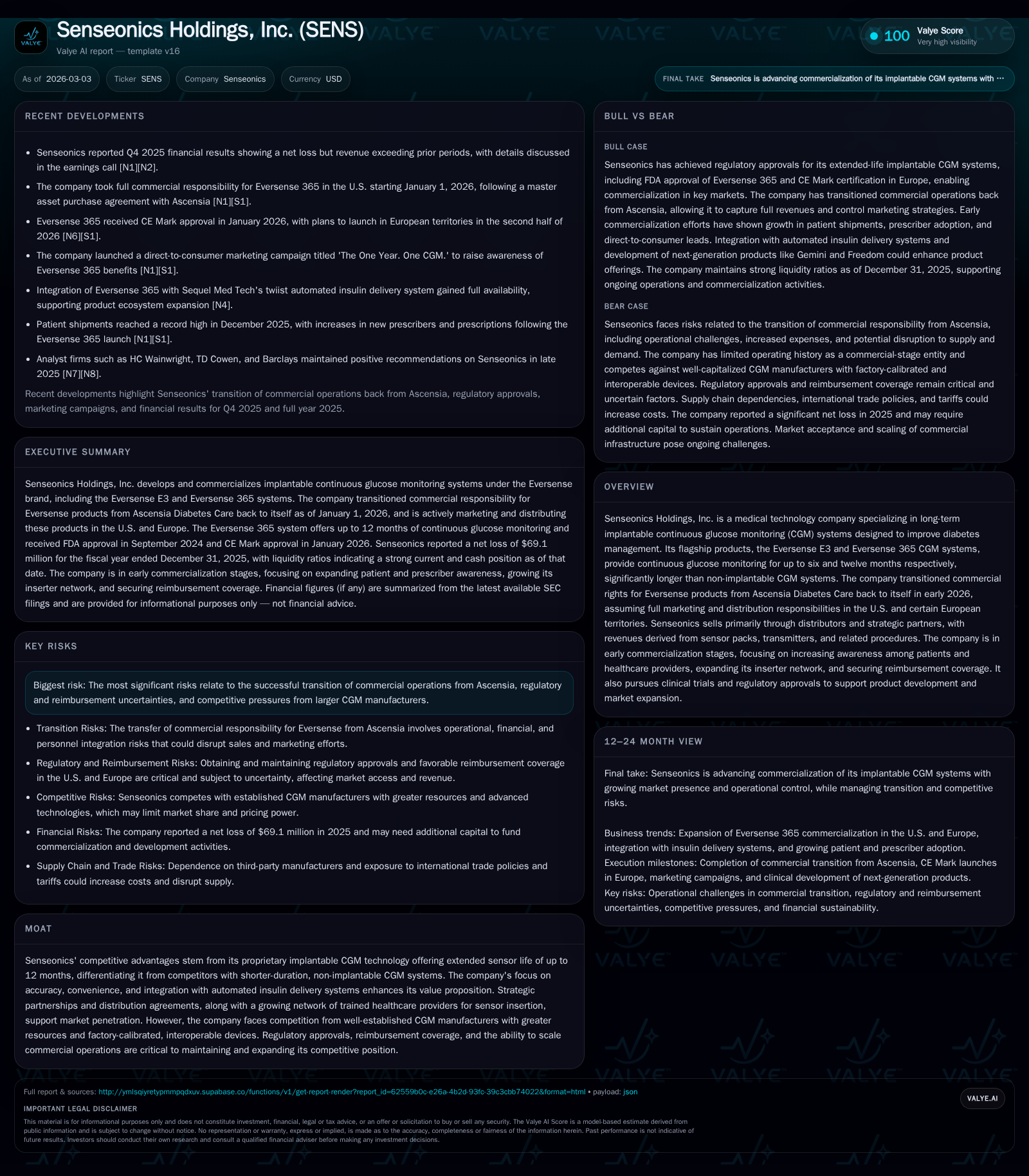
Senseonics Holdings, Inc. specializes in implantable continuous glucose monitoring (CGM) systems with industry-leading sensor longevity of up to 12 months, distinguishing itself from conventional non-implantable offerings. Over recent years, revenue growth has been steady, driven by regulatory approvals and strategic product launches, though the company remains unprofitable with growing operating losses largely due to expanding commercialization activities. The recent re-assumption of U.S. and select European commercialization responsibilities from Ascensia marks a pivotal shift aiming to capture higher revenue share but entails challenges including increased operating expenses and integration risks. Forward growth depends on successful market adoption, reimbursement coverage expansion, and execution of product integration projects such as collaboration on automated insulin delivery systems. Capital position remains adequate in the near term, but continued negative cash flows highlight the importance of additional funding for sustained operations.
Company Overview and Industry Position
Senseonics Holdings, Inc. focuses on long-term implantable continuous glucose monitoring (CGM) systems aimed at improving diabetes management via sustained accuracy and convenience. Unlike conventional transcutaneous CGMs requiring frequent sensor replacement every 7–15 days, Senseonics’ Eversense line offers sensors implanted subcutaneously lasting up to 12 months with the Eversense 365 model and six months with the Eversense E3 model [S1][S22]. This extended sensor life is a key differentiator in a rapidly evolving medical technologies sector dominated by well-capitalized incumbents such as Dexcom, Abbott, and Medtronic.
The company’s innovative approach combines an under-the-skin sensor, removable rechargeable transmitter, and smartphone app ecosystem facilitating real-time glucose monitoring over extended periods. Strategic partnerships have supported distribution historically with Ascensia Diabetes Care managing commercialization rights until January 2026 when Senseonics resumed these responsibilities domestically and in select European territories [S1][S2][S12].
Addressing reimbursement complexities remains central due to heterogeneous payor acceptance levels across geography; approximately 300 million U.S. lives now have potential access through major insurers including UnitedHealthcare and Medicare programs [S18]. However, some payors continue to list the Eversense system as experimental or investigational pending more extensive clinical adoption data.
Historical Financial Performance
Senseonics has experienced revenue growth reflective of advancing commercialization but continues to report significant losses consistent with early-stage medical technology ventures engaging heavily in R&D and market buildout. Revenue grew from approximately $13.7 million in FY2021 to near $16.4 million in FY2022 representing a roughly 20% year-over-year increase [F1]. This reflects the phased commercial launches and regulatory clears including CE Mark approvals across Europe starting mid-2022.
However, losses have deepened given investments needed to resume direct commercialization after years of outsourcing this function. Operating income declined consistently over recent years with a notable operating loss of about $68 million in FY2025—an improvement of nearly 9% compared to prior years though still substantial relative to revenues [F1]. Similarly, net income remained negative at roughly $69 million for FY2025 with an approximate ROE of –113%, signaling ongoing structural investment needs exceeding current earnings capacity [F1].
Operating cash flows have mirrored net losses exhibiting persistent cash burn—FY2025 CFO was negative $59 million while capital expenditures stayed modest at just above $1.1 million focusing on operational assets rather than expansion capex [F1]. The resulting free cash flow deficit approached $60 million last fiscal year.
Historical performance (annual)
| FY | Net ($mm) | CFO ($mm) | OpInc ($mm) | Capex ($mm) | Net YoY |
|---|---|---|---|---|---|
| 2025 | -69 | -59 | -68 | 1 | +12.1% |
| 2024 | -79 | -60 | -75 | 2 | -30.2% |
| 2023 | -60 | -70 | -76 | 0 | -142.5% |
| 2022 | 142 | -66 | -69 | 0 |
Source: SEC companyfacts cache [F1].
Capital returns and efficiency (annual)
| FY | FCF ($mm) | ROE% |
|---|---|---|
| 2025 | -60 | -113.2 |
| 2024 | -63 | 474.9 |
| 2023 | -71 | -168.7 |
| 2022 | -67 | -5517.0 |
Source: SEC companyfacts cache [F1].
*Note: FY2022 net income figure includes a non-recurring component inflating the number positively versus other years.
Transition of Commercial Operations
A key company milestone occurred at the start of calendar year 2026 when Senseonics formally assumed all commercial responsibilities for its flagship Eversense product line in the United States as well as selected European territories previously under Ascensia’s purview [S3][S12]. The strategic rationale involves capturing a greater portion of sales revenue directly rather than sharing with third-party distributors while enabling tighter control over marketing strategies.
This transition was formalized after protracted negotiation culminating in a Master Asset Purchase Agreement establishing Senseonics’ sole revenue entitlement for sales henceforth within these regions [S12]. However, the company acknowledges operational risks associated with restarting internal sales teams after relinquishing commercial functions five years earlier. Integrating personnel formerly employed by Ascensia has been underway but retention uncertainties persist along with logistical challenges typical of such large-scale business transfers [S2][S27].
Operating expenses have spiked accordingly as Senseonics invests heavily in rebuilding direct salesforces, market education efforts targeted at healthcare providers specializing in diabetes care, digital advertising campaigns aimed at driving patient demand (e.g., “One Year One CGM” campaign), and expanding its network of qualified sensor inserters now branded "Eon Care" across approximately thirty U.S. states [S24][N1][N5].
Growth Prospects: Products and Collaborations
Senseonics’ future top-line growth hinges critically on scaled market acceptance driven by:
- Extended Sensor Life: With FDA approval for Eversense 365 allowing one-year continuous implantation—the longest commercially available—patients benefit from reduced sensor replacement frequency and procedural disruption compared to alternatives requiring weekly or biweekly sensor changes [S1][N6].
- Enhanced Accuracy & Convenience: Clinical trials demonstrate solid mean absolute relative differences (MARD) around low single-digit percentages indicating clinically reliable glucose readings suitable for therapeutic decision-making including insulin dosing without confirmatory fingersticks [S21].
- Integration Initiatives: Collaboration with Sequel Med Tech aims to pair Eversense’s implantable CGM capability seamlessly with Sequel's Twiist™ automated insulin delivery system into a single consumer offering expected imminently post-2025 Q4 development cycle completion—a significant innovation likely to boost adoption among insulin-dependent patients seeking closed-loop management solutions [S4][S9].[N4]
- Product Pipeline Variations: Future "Gemini" versions plan to incorporate dual functionality merging CGM with flash glucose monitoring technologies allowing optional interaction modes (transmitter-based or phone swipe reading) enhancing user flexibility without reliance solely on transmitter hardware devices[S17].
- Geographic Expansion: Pending European CE mark approvals enable planned second-half 2026 launch of Eversense 365 across multiple EU countries although commercialization remains subject to government tender processes varying by country adding timeline uncertainty[S1][N6].
However, growth faces significant constraints due to entrenched competitors like Dexcom’s G-series devices benefiting from factory calibration (no fingerstick calibration required), longer market presence,and interoperability certifications facilitating seamless linkage with insulin pumps[S22]. Moreover reimbursement hurdles remain pervasive especially outside the U.S., where payment systems often require specific government tenders or local approvals before widespread inclusion into standard care protocols[S18].
Commercialization Milestones & Upcoming Developments To Watch (Analysis)
While explicit company financial guidance remains limited in filings and public disclosures,[N1][N2] several operational milestones warrant close attention moving forward:
- Complete hiring/training pipeline for U.S./European direct salesforce ramp-up expected throughout 2026.
- Expansion of authorized insertion networks beyond ~30 current states enhancing patient procedural accessibility.
- Successful market reception of integrated automatied insulin delivery device post-Sequel collaboration rollout anticipated shortly after late-2025 completion.[S4][S9]
- Progression of reimbursement advocacy targeting full one-year coverage policies replacing existing six-month cycles among major U.S payors.[S18]
- Tender outcomes within European territories dictating pace and extent of new market penetration.[S15][S19]
- Clinical evidence generation addressing safety/accuracy perceptions influencing payor acceptance.[S18][S21]
- Impact assessment following patent litigation stay continuation relating to intellectual property disputes initiated May 2024.[S8]
Monitoring quarterly results will help clarify if sales volumes accelerate sufficiently against increasing commercial cost bases enabling eventual path toward operating leverage.
Capital Allocation & Financial Health
As of end-2025, Senseonics held unrestricted cash, equivalents and liquid investments totaling approximately $40 million against current liabilities near $24 million yielding a strong liquidity ratio (~4.8x) indicating short-term solvency strength despite persistent losses[F1]. However ongoing negative operating cash flows exceeding capex requirements by more than $60 million annually underscores the imperative for additional financing or improved operating performance.[F1][S20]
The company spent minimal amounts on capital expenditures consistent with contract manufacturing reliance rather than owning production assets[F1]. There were no dividends or share repurchase programs noted reflecting prioritization of reinvestment into product development and commercial expansion activities.
ROE remains substantially negative (~ -113%) given net losses dwarfing shareholders’ equity base[F1], symptomatic of early commercialization phase companies burning cash ahead of scaling profitability.
Risks Summary
Legal risks include ongoing patent infringement allegations filed by Cellspin Soft Inc., currently stayed pending inter partes reviews at USPTO involving patent claims challenged based on complex ownership issues linked to TikTok’s involvement.[S8] Regulatory compliance risk covers routine FDA inspections potentially triggering warnings or restrictions impacting product availability.[S5][S6] Commercial execution risk stems from re-establishing internal sales/distribution capabilities five years after prior outsourcing,[S2][S27] while reimbursement uncertainties persist both domestically and regionally within Europe.[S18][S19] Additional operational risks relate to reliance on outsourced manufacturing vulnerable to geopolitical trade tensions/tariffs potentially increasing cost base without easy passthrough due to pricing rigidity inherent in medical device reimbursement systems.[S16][S9] Finally cybersecurity threats receive active board-level oversight but represent ongoing reputational risk should breaches occur.[S10][S23]
Conclusion
Senseonics stands out technologically within the competitive CGM industry by offering uniquely long-life implantable sensors designed for superior patient convenience that can drive adherence enhancements crucial for effective diabetes management. The critical shift back towards direct commercialization aims at higher margin capture but entails substantial operational investment increasing short-term losses amid execution complexity.
Long-term growth hinges upon successful scaling of installed user base supported by expanded payer coverage programs and integration into automated insulin delivery solutions strengthening clinical value proposition. Maintaining sufficient liquidity during this growth phase will be paramount given ongoing negative cash flow trends requiring capital infusion or operational inflection.
Investors should monitor milestones related to commercialization ramp metrics, regulatory/tender statuses especially within Europe, progress on collaborative product integrations, reimbursement landscape shifts,and legal proceedings updates as bellwethers for trajectory toward sustainable profitability.
This report is for informational purposes only reflecting data as of early March 2026 without any investment recommendations or price forecasts.
Disclaimer: This is research-only, informational analysis and not investment advice. It may include AI-generated interpretation and general industry context. Always verify important details using primary sources.

Comments