
Sionna Therapeutics Advances Novel CFTR NBD1 Stabilizers While Managing Clinical and Financial Challenges
Sionna Therapeutics pursues innovative cystic fibrosis treatments targeting the undruggable NBD1 domain amid mounting losses and key clinical milestones.
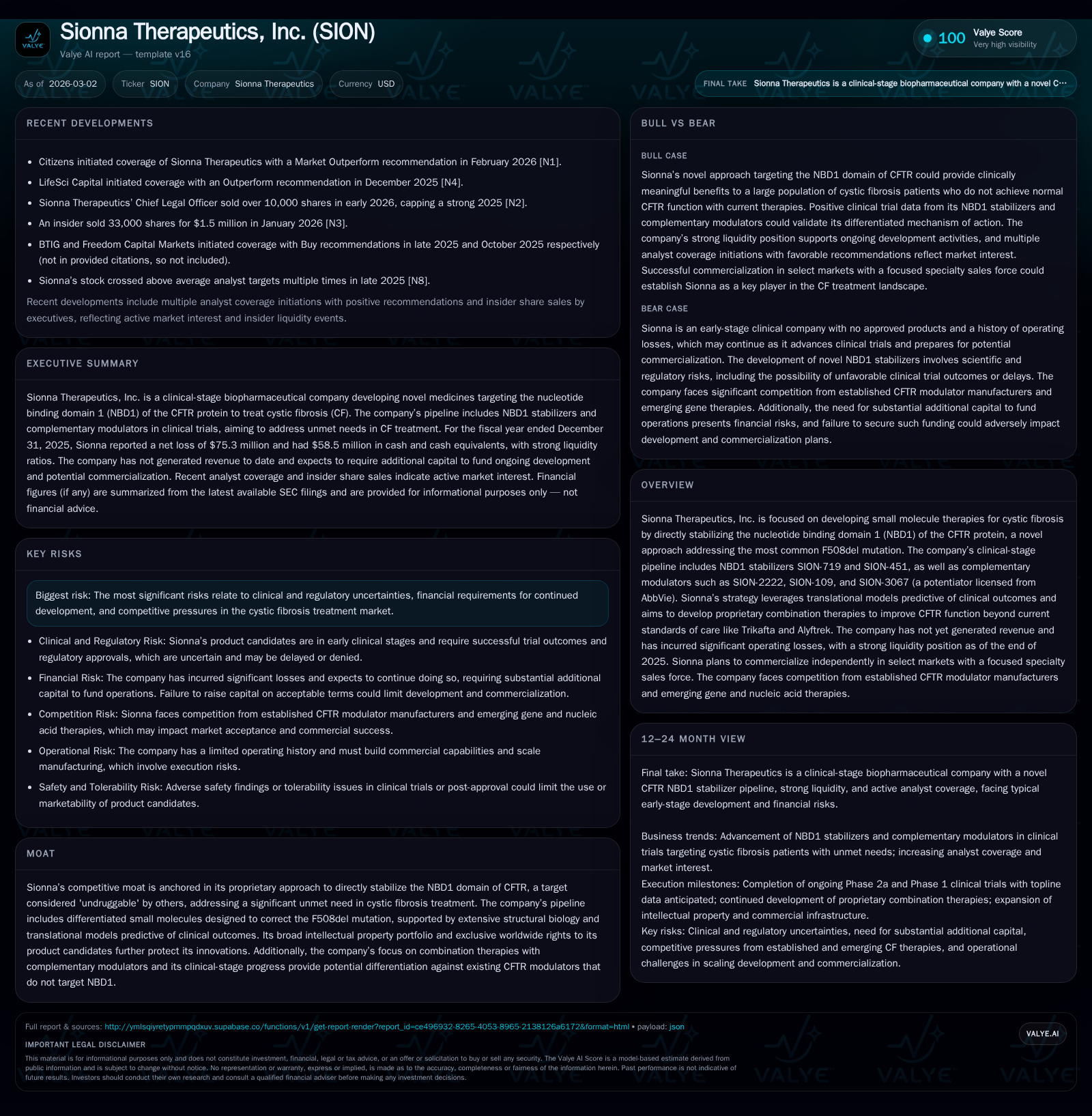
Sionna Therapeutics, a clinical-stage biopharmaceutical company, focuses on developing small molecule therapies that directly stabilize the nucleotide binding domain 1 (NBD1) of the CFTR protein to address the prevalent F508del mutation in cystic fibrosis. Since inception in 2019, the company has incurred significant operating losses driven by extensive R&D investments but maintains a strong liquidity position. In 2025, positive Phase 1 trial results supported advancement into Phase 2a studies. The firm's proprietary approach offers potential differentiation versus incumbent modulators, but substantial clinical and regulatory risks remain along with financial uncertainties as commercialization capabilities are still developing.
Company Overview
Founded in 2019, Sionna Therapeutics focuses on developing small molecule treatments for cystic fibrosis (CF) by stabilizing the nucleotide binding domain 1 (NBD1) of the CFTR protein—a novel mechanism that directly targets the most common F508del mutation. This mutation compromises CFTR folding, stability, and function leading to debilitating multisystem disease manifestations.
Despite advances from existing CFTR modulators like Vertex’s Trikafta, a large subset of patients do not achieve normal CFTR function, leaving unmet clinical needs. Sionna aims to restore CFTR closer to wild-type levels through proprietary NBD1 stabilizers (SION-719 and SION-451) with complementary modulators including licensed potentiator SION-3067 from AbbVie. Their approach leverages more than a decade of structural biology insights and translational preclinical models predictive of clinical outcomes.
Historical Financial Performance
The company remains pre-revenue, heavily investing in research, development, and clinical advancement. Operating losses have been significant across its short operating history. Net losses increased from approximately $61.7 million in FY 2024 to $75.3 million in FY 2025 [F1][S1], fueled largely by costs related to advancing its pipeline through Phase 1 trials and early Phase 2 initiation.
Cash flow from operations is negative—estimated free cash flow was approximately -$66.7 million as of year-end 2025—underscoring ongoing funding requirements [F1]. However, liquidity through cash and equivalents was robust at roughly $58.5 million at year-end FY25 against modest current liabilities of about $11.7 million, producing a strong current ratio above 20x [F1].
Historical performance (annual)
| FY |
|---|
| 2025 |
Source: SEC companyfacts cache [F1].
Net losses reflect sustained R&D spend associated with early development stage.
Pipeline Progress and Future Growth Prospects
Key growth drivers include successful clinical development of their NBD1 stabilizer candidates and building differentiated combination regimens that exceed current therapies’ efficacy.
In mid-2025, Sionna announced favorable topline phase 1 trial results for SION-719 and SION-451 involving over 200 healthy volunteers showing good safety profiles without serious adverse events or dose-limiting toxicities [S2]. Pharmacokinetic data indicated both could be administered with or without food using oral tablets meeting target exposure thresholds.
Building on this data, the company launched Phase 2a proof-of-concept trials named PreciSION CF targeting patients on standard-of-care treatments like Trikafta aimed at demonstrating improved CFTR function measured by sweat chloride reduction [S2][N1]. This stage will be pivotal for validating clinical utility and commercial potential.
In addition to proprietary dual combinations involving their NBD1 stabilizers with complementary modulators (including licensed assets from AbbVie), Sionna also explores co-administration with existing modulators to broaden therapeutic reach and market opportunities [S2][N1].
However, significant uncertainties remain around later-stage clinical success probabilities, regulatory approvals globally, market adoption versus entrenched competitors, manufacturing scale-up challenges, and pricing & reimbursement landscapes . Extensive risk disclosures highlight threats from regulatory complexities and healthcare reforms possibly impacting timelines and costs.
Capital Allocation and Returns Profile
As a pre-commercial entity without revenue streams, capital allocation focuses predominantly on sustaining high R&D expenditures necessary for clinical progression. There are no dividends or share repurchases at this stage given consistent negative net income [F1].
The return on equity is negative at approximately -24.5% based on trailing net loss relative to equity due to absence of profit generation so far [F1]. Cash reserves provide near-term runway but additional financing will be required to support costly late-stage trials and eventual commercialization preparation.
Competitive Moat Considerations
Sionna’s moat centers on its disruptive approach targeting the historically ‘undruggable’ NBD1 domain—a critical component for proper CFTR folding that existing approved therapies do not engage directly. The broad IP portfolio covering their proprietary small molecules coupled with exclusive worldwide rights strengthens barriers to entry.
Their integrated pipeline combining novel stabilizers plus synergistic modulators aims to improve outcomes beyond current standards addressing a sizable patient population with at least one F508del allele (~90%) [N1][S2]. This scientific specialization is underscored by decades of structural biology research anchoring translational model fidelity.
Nonetheless, success depends heavily on translating early safety into meaningful lung function improvements; any setbacks could exacerbate competitive risk from established players like Vertex Pharmaceuticals with already approved regimens widely adopted [N1][S2].
Regulatory and Legal Risk Environment
Sionna operates within an intensely regulated ecosystem governed by FDA rules plus international authorities covering good clinical practice (GCP), good manufacturing practice (cGMP), promotional practices, pricing transparency, pharmacovigilance post-launch requirements among others .
Failure to comply can result in suspension or revocation of approvals, fines, recalls or criminal penalties affecting commercial ability in key markets. Furthermore, healthcare reform pressures exert pricing constraints potentially impacting profitability once commercialized.
Additionally, risks extend into supply chain compliance particularly regarding environmental health & safety regulations related to hazardous materials handled across synthesis and manufacturing contracted third parties [S13].
Management must also guard against fraud/abuse law breaches given intricate pricing schemes common in specialty pharmaceuticals; internal compliance programs have been established but efficacy remains unprovable until operational experience is gained [S6][S10].[S14]
Strategic Outlook Analysis
While explicit guidance beyond ongoing trial initiations is limited publicly [N1][S3], investors should monitor:
- Phase 2a trial outcome data readouts assessing pharmacodynamic endpoints,
- Any updates on regulatory submissions or accelerated pathways,
- Financing events or partnerships enabling sustained pipeline investment,
- Competitive developments especially new CFTR modulators gaining approval,
- Progress toward manufacturing scale plans or commercialization infrastructure formation.
Given its early-stage profile coupled with novel science addressing major unmet needs in CF treatment simplification and efficacy enhancement potential, Sionna embodies both high upside possibilities contingent on successful validation plus intrinsic binary risks typical of biotech innovators pursuing first-in-class mechanisms.
This analysis is based solely on publicly available information as of March 2026 without speculative forecasts or investment recommendations.
Disclaimer: This is research-only, informational analysis and not investment advice. It may include AI-generated interpretation and general industry context. Always verify important details using primary sources.

Comments