
Sirius XM Holdings Inc.: Navigating Licensing Complexities and Competitive Pressures in Audio Entertainment
An in-depth analysis of Sirius XM’s business model, competitive landscape, financial health, and risks shaped by its licensing agreements and industry dynamics.
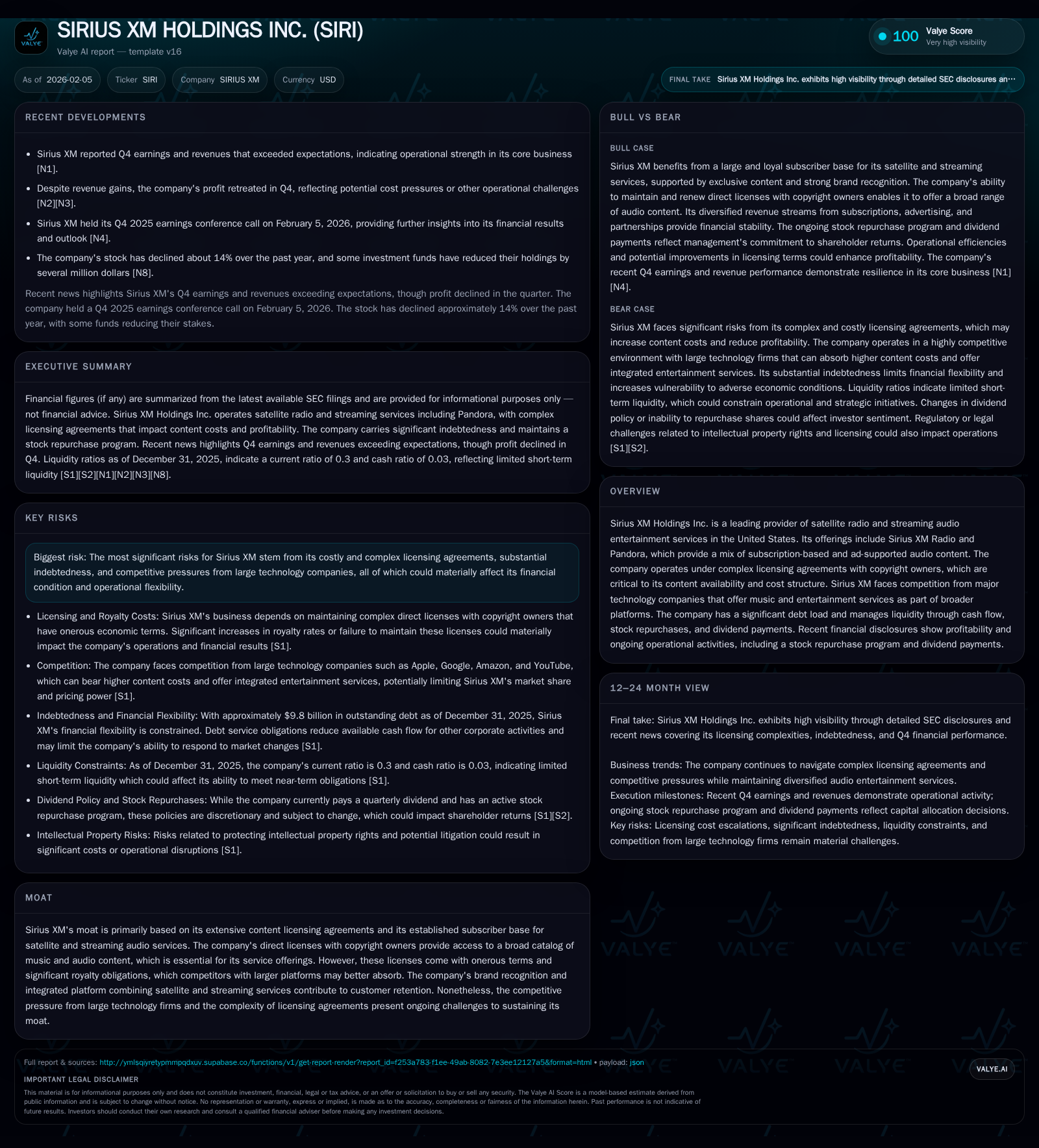
Sirius XM Holdings Inc. operates a leading satellite and streaming audio platform in the U.S., combining Sirius XM Radio and Pandora services under complex content licensing structures. While it benefits from entrenched subscriber relationships and direct licenses with copyright owners that safeguard content access, the company faces significant cost pressures from onerous royalty obligations. Competition from tech giants bundling entertainment into broader platforms intensifies these challenges. Financially, Sirius XM maintains profitability but manages a substantial debt load, with liquidity supported by operational cash flow and ongoing share repurchases. Its future performance hinges on successfully managing licensing costs, competitive positioning, and cash flow generation amid evolving market conditions.
Business Overview
Sirius XM Holdings Inc., as of early 2026, remains a dominant player in the U.S. audio entertainment industry through a dual-platform approach combining satellite radio with streaming services anchored by Pandora [S1]. This hybrid model delivers subscription-based products alongside ad-supported options, targeting a broad listener base seeking curated music, talk shows, news, and other audio content.
At the core of Sirius XM's service offering lies its extensive network of complex licenses with copyright owners governing sound recordings and musical works. These agreements enable the company to access an expansive catalog essential for both Sirius XM's satellite subscribers and Pandora's streaming audience. However, the complexity and economic terms—described internally as "onerous"—pose significant cost challenges [S1].
Industry Positioning and Moat
The company's moat is carved out primarily from its direct licensing arrangements that establish exclusive or preferential rights to vast amounts of music content for interactive streaming features on Pandora Premium, Plus services, and ad-supported tiers. This direct licensing provides an advantage over services reliant on statutory licenses but simultaneously exposes Sirius XM to heavy obligations, including royalties that may escalate due to most favored nation clauses embedded in contracts [S1].
Brand recognition built over decades in satellite radio coupled with Pandora’s established presence contributes to customer retention. Yet the firm must continually justify subscription pricing amidst fierce competition where major technology firms bundle music streaming into broader ecosystems (Apple Music within iOS, Google/YouTube Music tied to Android and YouTube platforms) [S1]. These tech conglomerates have scale advantages allowing them to bear high royalty costs more flexibly.
Competitive Landscape
Sirius XM directly competes not only with traditional satellite radio alternatives but more challengingly with internet-based services operated by large tech companies who embed music into multi-service offerings (voice assistants, video streaming) enhancing user stickiness. This multi-pronged competition pressures Sirius XM in areas like marketing spend efficiency, feature innovation (interactive playback controls), user experience improvements, and price competitiveness.
Pandora’s presence as an ad-supported option seeks to balance between monetizing free users through advertising while upselling premium interactive features requiring higher licensing fees.
Financial Profile
According to its latest annual filing for fiscal year ended December 31, 2025 [F1], Sirius XM achieved net income of $805 million demonstrating sustained profitability despite cost headwinds. However, the company's balance sheet reveals strained liquidity metrics—with current assets at roughly $1.098 billion overshadowed by current liabilities totaling about $3.653 billion [F1]. The resulting current ratio near 0.3 signals tight short-term funding buffers.
Cash and equivalents stood at approximately $94 million at year-end [F1], indicating limited immediate reserves relative to operational needs. The firm supports its capital structure through strong operating cash flows complemented by active stock repurchase programs authorized for over $1 billion—as disclosed in recent quarterly filings—with aggregate repurchases nearing $96 million during Q3 2025 alone [S2].
These repurchases coexist alongside regular dividend payments aimed at shareholder value capture.
Licensing Complexities and Risks
Company disclosures stress that licensing cost increases represent a material risk factor [S1]. Notably, the Copyright Royalty Board (CRB) commenced proceedings in January 2024 concerning rates for statutory licenses applicable to non-interactive streaming from 2026 through 2030. Any adverse rulings or regulatory adjustments could materially elevate Sirius XM’s royalty expense profile.
Further risk arises from contractual "most favored nation" clauses entailing payment escalations if competitors secure more favorable terms—heightening cost volatility unpredictability [S1]. The tightrope of compliance is delicate; breaches or failures in license management can lead to revocation of rights affecting music availability or interactive features on Pandora platforms with potentially severe commercial repercussions.
Additionally, audits by SoundExchange and other rights organizations frequently generate disputes that can impose costly retroactive payments alongside fees and penalties [S1].
Strategic Challenges and Outlook
Looking ahead, Sirius XM must navigate multiple converging pressures:
- Managing its indebtedness while funding share repurchases,
- Negotiating license renewals on economically viable terms,
- Enhancing product differentiation in an increasingly commoditized digital audio marketplace,
- Responding strategically to consumer migration toward bundled entertainment offers from tech majors,
- Balancing subscriber growth initiatives without eroding margin through pricing concessions.
While recent earnings releases demonstrated capability to beat revenue estimates [N1], profitability saw some retreat in Q4 reflecting heightened content costs or operating expenses [N5][N6]. Market sentiment has been volatile; the shares experienced declines during 2025 attributed partly to competitive fears [N13][N14]. Yet high dividend yields continue attracting income-focused investors despite underlying uncertainties [N7].
Conclusion
Sirius XM Holdings stands at a strategic inflection point typical of legacy media firms confronting digital disruption amid entrenched regulatory frameworks for content use costs. Its entrenched licensing agreements provide a double-edged sword: essential entry barriers against new entrants but also incubators for steep ongoing expenditures.
Success depends on deftly managing this cost structure while maintaining compelling consumer value propositions via integrated satellite-streaming platforms. The firm's robust operational cash flows stabilize its financial footing though liquidity remains tight given substantial short-term obligations. Competition from tech giants bundling entertainment necessitates continued innovation beyond mere content availability toward superior user experiences.
The path forward will require nuanced licensing negotiations coupled with strategic agility to adapt to shifting consumer preferences amidst evolving industry economics.
This analysis synthesizes publicly available regulatory filings including the latest Form 10-K and 10-Q reports filed by Sirius XM Holdings Inc., alongside recent market commentary through February 2026. It aims to provide an informed view of company fundamentals absent investment recommendation.
Disclaimer: This is research-only, informational analysis and not investment advice. It may include AI-generated interpretation and general industry context. Always verify important details using primary sources.

Comments